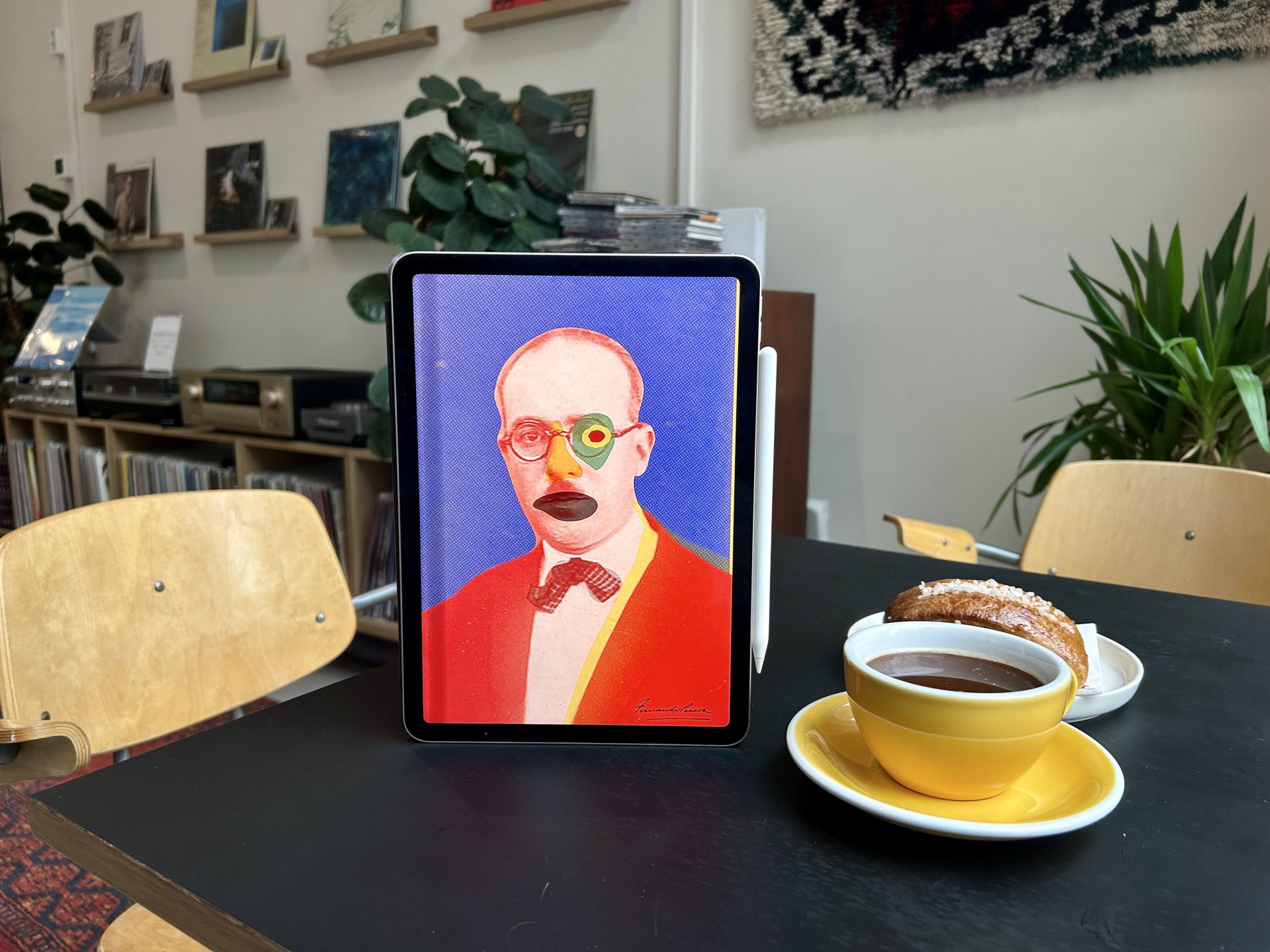
Where do I even begin with this one? The Book of Disquiet is unlike anything I have ever read. To give you a little context first, Fernando Pessoa was a Portuguese poet famous for creating entirely distinct literary personalities and writing from within each one with stunning authenticity. Over the course of his thirty-five years of writing, Pessoa used more than five dozen heteronyms, with the best known being Alberto Caeiro, Ricardo Reis, Álvaro de Campos, and Bernardo Soares. Of these four, Bernardo Soares is considered the heteronym closest to Pessoa himself. The Book of Disquiet follows the fragmented, unconnected recollections of Soares’ life, and through him, Pessoa explores some of life’s biggest and most unsettling questions.
This particular edition was put together by Pessoa scholar Jerónimo Pizarro, who makes a fascinating case for reading the book in the order it was written, keeping its two distinct phases separate.
Pizarro argues that The Book of Disquiet is essentially two very different books sitting under one cover, separated by about ten years of writing. In the earlier phase, the writing floats through a vague, almost dreamlike world. In the later phase, something shifts. Lisbon enters the picture, fully and passionately. “Oh Lisbon, my home!” Pessoa writes, and you can feel every bit of that love.
The book was like a deeply personal notebook, filled with feelings of angst, alienation, and a kind of beautiful melancholy. The restlessness and tedium Pessoa felt in his own life bleed through every single page.
It asks questions about consciousness, about dreams and the strange, peaceful pull of sleep, about God, love, death, and happiness. It dwells on nostalgia, specifically, nostalgia for a past that never even existed, and on loneliness, and on what it really means to exist. It runs through all of it is this intense, almost overwhelming love for writing, for literature, and for Lisbon itself.
The Book of Disquiet is so layered and complex that I genuinely struggle to put the full experience into words. So instead of trying too hard, I’ll let some of my favorite passages below do the talking. I think they’ll give you a much better feel for what this book truly is.
My Favorite Bits
- Each one of us is a speck of dust that the wind of life lifts up, then lets fall. We need to find a support, to place our small hand in another larger hand, because the hour is always uncertain, the heavens are always far away, and life always an alien thing. Those of us who have risen highest merely know from closer to how hollow and uncertain everything is. We may be guided by an illusion, but one thing is sure, it is not our consciousness that guides us.
- Happy are those who suffer in unity! Those whom anxiety troubles but does not divide, who believe, even if only in unbelief, and who have no reservations about sitting in the sun.
- I have no clear idea of myself, not even an idea that consists of having no idea of myself. I am a nomad of my own consciousness of myself.
- Living is pointless. Only looking is worthwhile. If I could look without living, I would achieve happiness, but that’s impossible, as is everything we dream about. How ecstatic the ecstasy that did not involve life!
- My isolation is not a search for happiness, which I do not have soul enough to achieve, nor for tranquillity, which no one achieves unless they never lost it in the first place; it is a search for sleep, extinction, and a modest renunciation.
- I asked for so little from life and life denied me even that. Part of a ray of sunlight, a nearby field, some peace and quiet and a mouthful of bread, not to feel the knowledge of my existence weigh too heavily on me, to demand nothing of others and have them demand nothing of me.
- I read and I am set free. I gain objectivity. I have ceased to be my usual disparate self. And what I read, rather than being a near-invisible suit that sometimes weighs on me, becomes instead the great clarity of the outside world, in which everything is worthy of note, the sun that everyone can see, the moon that weaves a web of shadows on the still earth, the vast spaces that open out into the sea, the dark solidity of the trees waving aloft their green branches, the solid peace of ponds in gardens, the paths thick with vines on the terraced slopes of the hills.
Author: Fernando Pessoa
Publication date: 1 January 1982
Number of pages: 544 pages
Leave a Reply