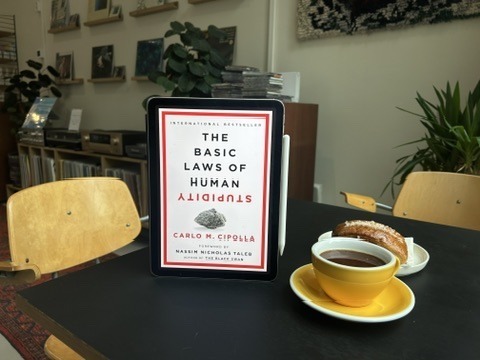
The Basic Laws of Human Stupidity is a really short book where Carlo M. Cipolla wastes absolutely no time in explaining human’s stupidity. Right from the opening pages, he drops a claim that is equal parts provocative and oddly convincing: stupid people are far more numerous than you’d ever expect, and their proportion stays eerily consistent across every kind of human group imaginable. Intellectual circles, rural communities, elite institutions, doesn’t matter. The ratio holds.
Before going further into the book, it’s worth pausing on how Cipolla actually defines the word “stupid” because he’s deliberately precise about it. In this book, stupidity isn’t about low IQ scores or poor academic performance. A stupid person is someone who causes harm to others without gaining anything for themselves in return.
The bandit, such as the con artist, the selfish schemer, at least operates with a logic. There’s a goal, a payoff, a reason behind the harm they cause. The stupid person? None of that exists. Just collateral damage, with zero benefit on their end. It’s almost more unsettling that way.
In my view, one of many laws that deserves the loudest conversation, especially right now is written as the second basic law, which states that the probability of any given person being stupid is entirely independent of every other characteristic they possess. Every. Single. One.
Stupidity, in Cipolla’s view, is an indiscriminate privilege, uniformly distributed across all human groups, regardless of status, education, wealth, or social standing. A person can hold a doctoral degree and still fumble basic everyday reasoning. Someone can be extraordinarily gifted in their craft and be completely lost when navigating something outside of it. Reducing a person to one impressive trait and assuming competence across the board? Already a mistake.
There’s something deeply relatable buried in this law too. Think about the most prestigious, high-achieving environments you’ve ever been part of, like a competitive university, a respected workplace, an accomplished social circle. The proportion of stupidity was still there, wasn’t it? The Second Law simply confirms what experience has already been teaching us all along.
Cipolla even packages it into one particularly vivid image: whether you withdraw to a monastery or spend your days in the most glamorous company imaginable, the percentage of stupid people you encounter stays the same. And thanks to the First Law, where it states “Always and inevitably everyone underestimates the number of stupid individuals in circulation,” the existence of stupid people will always be higher than you anticipated.
Always and inevitably everyone underestimates the number of stupid individuals in circulation.
Carlo M. Cipolla, The Basic Laws of Human Stupidity
Here’s where the book gets uncomfortably timely. Cipolla points out that dealing with a stupid person leaves you with no real line of defence because the behaviour itself carries no logical structure to begin with. There’s nothing to argue against. No framework to engage with.
In the era of social media, scroll through any comment section on a divisive post and that observation lands with alarming accuracy. The endless back-and-forth with strangers online, the debates that spiral into nothing, the conversations that leave everyone more exhausted and no one more informed, this book also explains why all of that happens. Engaging with structureless chaos using structured logic was never going to work.
And still, and this is the part Cipolla finds particularly troubling, the non-stupid consistently underestimate the actual damage that stupid individuals create. The cost is real as well as the impact accumulates. And the very people who should know better keep forgetting it, over and over again, often at their own expense.
Picking up this book for the first time, the title feels like it might be another popular nonfiction title about cognitive biases and mental blind spots. The kind of book you’d spot on a “best productivity reads” listicle. But this book is absolutely not part of those books.
That creeping dissatisfaction so many people feel about the state of the world? Cipolla may have just given it a name, a framework, and a set of laws to explain it here.
Highly recommend picking it up, if only to feel slightly more prepared the next time the ratio reveals itself.
Author: Carlo M. Cipolla
Publication date: 1 Jan 1976
Number of pages:
Leave a Reply