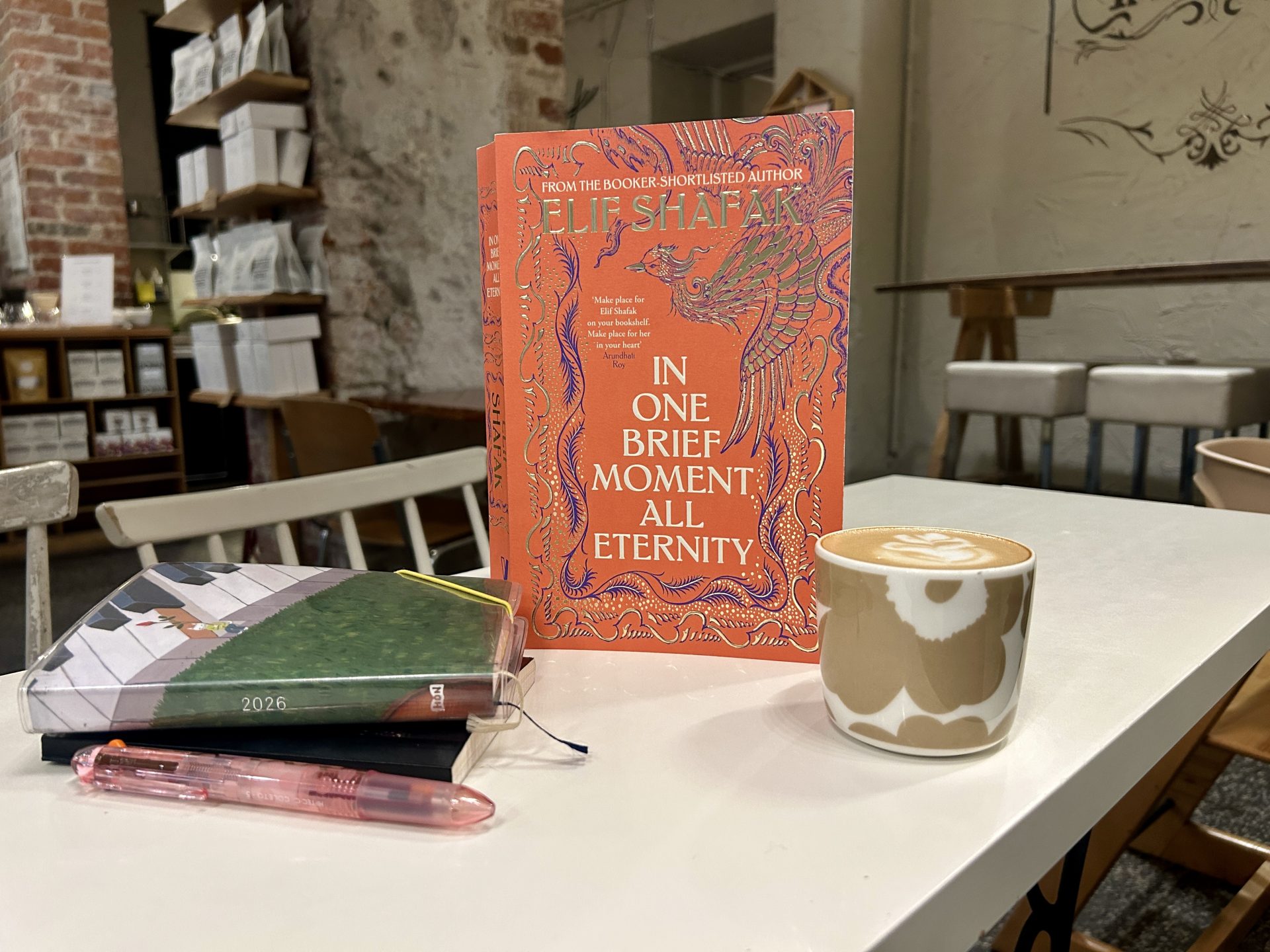
Elif Shafak is one of my all-time favorite authors. Ever since There Are Rivers in the Sky (2024), I’ve been waiting for a new book from her. And finally, In One Brief Moment All Eternity is here! I was so excited that I didn’t even bother with the synopsis. I skipped the reviews and never flipped to the back cover. I trusted Shafak completely, so I bought the book and read right away, knowing absolutely nothing about it. For me, that’s one of the great joys of being a reader: picking up a new release from an author I love, one with a track record this strong, and letting her lead the way.
In One Brief Moment All Eternity follows Gustave Flaubert as he pours himself into writing Madame Bovary. He watches people, digs into research and gathers every detail he can find. This is where going in blind caught up with me. I had no idea Madame Bovary was a real novel, let alone a famous classic (yes, my literary journey still has a few gaps!). Thus, I didn’t know Gustave Flaubert was a real writer, either. It only clicked when I arrived near the end of the book, when Eleanor Marx, the youngest daughter of Karl Marx, shows up wanting to translate Madame Bovary into English. That made me stop and wonder: did Madame Bovary‘s novel actually exist? So I put the book down and looked it up.
It did! Madame Bovary first appeared as a serial in the Revue de Paris in 1856, then came out as a full novel in 1857. Eleanor’s translation was published in London in 1886 and became the first English translation of Madame Bovary published in Britain. I still remember how stunned I was when I read that part. Imagine being almost at the end of a book and only then realizing that Shafak has written about the life of a real author, the people who inspired him and even the woman behind his masterpiece’s first British translation.
Actually, Shafak had already won me over in the opening pages. The novel begins inside Gustave’s head as he wrestles with whether he should kill a woman named Emma. It feels dark and tense, right up until you realize Emma is the heroine of the novel he’s writing. Then, in the very next chapter, Emma gets to speak for herself.
Chapters about Gustave’s life alternate with chapters told by a whole cast of narrators who cross his path. Most of them are women, some real and some imagined. Each narrator opens up about their own life and thoughts, and as you read on, the links between them start to appear. Siblings, or people who know each other, might each meet Gustave at a different time, in a different place and at a different stage of his life. Connecting those dots felt like piecing together a puzzle. The story also spans decades and travels from Paris to places like Istanbul, Cairo and Beirut, so the world feels wide and alive.
Talk about a gripping opening, a smooth flow and surprises right up to the final pages! Elif Shafak strikes again, and her storytelling is as captivating as ever.
A Poetic Writing Style
Then there’s Shafak’s writing style, which is as beautiful as ever. Her prose is poetic, and she slips in reflections on literature, art, life and politics without ever weighing the story down. Shafak has a gift for reminding us what it means to be human. Through so many narrators, especially dominated by women, she shows that each of us lives a different life, and that we each feel and see the world in our own way. It’s humbling.
I keep a commonplace book where I copy down my favorite lines from everything I read. If I counted the pages, I’m sure Shafak’s words fill more of them than any other author’s. This book added a whole new batch of lines I want to keep, return to and think over again and again as you can see it in the My Favorite Bits section below. I saved so many lines that I could even sort them by theme, and those are only my selected picks to share here! My commonplace book holds plenty more. I’d love to share them all here, but I believe they’ll hit you even harder when you read them yourself, in their full context, inside the stories Shafak built around them.
While reading, I kept pausing to ask myself when was the last time read a book this poetic, this beautifully told and with a plot this good. Probably Shafak’s last book.
It’s already November 2026, and I’m confident In One Brief Moment All Eternity will land among my best reads of the year. If you love literary or historical fiction, stories about writers and their craft, or books that give forgotten voices, especially women, a chance to speak, put this one on your list.
My Favorite Bits
About Literature
- Have you ever felt like you were born into the wrong family, the wrong country or the wrong century altogether? Such was the state of my soul, growing up. There I was, longing for something — anything — to make my heart race, for the faintest glimmer of adventure beneath the dullness. Books became my companions.
- ..here, alone, and away from all judgement, disappointment and disapproval, he will lovingly remain in the company of fictional beings, each just as strange as he is.
- Books do not mind if you read them at your own pace. Books, unlike humans, do not judge.
- History captivates him, philosophy intrigues him, poetry stirs his heart. Where once he resisted reading, he now simply cannot read enough. And so, sequestered in the library of his house as a punishment for his misdeeds, he becomes an addict of the written word, a book-lover with a quenchless curiosity no tutor could possibly have inspired in him.
- Books reassure him that he is not alone in his hurt and despair; others have overcome similar trials, and so, he might too.
- He will arrange his adversaries on the pan of literature like glossy chestnuts and pop them with the heat of his writing. This is how a writer takes revenge. Not with punches or swords, but with words.
- At a tender age he has discovered that books are his friends. (..) he understood that the mad and the sad were also his people. (..) he is beginning to realize that nature, too, is his ally. (..) He is convinced that he is ageing not only in years but in stories—real and imagined.
- ‘..With every book I finish, every new thing I learn, I age a bit more. Do you think that is pretentious? Ludicrous? Irrational? But it is the plain truth. My truth. I’m already more than a hundred years old. One day, I’d like to be a thousand. Anyone can be a thousand years old if they keep reading and gathering stories.’
- Since he lacks faith that tomorrow will be any better, the only thing that keeps him alive is the pursuit of literature. The stories that he might some day get to write.
- If the purpose of praying is to commune with God, the purpose of reading fiction is to commune with others, with otherness. He is not expecting his readers to approve of Emma’s actions, or to like her even, but simply to find in her sins and struggles a story profoundly human.
- I yearned to sail away, and it was the greatest gift to discover that I could spirit myself to other places, near and far, simply by reading books. That is how it began, my love of literature.
- ‘Do not read, as children do, to amuse yourself, or like the ambitious, for the purpose of instruction. No, my dear, read in order to live.’
About Love
- Everyone in this world believes in love, even those who claim otherwise. The sole distinction lies between people who assume that love only happens to others, and those who, despite doubts and disappointments, retain the faith that, one day, it will come and find them too.
- There is no greater burden on our conscience than knowing deep within that we are failing those we love and whose love we need.
- ‘You want me to seek steadiness and stability? But that is not love, Élisa, ’he said. ‘That is what society dictates. Whereas love, true love, is messy. Confused. Clumsy. Chaotic. Often unconsummated. Not necessarily requited. Love is a marvellous vision we briefly glimpse and lose — and then spend our entire lives trying to find again.’
- When it comes to love, he will be neither the owner nor the owned.
- Romantic relationships are charming, true, but once they reach full blossom, they wither away. Whereas a companionship of the mind, a camaraderie of the soul, is solid and sturdy enough to withstand the storms of our terrible, terrible century.
- To love someone requires to give them your heart — but to do so would apparently kill you. This could only mean one thing: love is an impossibility.
About Solitude
- .. he has preferred the company of his own thoughts to that of others. He is no stranger to solitude. Yet this wretched day has altered something in him permanently, leaving a mark that he will carry till his last breath: a distrust of the masses. Of human beings. It is not exactly misanthropy — although there is an aspect of that too — for he still enjoys deep conversations and exchange of ideas, but rather an acknowledgement of the dangers of popular opinion. He has watched a crowd cheer and celebrate as a woman was put to death, and barely a soul paused to ask, what if they were all wrong about her? Is there anything more dangerous than certainty born of ignorance?
- No one is more content in their seclusion, nor more resistant to being introduced to new people or new situations than those who genuinely find comfort in solitude.
- He does not wish to be part of polite society, if such politeness conceals pretension and platitudes at its core. He would like to develop an attachment to a small number of friends to whom he will always remain faithful. (..) He is desperate to divorce himself from civilization. Until he discovers the way to do that, he can at least observe her with a calm and critical eye, just as he watched the grown-ups around the dinner table as a boy whilst stories kept unfolding in his imagination. He is a stranger on earth and doesn’t belong anywhere other than a secluded corner where he will craft his art instead of emulating others. Striving toward this end will be his sentimental education.
About Everything Else
- I only wished for a taste of life beyond the narrow bounds assigned to me. From the time I was a girl, I have been instructed on what I must not say, what I must not do, what I must not even dare to dream. I yearned for something more.
- They say I am greedy, spoiled. Selfish to the point of self-destruction. Yet those who rashly censure me might be forgetting how I came to be this way. They do not realise the path I was allotted at birth was so narrow, so unbearably tedious that I felt I had no choice but to turn away from it, and retreat into the sanctuary of my fantasies. I was a dreamer because my dreams were more pleasant than the world surrounding me. I do not believe I am alone in this. No one becomes a dreamer unless their dreams are happier than their reality.
- Luck is not what we receive in this life, but what we are spared, and what we are spared is, in all likelihood, what other people might be experiencing at this instant. Our else’s good fortune, therefore, is merely another name for someone misfortune.
- It is all too easy to assume that we will never plummet to such lows, but a stable life is not guaranteed. A small misstep, an involuntary slip, a swift tumble from normalcy. It takes so little to fall a great distance.
- he is beginning to believe that success and failure are equally illusory. The true meaning of life must lie elsewhere. Only when we laugh and cry, rejoice and suffer, yearn and love, write and read, vibrate to our full capacity in harmony with nature.. only then we can be fully human. Struggling to explain any of these views to those around him he jots absent-minded musings in his notebook — until, resentment seizes him once again. “Nothing,” he states, “is more humiliating than to see idiots succeed in enterprises we have failed in.”
- ‘Running away from my family — and waiting to get wings, ’he said. ‘I believe if one always looked at the skies, one would end up with wings.’
- The fear of the future is the worst thing about the present.
- Not everyone ages the same way. Some people are old before they were young, out of breath before having run, and weary of life before having lived.
- Time. It does not stop moving just because you have. How unreasonable to assume it a uniform entity, experienced by each and every human being in the same way, for they can never exist within the same hour, the same moment, the one who lives his life unscathed by loss and the one whom grief has robbed of all joy. For the latter, every day is an extension of an absence, like the hills that send back echoes of a sound no longer there.
- .. ever since his youth he has had an enduring tendency towards pessimism and crippling anxiety. When he looks at a pretty woman, he cannot help but imagine the cadaver that she will one day inevitably become; when he sees a plump, rosy-cheeked baby sleeping in a cradle, the first image that springs to his mind is of a wizened, ailing body; and when he picks a juicy red apple from a tree he is overwhelmed by the thought of its imminent, inescapable decay, so real to him that he can smell the faint odour of rot.
- They call this ‘civilisation’, a system capable of generating rancour and distrust so visceral that brother is willing to kill brother.
- ‘I never thought my heart could hold so much suffering and remain alive.’
- The dangers of automatic thinking. The dangers of not thinking. There is only one pillow one can rest one’s head on peacefully, and that is the pillow of doubt.
- .. human beings reduced to mere skin and bone, compelled to slave all day, every day, without respite or reward, even children so young that they must stand on tiptoe to reach their workbenches, denied the most basic necessities, all this torment just so a small number of people can get richer and richer, greedier and greedier, and still they will not deem it enough. This gross unfairness I could not unsee, and once I had seen it, I could not be silent about.
Author: Elif Shafak
Publication date: 15 October 2026
Number of pages: 608 pages
Leave a Reply