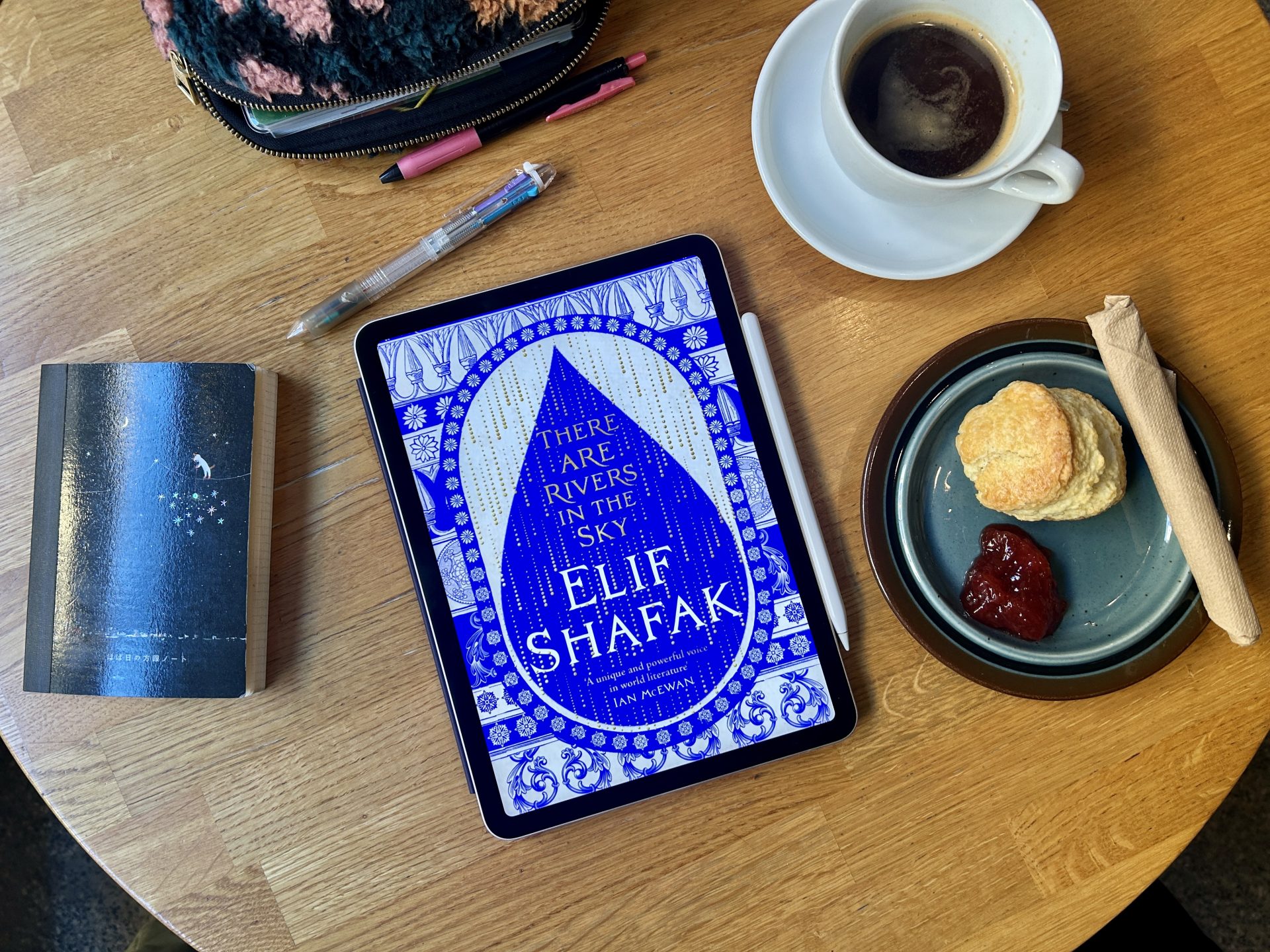
I’ve read a handful of books where nature takes centre stage, but this was my first time encountering a story told so beautifully through something as unassuming as water. There Are Rivers in the Sky does not treat rivers in a literal sense or revolve entirely around them. Instead, the story unfolds through three characters living in different times and places, whose journeys slowly reveal how deeply they are connected by rivers. And that’s what makes this book genius.
Yesterday I was a river. Tomorrow, I may return as a raindrop.
Elif Shafak, There Are Rivers in the Sky
Arthur Smith, inspired by the Assyriologist George Smith, is born into poverty but gifted with an extraordinary mind. His memory is sharp, his curiosity endless. He begins his working life in a publishing house, where his intelligence is recognised and nurtured. Everything shifts when he witnesses the arrival of the lamassus sculptures at the British Museum. From that moment, Nineveh becomes a lifelong calling.
Then there is Zaleekah. Recently separated and rethinking her life, she finds herself drawn to rainfall and the delicate cycle of water. She moves onto a houseboat, and through an unexpected encounter with a tattooist, her long-dormant interest in cuneiform begins to stir again, opening doors she did not sure she still wanted to walk through.
The third voice belongs to Narin, a young Yazidi girl growing up along the banks of the Tigris. Her grandmother is determined that her beloved grandchild will be baptised in the sacred Valley of Lalish. Through Narin’s eyes, the river feels ancestral, spiritual, and connectedly personal.
Against these lives, Elif Shafak paints the haunting backdrop of Nineveh, a city once rich with knowledge, later destroyed by fire after civil war. Its great library, preserved in fragments through clay tablets now housed in the British Museum, casts a long shadow over the story. History here never feels distant. It breathes, lingers, and quietly shapes every character.
The ancient past flows seamlessly into the present, and the three narratives feel separated yet well-connected at once from the very beginning. Small hints are scattered along the way, picking the reader’s curiosity toward what lies ahead.
By the final pages, this became the kind of book that sparks an eagerness to visit the British Museum, to stand before those tablets and imagine the journeys Arthur Smith witnessed and experienced.
I read this in January 2026, and it quickly secured its place among my favourite reads of the year. Starting the year with There Are Rivers in the Sky set the bar impressively high for my next reads and I can already tell it will be difficult to match.
My Favorite Bits
- “Well, this world is a school and we are its students. (..) Some people learn love, kindness. Others, I’m afraid, abuse and brutality. But the best students are those who acquire generosity and compassion from their encounters with hardship and cruelty. The ones who choose not to inflict their suffering on to others. And what you learn is what you take with you to your grave.”
- “Words are like birds. When you publish books, you are setting caged birds free. They can go wherever they please. They can fly over the highest walls and across vast distances, settling in the mansions of the gentry, in farmsteads and labourers’ cottages alike. You never know whom those words will reach, whose hearts will succumb to their sweet songs.”
- People fall into three camps: those who hardly, if ever, see beauty, even when it strikes them between the eyes; those who recognize it only when it is made apparent to them; and those rare souls who find beauty everywhere they turn, even in the most unexpected places.
- If poverty were a place, a hostile landscape into which you were deliberately pushed or accidentally stumbled, it would be an accursed forest—a damp and gloomy wildwood suspended in time. The branches clutch at you, the boles block your way, the brambles draw you in, determined not to let you out. EVen when you amange to cut down one obstacle, instantly it is replaced by another. You tear the skin off your hands as you work doggedly to clear a path elsewhere, but the moment you tunr your back the tree close in on you again. Poverty saps your will, little by little.
- With all the others—the stamps or the pretty, shiny paper—you can use them only once or twice, then they are gone, but books it seems to me, do not end, even when we are finished reading them.
- The world is changing faster than minds can grasp. It’s picking up speed like a steam engine. (..) When times are confusing, everybody is a little lost. No one is as inwardly confident as they present themselves to be. Hence the reason we must read, my boy.
- While others can decide on a simple and unassuming life, those who come from troubled regions or difficult backgrounds do not have that luxury. For every displaced person understands that uncertainty is not tangential to human existence but the very essence of it.
- Being an outsider is all about survival, and no one survives by being unambitious; no one gets ahead by holding back. Immigrants don’t die of existential fatigue or nihilistic boredom; they die from working too hard.
- All too often, we humans destroy nature and call it progress.
- The sun is weak when it first rises, and gathers strength and courage as the day goes on.
- One always begins to forgive a place as soon as it is left behind.
- Wisdom is a mountain capped with snow. I’ve yet to meet the person who’s given it a hug.
- Women are expected to be like rivers—readjusting, shapeshifting.
- What defies comprehension isn’t the mysteries of the world, but the cruelties that humans are capable of inflicting upon each other.
- Home is where your loved ones are, but the reverse is also trues. Those you love are your sanctuary, your shelter, your country, and even, when it comes to that, your exile. Wherever they go, you will follow.
Author: Elif Shafak
Publication date: 8 August 2024
Number of pages: 446 pages
Leave a Reply