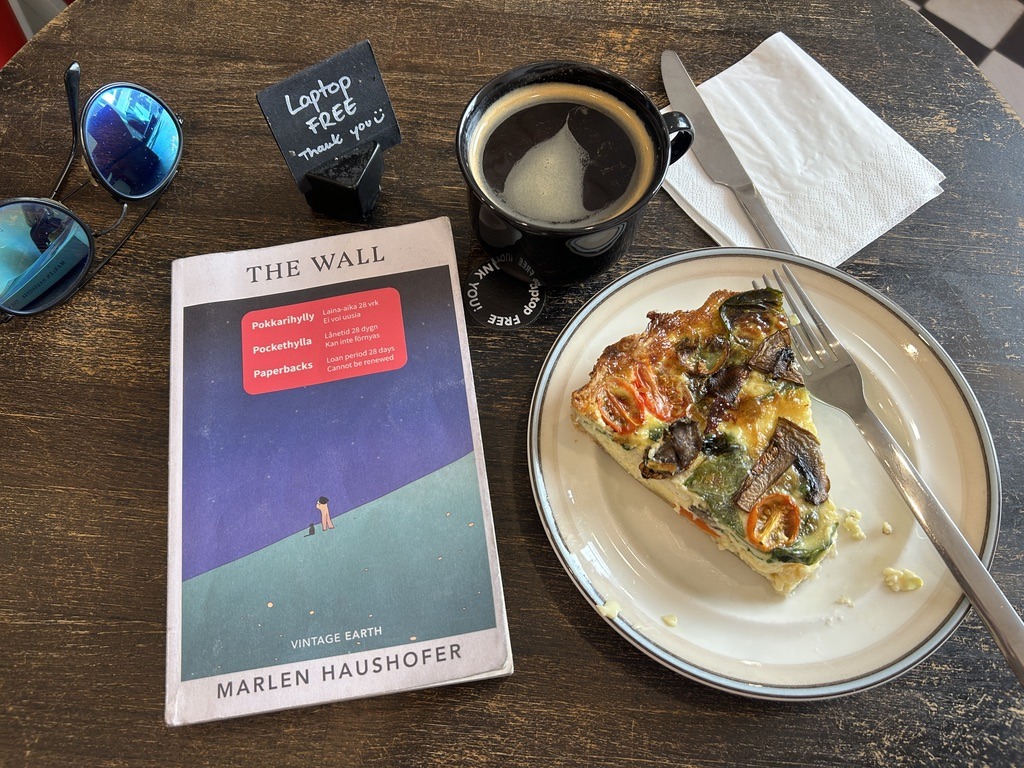
Being a woman means you have to make sense to everyone around you. Your actions need to be readable, your presence needs to be justified, and somehow, just existing in a space on your own terms is already asking for too much. Real solitude, the peaceful, and judgment-free kind are almost a fantasy for women. The only way it could ever truly exist is if the whole world stopped, and there was simply nobody left to have an opinion about it.
And that is the scenario of Marlen Haushofer imagined when she wrote The Wall.
Haushofer created this extraordinary premise so her narrator could finally have it: freedom, solitude, and a life lived entirely on her own. An invisible wall appears and seals her off from the rest of the world, and from that point on, it is just her. The wall itself is never concretely defined, and for me, that is where the magic of this book lies. It can be read as a physical barrier, a metaphor, a symbol of emotional isolation, or a representation of every invisible obstacle life throws at us. The interpretation is yours to make and whatever you bring to it, the story will meet you there.
The narrator’s survival behind the wall is written in this gorgeous, almost poetic literary style that pulls you into a slower, more reflective pace. On one level, it is a raw story about staying alive. On a deeper level, it mirrors how we move through life itself: finding some version of a routine, achieving just enough balance to keep from falling apart, and calling that survival. But even in total isolation, away from people and their opinions, the narrator still cannot escape the conditioning. The feeling of being unworthy, incompetent, of being just a woman. It stays with her even when no one is around to remind her of it.
The animals she shares her isolated world with are also a big part of this story’s emotional pull. Each one she loses along the way carries weight, and those losses shape the journey in a way that is genuinely affecting.
At some sections of the book, there were moments I felt genuinely bored where most part of there is no plot twists, dramatic turning points, or emotional gut punches. The whole book is just survival, day in and day out, in the most unglamorous, repetitive way. I was frustrated by that. However, thinking deeper about the way they are presented in this book, is that not exactly how life actually goes most of the time? The big moments are rare. What fills the majority of our days is the monotony, the unremarkable routine of just doing what we need to do to keep going. Haushofer leans into that fully, and once you accept it, the monotony stops feeling like a flaw and starts feeling like the whole point.
The Wall gives you space to think, to project, to reflect on your own walls and how you have been surviving behind them. Because we all have one. We always have. The difference is just in how we each choose to face it.
My Favorite Bits
- So many things have happened to me that I must write if I am not to lose my reason.
- There was nothing in my head that I could make sense of.
- I had to stay quite calm and simply get through it. It wasn’t the first day of my life that I had had to survive like this. The less I resisted it, the more bearable it would be. The dazed state of the previous day had entirely vanished from my head; I was able to think clearly, as clearly as I ever had, but when my thoughts approached the wall it was as if they too bumped up against a cool, smooth and quite insuperable barrier. It was better not to think about the wall.
- I remember very clearly how little imagination most people used to have. That was probably their good fortune. Imagination makes people over-sensitive, vulnerable and exposed. Perhaps it’sa form of degeneracy. I have never held the shortcomings of the unimaginative against them, sometimes I’ve even envied them. They had an easier and more pleasant life than everyone else.
- My mind is free, it can do what it likes, but it mustn’t lose its reason, the reason that will keep me and the animals alive.
- Never again shall I have the opportunity to make up for these losses, for even if I manage to find the many books stacked up in the lifeless houses, I will never be able to retain what I read. When I was born I had a chance, but neither my parents, my teacher nor myself was able to spot it. It’s too late now. I shall die without having used the chance that I had. In my first life I was a dilettante, and here in the forest, too, I shall never be anything else. My only teacher is as ignorant and untrained as I am, for my only teacher is myself.
- It’s strange, in fact, how slight my pleasure is every time I complete a task. Once it’s out of the way I forget it, and think about new things to do. Even at that time I didn’t allow myself much time to recover. That’s how it always was: while I was slaving away I dreamt about how I would rest quietly and peacefully on the bench, but as soon as I finally sat down on the bench I grew restless, and started looking out for new work to do. I don’t think this was due to any particular industriousness, since by nature I’m rather lethargic, but was probably through self-protection, for what would I have done otherwise but remember and brood? That was exactly what I mustn’t do, so what was there to do but more work?
- That was reality. Because I have seen and felt all that, it’s difficult for me to dream in the daytime. I have a violent resistance to daydreams, and I feel that hope has died in me. It frightens me. I don’t know whether I will be able to bear living with reality alone. Sometimes I try to treat myself like a robot; do this and go there and don’t forget to do that. But it works only for a short time. I’m a bad robot; I’m still a human being who thinks and feels, and I shall not be able to shake either habit. That’s why I’m sitting here writing down everything that’s happened, and I’m not worried about whether the mice will eat my notebooks or not. Writing is all that matters, and as there are no other conversations left, I have to keep the endless conversation with myself alive. It will be the only report that I shall ever write, for when it is written there won’t be a single little piece of paper left to write on in the house.
Author: Marlen Haushofer
Publication date: 1 January 1963
Number of pages: 246 pages
Leave a Reply