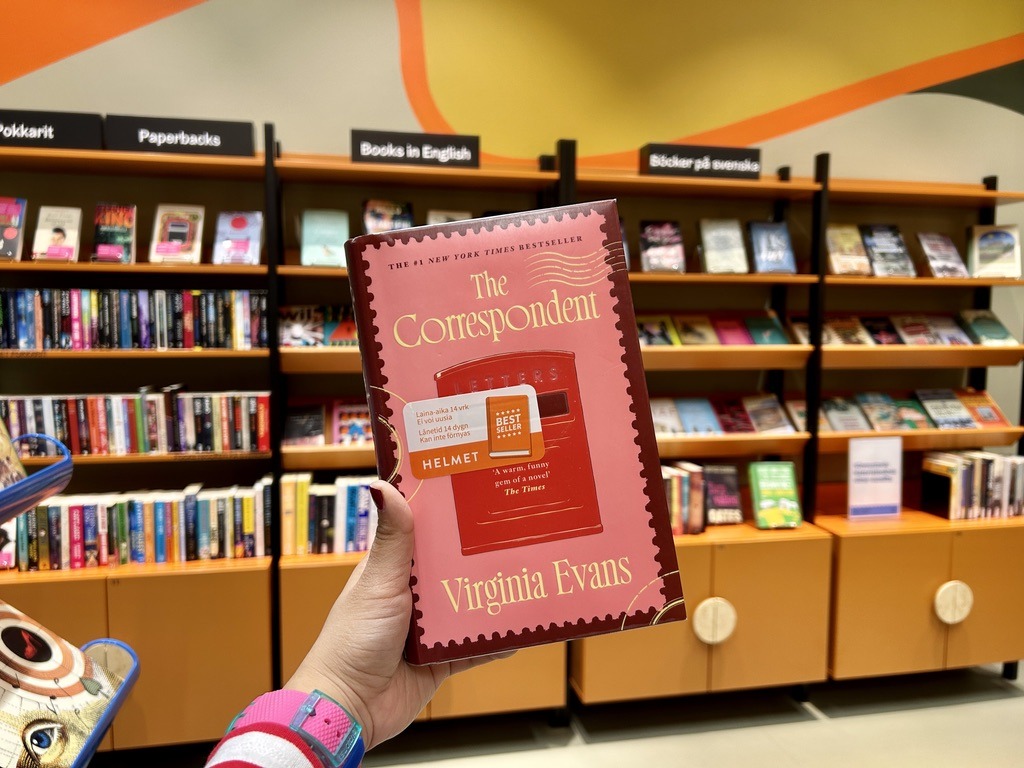
The Correspondent by Virginia Evans had been on my radar shortly after it came out. The praises were everywhere, and the buzz was loud enough that I made myself a promise: if I ever spot it in a bookstore, I am buying it, no questions asked. Then one day, during my casual browse through the shelves at my neighbourhood library there it was. It sat right there like it had been waiting. I may or may not have wanted to hug it off the shelf.
So. Let’s talk about this book.
The format alone is a stroke of genius. Virginia Evans throws out the mainstream all-knowing narrator entirely and instead hands us a stack of puzzle pieces. Letters. Replies. Dates that shift. Greetings that change tone over time. Scattered hints tucked between the lines. As readers, we become detectives, piecing together Sybil’s world from fragments, working out the backstory, the timeline, the relationships, purely by drawing our own conclusions. The way the narrator recounts the same events through different words and emotions across letters feels incredibly human. Because that is how life works, isn’t it? The same experience can be lived, felt, and told in a hundred different ways. Perspective is everything.
At the centre of it all is Sybil Van Antwerp, 72 years old, sharp-tongued, fiercely independent, and deeply well-read. She has spent her life using letters to make sense of the world and her place in it. When we meet her, she has just received news that she will gradually lose her sight over the coming years. And she does what Sybil does best: she keeps it to herself. She creates distance. She avoids the conversation.
Some readers might find her frustrating. I completely understood her.
Sybil is a woman fighting to hold onto her independence, wrestling with emotions she would rather not name out loud. She carries guilt from mistakes she made long ago: serious ones, life-altering ones. She tries to make amends where she can, knowing full well that some doors are already closed. She helps people when she is able to. She reaches out. She owns her faults, and she calls out the faults of others when she needs to. She is a lot of things at once: difficult and warm, guarded and generous. And that complexity is exactly why I love her character. Sybil always tries.
Reading this book feels like stumbling across someone’s private messages, except you are fully invited in. It is conversational, intimate, and surprisingly fun. There is a certain pleasure in reading correspondence, in watching relationships develop through the rhythm of letters sent and received, without any narrator telling you how to feel about it.
And the ending. I knew, somewhere in the back of my mind, that the story was heading somewhere bittersweet. The emotional build-up made that much clear. But the suddenness of it? That I did not see coming. It caught me completely off guard, and that unexpected jolt of sadness lingers. in me
The Correspondent is a book about how one person can contain multitudes: how a single life, told through letters, can hold joy and regret and love and stubbornness and grace all at once. If you enjoy character-driven stories with a format that genuinely earns its place, this one deserves a spot on your shelf.
My Favorite Bits
- There is something more important than law and people with their lives do not fit into one box.
- I was quite and watchful. I remember I always finding it odd the way people had of speaking around and around a thing rather than directly to the thing, and I was often punished for insolence and rudeness.
- I’m not sure I’ve ever felt at home in the world, but I’m not sure that’s unique.
- When you find a place for yourself in the world, it feels like music.
- Although with age I have learned my feelings and my experience are, sadly, not unique. Terrible things happen. We make choices. Time cannot be rewound. The good that comes out of the bad can be unbearable.
- He taught me that, too. To say what people want to hear, not necessarily the truth, because most people tell you they want to hear the truth, but they do not, and if you tell the truth it will come back to bite you like a snake finding its own tail to swallow. I remember how he would say this to my brother and me and I didn’t like the way it sounded because my mother taught the opposite, that if we do not say the truth we have nothing. We are nothing.
- I have found it to be absolutely astounding, all the trouble living has turned out to be. Things nobody ever warned me about.
- Remember: words, especially those written, are immortal.
- We are thirty in our hearts, before all the disappointment, all the ways it turned out to be so much more painful than we thought it would be, but then again, it has also been magic.
- “Most of us live less theatrically, but remain the survivors of a peculiar and inward time.” This feels like the truest thing I have ever read. I guess there’s no bottom to a person, but I feel you have left fewer stones unturned than anyone else who’s ever passed through, and it’s taken me some time to recognize how knowing you has been like coming in from the cold, lonely road to find a warm fire and a table laid, so thank you for that, Theodore.
Author: Virginia Evans
Publication date: 29 April 2025
Number of pages: 304 pages
Leave a Reply