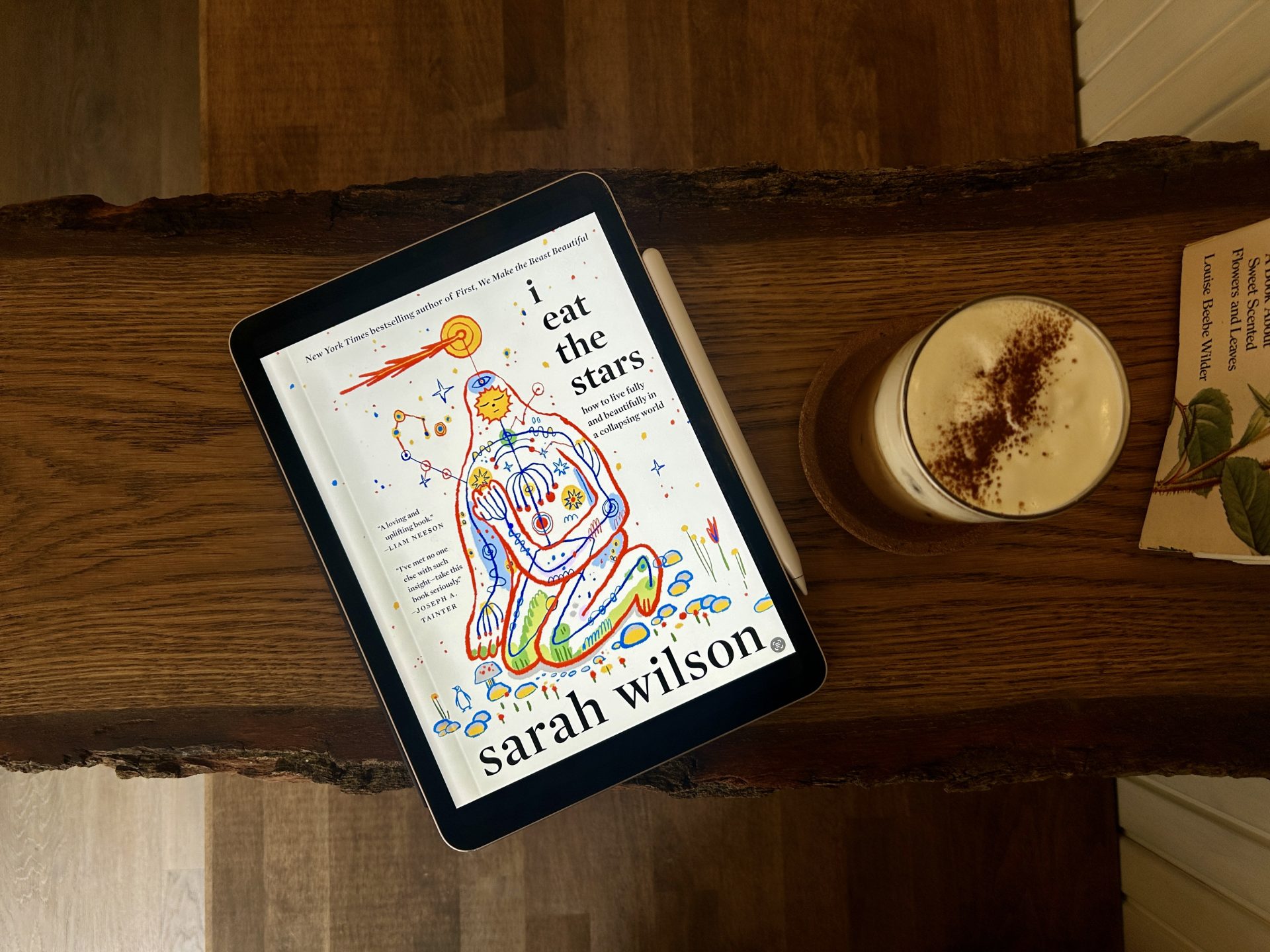
With everything happening around us today, I keep asking myself about the state of the world, and hopelessness is often what I end up thinking and feeling. Yet no matter how dark my view of the future becomes, a small belief stays hidden deep inside my mind: could this situation possibly still transform? So when Sarah Wilson admits in I Eat the Stars that she has been sitting with that same heaviness, her words resonated with my own thoughts so much.
Wilson argues that much of the world is now moving through the breakdown of the systems that once held everything together. Reading this book means facing a pile of brutal truths and some very large feelings you may have been avoiding.
Rethinking Hope
Wilson asks us to release the one we’ve clung to hardest of all: the belief that we can fix things and carry on with our comfortable, growth-based existence on this planet. According to her, that particular hope is over. And once you accept that, everything changes.
We’ve all been hoping so hard for a solution. Meanwhile, the hopeful stories we keep telling each other no longer match the headlines pouring in day after day, and that mismatch has created a profound cognitive dissonance inside us.
She also raises a worry I had recently. Many of us lean on our faith in humanity, our resilience, our knack for escaping even the grimmest scenarios. Yet as we watch our surrounding, society repeatedly fail to cooperate and rise together. That faith starts to crack. Wilson sees it happening already. People are giving up on each other and turning their neighbors into enemies, simply because none of us can live up to what we hoped for.
So when hope runs out, what remains? Her answer is truth. Truth is what can hold us now. She describes a truer form of hope, too: the certainty that something makes sense, regardless of how it all turns out. Integral psychology even has a name for this shift away from clinging to hope and toward bravely confronting reality: post-tragic consciousness. I found that framing freeing.
Living in the In-Between
One concept from the book reframed how I see this moment is liminality. It means a time or space between two things. Wilson finds it helpful to view our current era as liminal, and now I do too. In liminal times, we get to selectively carry the things we cherished from the past into the “Not Yet” future we are slowly becoming. That idea is kind of comforting for me.
She stays honest about the cost, though. All of us will be living with increased volatility and discomfort while we wait to find out what comes next. This “meantime” is critical. If we mishandle the discomfort and the uncertainty, Wilson believes tragedy becomes almost guaranteed, possibly in the form of mass civil unrest.
Her antidote for surviving the meantime is curiosity. Just like kindness, curiosity opens up important parts of our brains, making us more agile, more adaptable, better at solving problems, and less anxious. Sadly, our culture has grown decidedly less curious, and research shows this threatens our collective tolerance, our innovation levels, and even the democratic process. MIT studies from 2025 found that our almost overnight reliance on large language models like ChatGPT has sharply accelerated this decline.
If you’ve been carrying a low hum of dread about the world and wondering whether anyone else feels it too, this book will meet you exactly where you are. Still, like every other issue in this world full of complexity, a neat fix is never on offer here. By the last page, it hands you something sturdier than the hope you walked in with: a genuine appetite for life itself.
Author: Sarah Wilson
Publication date: 16 June 2026
Number of pages: 336 pages
Leave a Reply