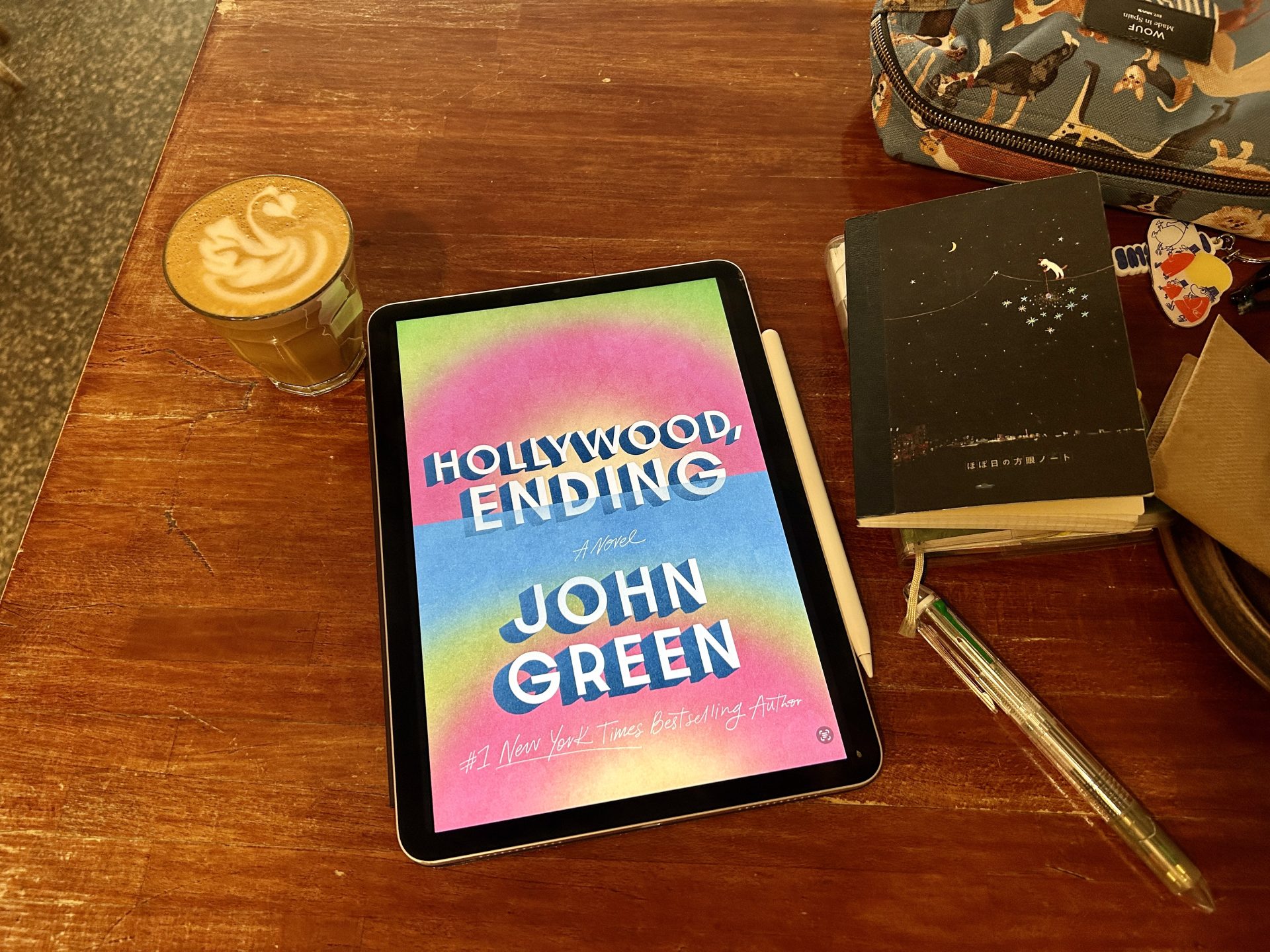
Finally, the long-awaited book by John Green, “Hollywood Ending,” dropped, and I was more than ready!
The story is about Kai and Juniper, two young rising actors who land roles in Andy Warhol Never Gets Old, a biopic that becomes their big break. The movie itself explores the tension between public image and private life, and the early days of celebrity culture through Warhol’s lens. But underneath all the Hollywood glitter, Hollywood, Ending invites readers to reflect on some fundamental questions: what do we owe the people we love, and what happens when those debts feel impossible to repay? Green also introduces the idea that both love and art hold a real kind of transformative power, which gives the story much more emotional weight than a showbiz premise might suggest.
Both Kai and Juniper carry complicated histories into the story. Juniper lost her mother to substance use disorder. Kai carries the scars of abuse from one of his teachers. These backgrounds shape how each of them moves through sudden fame, grief, vulnerability, and the relentless pressure of living under a social media spotlight.
Emotionally, the book covers a lot of ground. Grief, trauma, all layered on top of the dizzying climb toward recognition and the chaos that follows once you actually get there.
I read this book in about four hours. And while that’s partly a testament to how readable Green’s prose is, it also made me ask myself about the reading experience: is this book as light as it feels, or did I just read it too fast to fully absorb the story? I might be biased because I happened to be reading Hollow Bones by Jodi Picoult at the same time (yes, I read multiple books in certain period of time), and I couldn’t resist comparing the two reading experiences. Picoult hits differently in terms of emotional density, and that comparison—unfair as it probably was—shaped how I experienced Green’s book. That contrast likely explains some of the lightness I felt in Hollywood, Ending.
The lightness in Hollywood, Ending has two sides to it. On one hand, Green manages to present complex characters and their messy emotional landscapes in a way that never feels overwhelming to readers. He also slips in some beautiful, resonant lines throughout the story that I love (check on My Favorite Bits below). On the other hand, sadly, that same lightness meant the book didn’t leave a particularly deep mark on me.
For some contexts, many John Green fans found their way to his works through Paper Towns, but my starting point was different. I fell for his works not long ago through Everything Is Tuberculosis, one of his latest nonfiction collection. That one impressed me a lot. I remember going looking for more, and The Anthropocene Reviewed followed right after. So when Hollywood, Ending was announced, I was excited. This is his first adult fiction novel, and for me, his first fiction after being impressed with his nonfiction work. Obviously, I set my expectations high. Whether that shortfall is on the book or my expectations were too high, I have no idea. Probably both.
For me, Hollywood, Ending is an okay book. Green executes the story well, and the themes he’s working with—fame, debt, love, loss, the performance of being a person online—feel relevant. It just didn’t shake me the way I was hoping it would. So maybe Hollywood, Ending is recommended as light reading for you?
My Favorite Bits
- The dead are not in the past, not really, because you carry them around with you.
- “Warhol was making himself the whole time. That was the real art project. The constant construction of the self.”
- “..That’s what I like about acting. I get a break from being my goddamned self.”
- And I wondered whether loneliness is an inevitable by-product of success, because nobody else really knows what it’s like to be you, and anyway you can’t be sure whether people want to be near you because you’re you or because you’re a success, which is its own kind of aloneness.
- Fame makes you big but it also makes you two-dimensional.
- Everyone kept saying, “I’m sorry for your loss,” but I’d lost so much even before she died. I’d lost the certainty that mothers are good, that love is simple, and with her death, I’d lost even the ability to hate her. Grief is a strange bedfellow.
- “So you were an athlete and a theater kid?” “I contain multitudes,” he said.
- I am my only me.
- You never realize how permanent death is until somebody you love dies.
- Acting is a chance to visit rooms in my mind that I have no other way of discovering.
- One of the big problems with being a human is that you spend the whole time you’re here inside of one body, looking at the world through one set of eyes, unable to really imagine with any clarity what it would be like to be someone else. You see everyone, even the people who are closest to you, in the context of yourself. My mother. My brother. My friend.
- You’re talented, but it’s the ambition that’ll get you where you’re going.
- Art often seeks places language cannot seek, to express what cannot otherwise be expressed.
- The hardest thing in life is to be small, to not have any say over what happens to you or who does it. To be at other people’s mercy.
- I kept thinking about how the most cynical or ironic people tend to also be the most vulnerable, because they can’t afford to risk sincerity.
- Just because you’re good at something doesn’t mean you have to do it.
- Art gives form to the formless.
- When you’re going through something really traumatic, you don’t know when it will end or how it will end. Or if it will end. And that’s what makes it so destructive.
- We are literally in a business where we are defined entirely by what people think of us.
- We’ve both had the kind of childhood where you learn too soon that you aren’t safe, that you never were, that the people tasked with protecting you can’t, or won’t, because they want something more from you than mere love, which is all children really have to offer.
Author: John Green
Publication date: 22 September 2026
Number of pages: 416 pages
Leave a Reply