

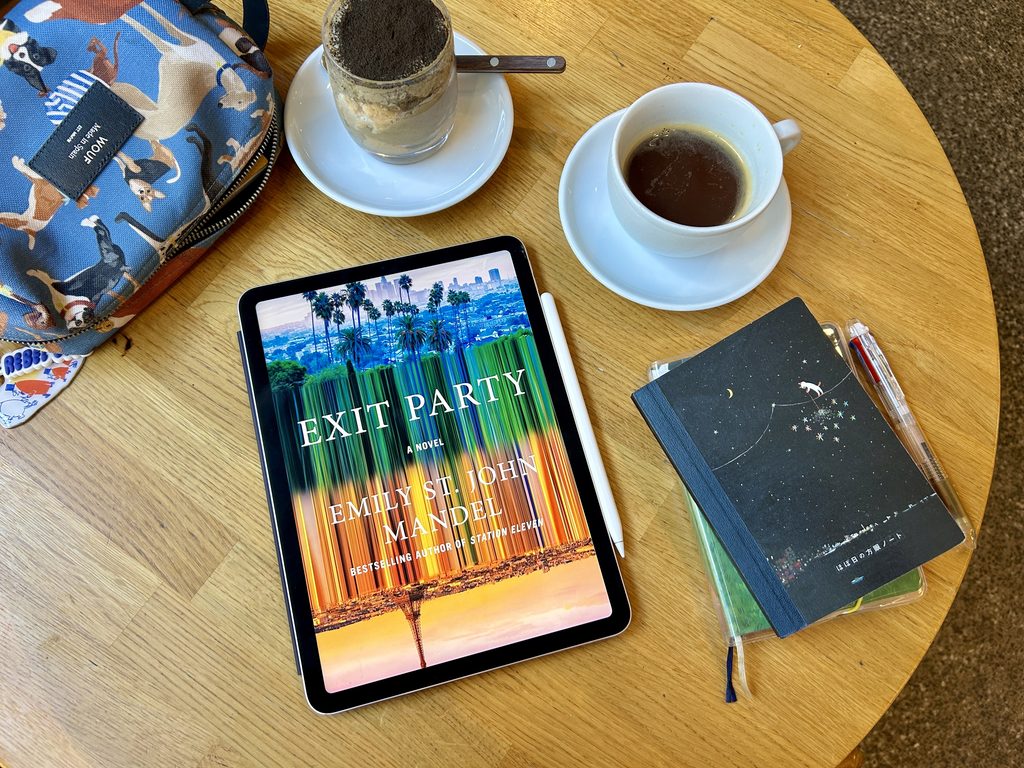
Emily St. John Mandel has a gift for building worlds that feel unsettling. Exit Party tells a mystery so intricate it demands your full attention, perhaps even a timeline drawn on paper beside you as you read, like what I did.
The story starts in 2031 Los Angeles, during the first spring after the collapse of the United States. The Republic of California has just lifted its curfew. Ari Waker, recently released from an 18-year prison sentence, heads to a party in Silver Lake with her roommate Gloria. Kareem, their generous and affable host, has thrown together what feels like a celebration of freedom itself.
Suddenly, everything shifts.
At the party, the impossible begins to unfold. A doppelganger of Gloria materializes in the crowd. Guests encounter duplicates of themselves dressed in different clothes, wearing different expressions. Kareem vanishes. Someone takes a painting off the wall: Swan Dive, a 1960s portrait of the ocean with feet disappearing into waves. The painting disappears and reappears, slipping between realities as if the party itself has become a threshold where different versions of the world collide.
Mandel weaves theoretical physics throughout her narrative, gradually revealing the mechanisms of what’s happening. Through conversations and journal entries, we learn about quantum entanglement and the nature of parallel universes. Two physicists theorize that identical objects existing across different universes emit the same electromagnetic radiation, a kind of fingerprint in space-time that could link them across dimensions.
One physicist proposes a three-dimensional model of time: the first dimension is how we experience it. The second dimension crosses the first, representing a slightly different version of today. The third dimension allows movement between these two axes. What if sometimes our ending point lands on a different axis entirely?
These theories form the backbone of what unfolds across the novel’s structure, which spans from a 1960s New York apartment through a century to a domed Paris in the 2060s and even a lunar colony. History isn’t linear here. It branches, intersects, and doubles back.
The challenge Mandel presents is immense: tracking characters who cross between realities, understanding their multiple selves, and grasping how a single chaotic party in Los Angeles connects to centuries of history. You might genuinely want to keep paper and pen nearby, sketching connections as they emerge.
When the two universes become entangled, Mandel takes full advantage of the opportunity to explore two profoundly different Americas. In one timeline (Side A), the nation has fractured into chaos: a dangerous patchwork of fractured territories, constant low-level violence, and shifting borders. People survive through necessity, bending rules to endure. In the parallel universe (Side B), order reigns absolute. A surveillance state controls every movement, every word, every thought. Citizens are housed in pristine glass towers, and drones hover perpetually overhead.
The true genius of the novel lies in how Mandel shows these opposing worlds aren’t actually so different. Both crush their inhabitants in their own way. Chaos and totalitarianism become mirror images, two extreme versions of dystopia.
Exit Party reads as a combination of mystery, science fiction, and character study. The speculative elements matter because they force us to ask: If another version of you exists in another world, how different would they really be? How much of who we are comes from choice, and how much from circumstance?
This is the question that lingers after you turn the final page. It’s the reason you might find yourself thinking about the book weeks later, reconsidering a character’s decision or wondering about a possibility Mandel left unresolved. It’s the reason Exit Party deserves your attention and possibly that piece of paper you kept beside you while reading.
My Favorite Bits
- Because the avoidance of patterns can save your life.
- You get more than one life. The transition between lives is sudden or slow.
- We don’t get to choose the world we’re born into. But you either learn to navigate that world, or you don’t.
- I didn’t like to think about getting older. I’d hated being an adolescent but I was afraid of adulthood, and I wished to stay for a moment in the in-between.
- The thing about living in a place like this was how hard you had to work to not see the obvious.
- A harmonious society comes at a price and we are not just the ones who exact that price, we are the ones who pay it.
- “I think if you live long enough, you become a migrant from another timeline. There’s the world you learn to navigate as you enter adulthood, and then that world slips away from you by degrees, and after a while there’s nothing left of it, but you’re still here.”
Author: Emily St. John Mendel
Publication date: 15 September 2026
Number of pages: 320 pages
Leave a Reply