For the past few years, my reading habit has gotten a little out of hand. I’ve been devouring books at a pace I never imagined, and somewhere along the way I noticed that the act of reading itself was holding me together. Books had a real effect on me. They lifted my mood, calmed my worries, and made me feel more like myself again. I started wondering why. What exactly happens between a reader and a page that can soothe a worry or carry you through a hard season?
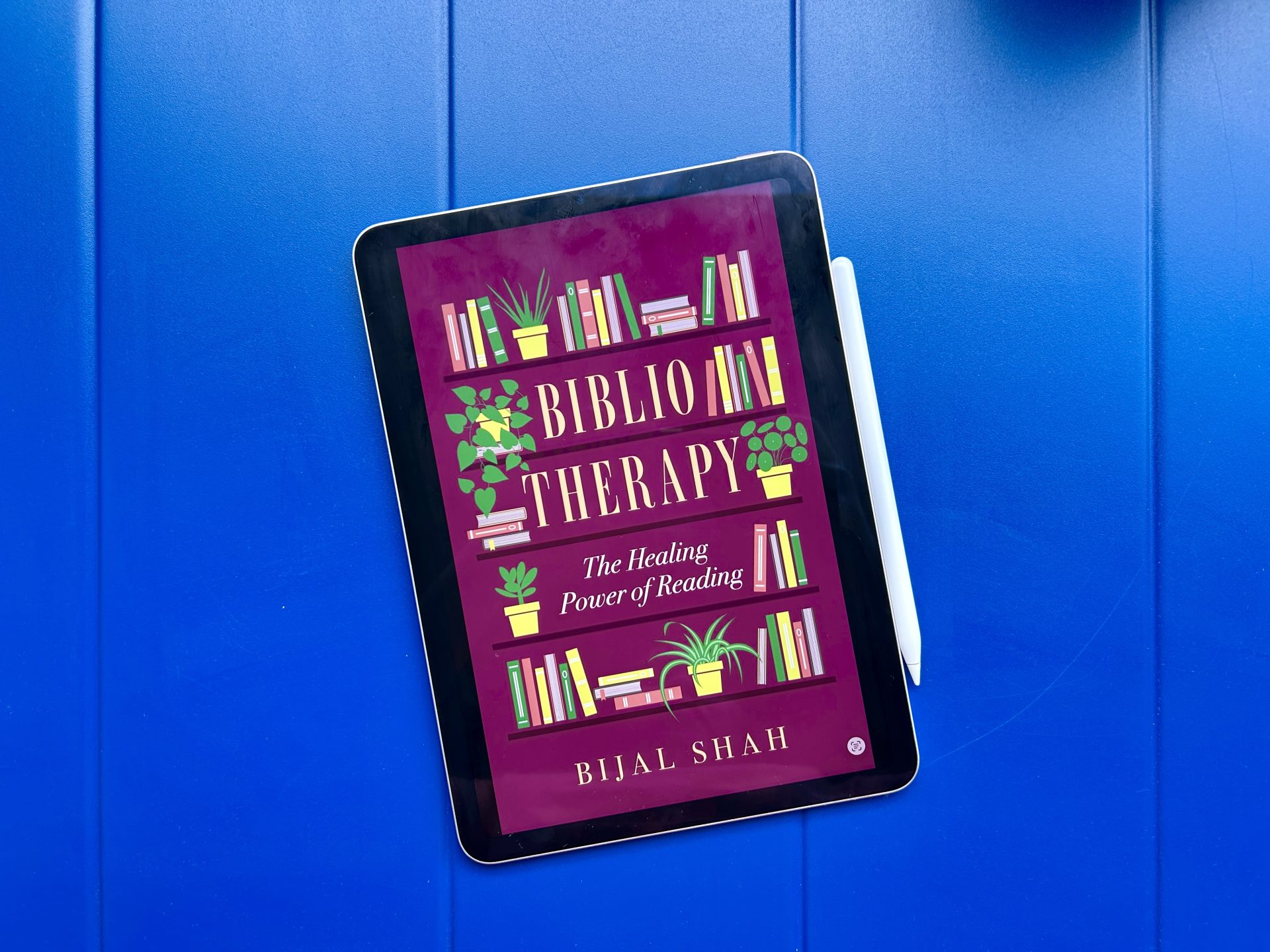
That curiosity sent me hunting for books about books, specifically ones that explore how reading affects the mind and body. After a few near-misses, I finally landed on Bibliotherapy by Bijal Shah, and it answered just about every question I’d been carrying around.
The first surprise was learning that there’s an actual name for the thing I’d been doing. It’s called bibliotherapy. I’d read a few books that brushed against the idea of healing through stories, but none of them gave the practice a proper name or a framework. Shah lays it all out: how reading heals us, why it works, and what makes a book the right book at the right time.
Shah also introduces a practice called literary journaling, which turns out to be a fancy term for something I’ve been doing for years in my commonplace book. I had no idea there was a name for it. The way Shah describes the process matches my own routine almost word for word: building a small personal narrative around what I read, paying attention to my emotional reactions, and jotting down whatever each book reveals about me. Reading those pages felt like meeting a stranger who already knew my habits. The journaling itself has always thrilled me as much as the reading, and now I finally have a vocabulary for why.
I also loved the section on poetry therapy. Last year I fell hard for poetry and felt its effect on me without being able to explain it. This book traces poetry’s long history as a healing tool, going all the way back to the American Civil War, then through both World Wars, with the practice still alive and well today. Learning about that lineage made my own poetry phase feel like joining a tradition that stretches back generations.
A genuinely new idea for me was the concept of literary curation. Sure, you can read anything you want, as much as you want (which is basically my approach to life). Shah explains how curating your reading with intention, choosing books that match what you’re going through, can move the healing from accidental to deliberate. She walks you through the entire book selection process, and as someone who tends to grab whatever calls to me from a shelf, I found this part of the book a real eye-opener. Maybe this is the part I’ve been missing from my reading journey for the past few years, and I can’t really call it undergoing bibliotherapy. I read a lot, find peace in the activity, and do literary journaling as well, but no one helps curate my reading list.
In this book, Shah also offers some practical takeaways. She states that audio-journaling as another way to process what you’ve read, and she shares prompts to help you start your own literary journal. These small additions make the book feel like a friend handing you tools.
My favorite part has to be the book prescriptions at the end. Shah has put together an A-to-Z list of recommendations, organized by mental health and wellbeing themes, pulling from every genre you can imagine. I’ve been treating this section like a personal library map. Whatever I’m feeling, there’s a prescription waiting for me.
If you’ve ever wondered why a book can feel like a friend, or why some reading seasons heal more than others, this one is worth your time. It’s the rare book about books that actually delivers on its promise.
Summary
How Reading Books Can Heal Your Mind
- Book characters can feel like real friends. When we read, we get to step inside a character’s head and see what they think and feel. Real friends and family can’t give us that kind of access. So even though these people only exist on the page, the bond can feel just as close, sometimes even closer.
- Books let us feel things we’ve never been through. Maybe you’ve never lost someone, had your heart broken, or faced real fear. Reading lets you try those emotions on without the real-life damage. It helps you understand what these feelings are like before life hands them to you.
- Stories about pain teach us about people. Reading about how others suffer shows us what humans can go through and how they react. This gives us a better sense of why people act the way they do, even in the darkest moments.
- Feeling understood is a kind of healing. Sometimes a book says exactly what you’ve been feeling but couldn’t put into words. That moment of “someone gets it” can be just as comforting as a long talk with a friend.
- Using books to heal has a name: bibliotherapy. People have turned to stories for comfort for hundreds of years. But the word bibliotherapy is fairly new. An American writer named Samuel Crothers came up with it in 1916.
Reading Fiction as Therapy: How the Healing Actually Happens
- Reading fiction is a two-way street. A book works its magic when the reader brings their own personality, memories, and feelings to it. The story and the reader meet halfway, and that’s where the emotional work begins.
- You have to feel safe before you can feel deeply. If you’re tense or guarded, the book can’t reach you. The reader needs to relax, lower their walls, and let the story stir up whatever it stirs up. Without that openness, the words stay flat.
- Looking for meaning takes effort. Healing doesn’t happen just by finishing a chapter. You have to think about what the story is really saying and how it connects to your own life. This is where the real work lives.
- There are simple ways to dig deeper. You can sit and reflect on what you read. You can write your thoughts down in a journal. Or you can talk it through with a therapist or a friend. Any of these helps the book sink in and do its job.
- The goal is self-awareness. When this process works, you start to see yourself more clearly. You feel less stuck, more in control, and more free to choose how you want to live.
How Bibliotherapy Works: The Science Behind Healing Through Books
- Bibliotherapy is a kind of art therapy that uses writing, fiction, nonfiction, poetry, anything, as medicine. The healing comes from the bond between you and the text, deepened by reflection through journaling or talking with a counsellor.
- Characters carry your feelings so you don’t have to. When you read, your pain sits in someone else’s hands. You watch a character feel what you’ve felt, and that small bit of distance makes it safer to face. Seeing your emotions in someone else makes it easier to accept them in yourself. And only by truly feeling pain can you finally let it go.
- Reading takes you into your own unconscious. Words lead you into the dusty corners of your mind, places you’ve ignored for years, or feelings you didn’t know you had. Writing back, through journals, letters, or stories of your own, helps you process what surfaces, with no one around to judge.
- The “shock of recognition” is when the work begins. Sometimes a sentence stops you cold because it describes you. That jolt opens the door to real change: breaking thinking patterns that no longer help, seeing the world from new angles, and figuring out which emotional baggage is truly yours.
- You’re both the watcher and the lived-in character. No other therapy lets you do this. You escape into fantasy and find truths about real life at the same time. Researchers Geoff Kaufman and Lisa Libby call this “experience-taking”: when you fully lose yourself in a character, you borrow their mind, and sometimes you keep a piece of it. Real behaviour can shift as a result.
- The brain and mood get real benefits too. Reading boosts self-awareness, fires up the imagination, and helps you manage emotions more skilfully. Over time, many readers feel less stressed, less anxious, and less low.
- Great for people who like doing the work alone. If traditional therapy feels too exposing, bibliotherapy gives you space and control. You set the pace. Close the book when it hurts. The only thing you really need is a sense that the author gets you, because that quiet feeling of being seen is what lets your defences drop and the healing begin.
Literary Journaling: How Writing About What You Read Doubles the Healing
- Writers often heal themselves on the page first. The best authors write what they know, and that usually means drawing from their own lives. To put real feelings into a story, they have to face those feelings first. That emotional work is woven into the writing, and when you read it, you feel it too. It’s why some books seem to understand you, because someone already worked through that pain to write them.
- What “literary journaling” actually is. Simply put, it’s keeping a running journal of the books you’ve read and the impact each one has had on you. Every time you finish a chapter or close a book, you sit down and write. You note how it made you feel, ask why those feelings came up, and capture anything you learned about yourself along the way. It turns reading from a one-way experience into a real conversation.
- Journaling is one of the best ways to come home to yourself. In the noise of everyday life, it’s easy to lose track of what you actually think and feel. Writing slows everything down. It lets you reflect, untangle your thoughts, and find a bit of clarity amid the stress.
- Writing down your reactions, good or bad, has real power. When a book stirs something up, put it on paper. Joy, sadness, anger, longing, all of it. This is especially helpful for the harder feelings, the ones you’d rather avoid. Naming them in writing is often the first step to letting them go.
- Journaling builds self-compassion. Putting your reactions into words softens the way you talk to yourself. You start treating your feelings with curiosity instead of judgement. That gentleness is one of the quiet ingredients of real healing.
- It deepens your bond with the book and with yourself. Reflecting in writing connects you more closely to the author’s message, and just as importantly, to the person you’re becoming as you read. You start to feel understood and a little less alone, one of the most powerful gifts words can give.
- It captures the small changes you’d otherwise miss. Healing rarely happens all at once. It shows up in tiny shifts, a new thought here, a softer reaction there. Journaling catches those quiet moments and lets you look back to see how far you’ve actually come.
How Bibliotherapists Pick the Right Book for You (and Why Algorithms Can’t)
- Algorithms can’t do what a bibliotherapist does. Online recommendation tools only know what you’ve already liked. They serve you more of the same. But healing often happens when you read something you’d never have picked on your own. Algorithms aren’t built for surprise, and surprise is half the point.
- Curation is the heart of bibliotherapy. A bibliotherapist’s real job is choosing the right book for the right person at the right moment. That kind of matchmaking takes a human touch.
- Good recommendations come from real conversations. A bibliotherapist doesn’t work in a vacuum. They talk to other therapists, teachers, social workers, and readers from all walks of life. They keep listening, learning, and stretching their own taste.
- Knowing the reader is everything. Above all, a bibliotherapist needs to understand the person sitting in front of them. That means real compassion, not a checklist. The better they know you, the better the book they can hand you.
- Gentle questions open the door. Bibliotherapists don’t interrogate. They ask soft, thoughtful questions to learn what you’re carrying, what you’re hoping for, and what kind of stories pull at you. Out of those answers comes a personal reading list built just for you.
- Sometimes the right book is one you’ve already read. Bibliotherapists usually try to introduce new titles. But every so often, returning to a familiar book is exactly what you need. A passage you read years ago might mean something completely different now, and meet you right where you are today.
My Favorite Bits
- To read is to become literate in ourselves, in humanity and in the wider world. Reading heals and provides pleasure simultaneously. It grounds us in reality, but immerses us in fantasy too. It allows us to explore the heights of our imaginations, but also the depths of our sorrows and misfortune. It acts as a mirror, showing us ourselves and our blind spots, but when we need it to nurture or save us from ourselves, it also takes us down rabbit holes that become our saving graces when life’s challenges become too much. It provides social connection through rich and diverse characters when we need it the most, but also offers us a quiet space when we are seeking more solitary pastures.
Author: Bijal Shah
Publication date: 22 February 2024
Number of pages: 310 pages
Leave a Reply