
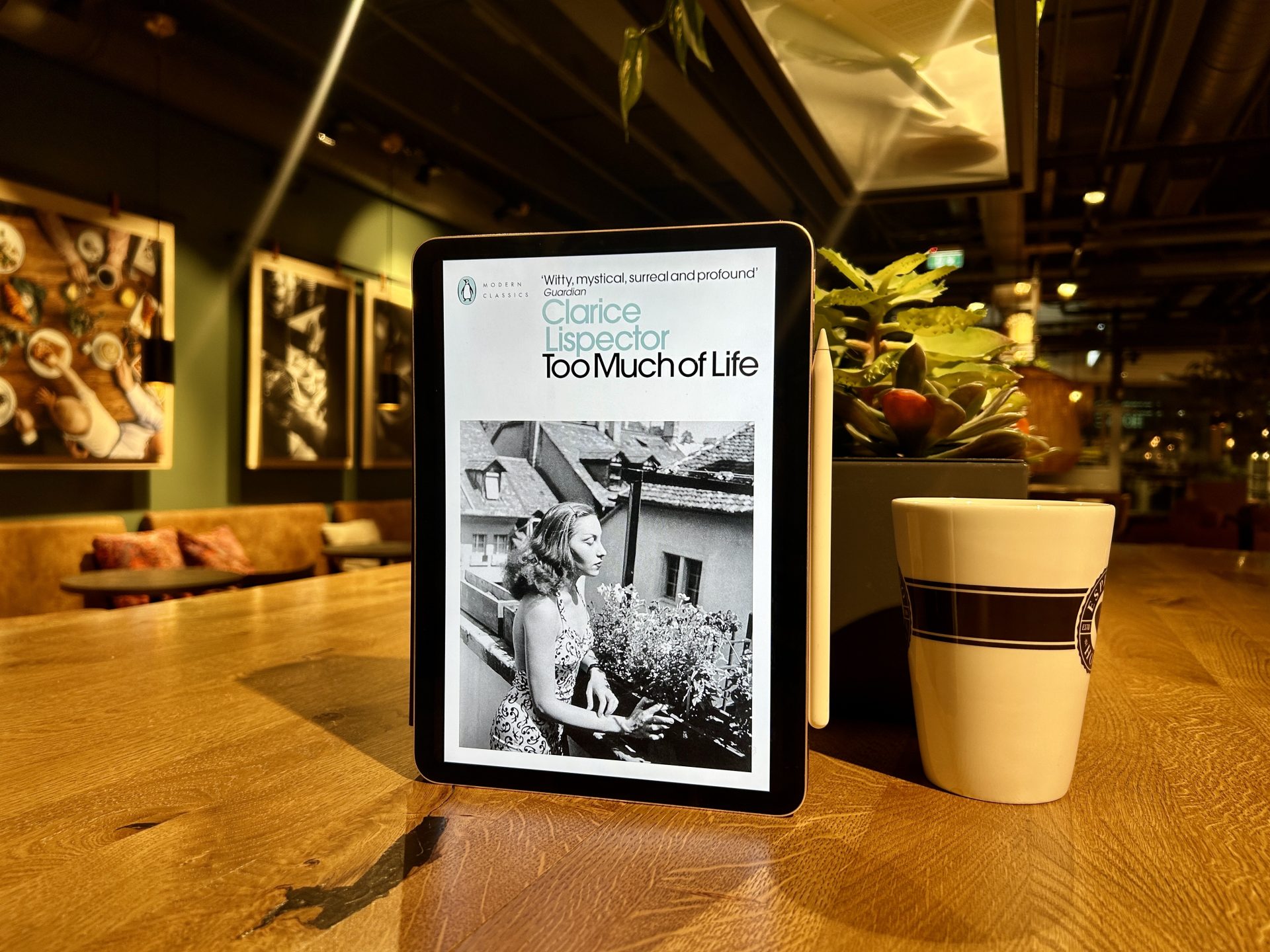
Too Much of Life is a collection of short pieces that Clarice Lispector wrote for the Jornal do Brasil while living in Rio. These were originally published as weekly columns, and together they form a book that feels personal. In this book, Lispector takes small, everyday moments and turns them into something meaningful, emotional, and sometimes even funny.
Her writing is hard to describe. It’s both beautiful and thoughtful but playful at once. I was completely drawn in, flipping through the pages without wanting to stop. There’s something soft and gentle in the way she writes. Her words slowly work their way into your heart, hug, and stay with you.
Sometimes, I saw myself in her reflections. Her way of observing the world felt strangely familiar, like she had peeked into my thoughts and translated them into more beautiful language than I could ever find. Other times, I didn’t relate at all. And yet, it didn’t matter. Even when our perspectives diverged, I still found myself captivated. Her writing, her way of thinking, it’s hard to look away.
Too Much of Life is more than 700 pages, but it didn’t feel long at all. I kept hoping it wouldn’t end.
Reading this book left a deep impression on me. It made me want to read more books like this, more moments of quiet observation, more writing that lingers. Lispector has a way of making you reflect, think, and feel, all at once.
By the way, I love this book so much that it ended up becoming the starting point of my journey into reading classic books.
My Favorite Bits
- “Anonymity”
There is a great silence inside me. And that silence has been the source of my words. And out of that silence has come the most precious thing of all: silence itself.
- “Persona”
(..) While silence may not say anything, at least it doesn’t lie, whereas words say what i don’t want to say.
- “The Cry”
(..) To return to my sense of weariness, I’m tired of so many people thinking I’m nice. I like the ones who don’t like me at all, because I feel an affinity.
- “State of Grace—A Fragment”
The discoveries one makes in this state cannot be put into words, cannot be communicated. That is why, when I’m in that state of grace, I remain seated, still, and silent. It’s like an annunciation. (..) God is quite right not to give us this state of grace very often. If he did, we might pass over permanently into the other side of life, which is also real, but then no one would ever understand us again. We would lose our shared language. It’s also a good thing that it doesn’t occur as often as I would like. Because then I might grow accustomed to happiness—I forgot to mention that, in the state of grace, you feel very happy. Becoming accustomed to happiness would be dangerous. We would become more selfish, because happy people are selfish, less sensitive to human pain, we would not feel the need to help those who need help—and all because we would find in grace life’s essence and reward.
- “In Search of The Other”
There is a good reason why I understand those searching for a path. Ah, how I struggled to find mine! And today how greedily and earnestly I seek the best way of being me, my personal shortcut, for I no longer dare speak of a path.
- “It’s Also Important Not to Forgive”
There comes a time when we must forget about being human and compassionate and take a stand, however wrongly, against the enemy. And return to a more primitive stage of dividing people into good and bad. The moment of survival is the moment when the victim is allowed to be cruel, cruel, and angry—when not understanding others is the right thing to do.
- “Not Understand”
I don’t understand. This is so vast that it passess all understanding. Understanding is always limited. But not understanding can be without boundaries. I feel that I am much more complete when I don’t understand. Not understanding, to my way of thinking, is a gift. Not understanding, but not as a simpleton. The good thing is to be intelligent and not understand. It’s an odd blessing, like being insane without being crazy. It’s gentle disinterest, a sweet silliness. Just that sometimes a worry creeps in: I want to understand a little. Not too much: but at least understand that I don’t understand.
- “Lightning Interview with Pablo Neruda”
“How would you describe the most complete human being?”
“Political, poetic. Physical.”
“What, in your opinion, makes a pretty woman?”
“One who is made up of many women.”
- “What is Anxiety?”
(..) Anxiety might be not having any hope in hope. Or accepting a situation without resigning yourself to it. Or not confessing as much to yourself. Or not being who you really are, and never will be. Anxiety might be the helplessness of being alive. It can also be not having the courage to be anxious—and running away is another form of anxiety. But anxiety is part of us: anything that is alive, because it is alive, shrinks in upon itself.
- “The First Book of Each of My Lives”
I was once asked what the first book in my life had been. I would rather talk about the first book on each of my lives.
- “More Than Wordplay”
What I feel I do not do. What I do I do not think. What I think I do not feel. Of what I know I am ignorant. Of what I feel I am not ignorant. I do not understand myself and I act as if I did.
Author: Clarice Lispector
Publication date: 1 August 2018
Number of pages: 742 pages


Leave a Reply