
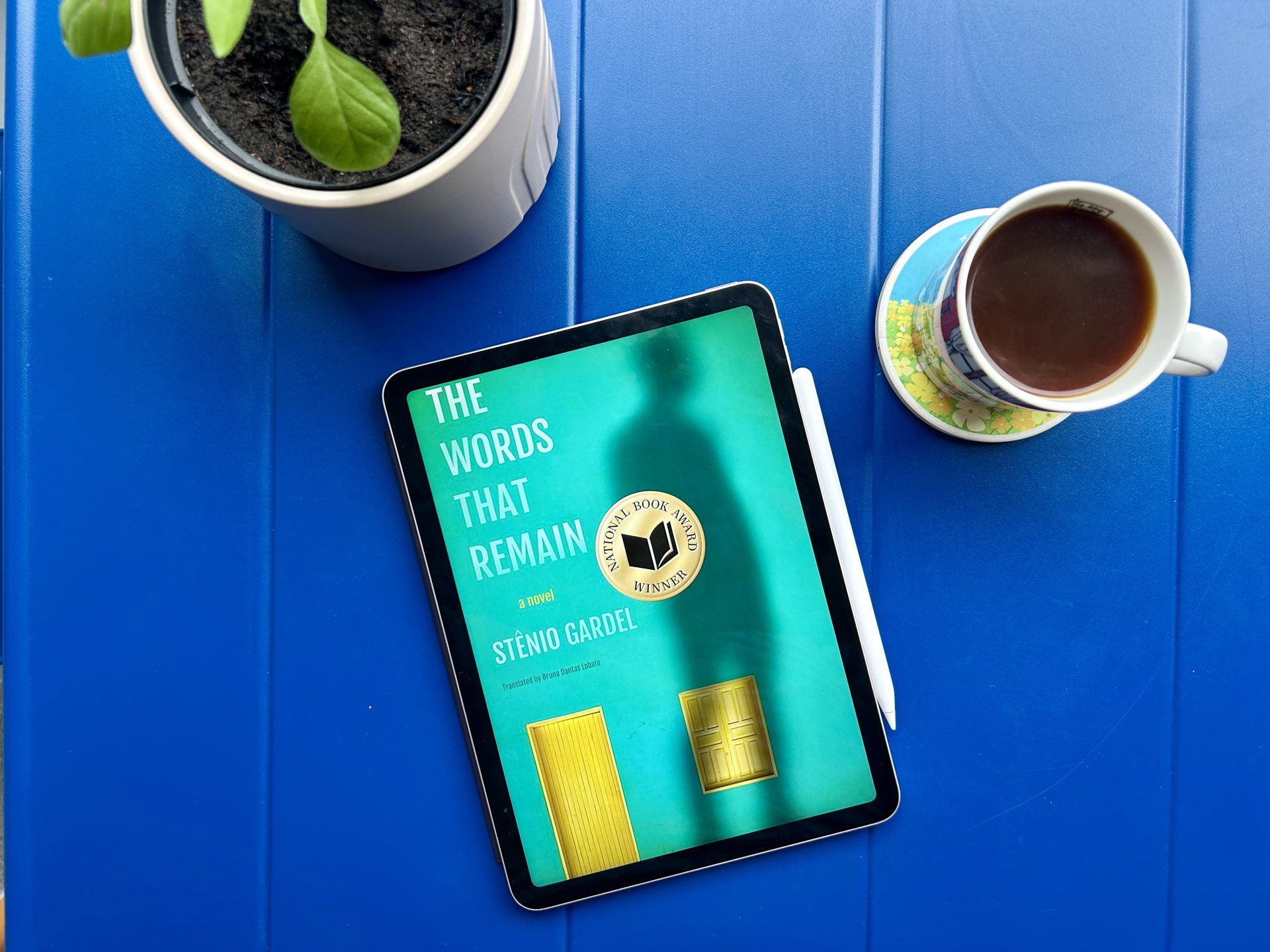
True to its title, this is one of those novels whose words burrow in and refuse to leave. I shut the book and found them still rattling around in my head.
The Words that Remain by Stênio Gardel is a story of Raímundo and Cícero, best friends growing up in a remote, hardscrabble Brazilian village. Both of them are working hard to keep their families afloat. The thing that separates them comes down to a single privilege: Cícero gets to attend school and learn to read and write, while Raímundo never does. His father had a blunt little philosophy about all of it: writing, the way he saw it, was for people who didn’t have to worry about putting food on the table. So Raímundo grows into adulthood unable to read or write, and that gap trails him as he drifts across Brazil, the grind of working-class poverty chasing him every step of the way.
And then there’s the letter. Cícero writes to him, and Raímundo ends up describing it as half-blessed, half-cursed, wholly mysterious letter he carries for over fifty years without being able to make out a single word. It becomes a knot of everything that ever passed between them: the love the two boys shared as young men, the violence that ripped them apart (both were beaten by their fathers and fled their homes), and a daily, stinging reminder of how far outside the world Raímundo has been pushed. Ignorance does exactly that, he reflects. It shuts you out, it isolates.
His loneliness runs deeper than illiteracy, though. Raímundo is a gay man in a time and place with no room for one, and he spends his life braced for the moment he might be found out and thrown away for it. “I like men, but I still am one,” he insists, and that line tells you how fiercely he clings to his idea of his own manhood, and how much homophobia he’s swallowed over the years and sometimes hurls right back at the world around him.
A word on how Gardel actually tells this, because the form is pulling a lot of weight. The narration slips back and forth between an all-seeing voice and Raímundo’s own, and the timeline never sits still for long, leaping backward and forward across his life. Passages of clean, ordinary prose suddenly give way to a breathless rush of piled-up detail, and you aren’t always sure whose thoughts you’ve landed inside. It can leave you a little dizzy, in the best possible way. Credit to Bruna Dantas Lobato, too, whose translation keeps that rhythm alive in English without flattening it.
It’s a slim novel, this debut of Gardel’s, and it earned the 2023 National Book Award for Translated Literature. Once you’ve read it, that win is well-deserved.
My Favorite Bits
- What couldn’t be said, was kept silent, a thought.
- I spent the rest of my life with emptiness, and this empty space grew, it took over me, I don’t have anything else to give.
- Words in poems mean more than they seem, words are stretched, where words alone can’t go, with poetry they can, they fly, like the bird, the bird that can hear loud silences, the loud silences, that can open dawns, shrink rivers, horizon stretches, only words can do that.
Author: Stênio Gardel
Publication date: 19 April 2021
Number of pages: 149 pages
Leave a Reply