
There hasn’t been a single day recently when I wasn’t grateful to have missed out on being a teenager in this exact moment. Growing up now, in a world ruled by social media and creeping AI, sounds exhausting. I can’t picture making an innocent, clumsy teenage mistake while someone films it and sends it around the world in seconds. I can’t picture a version of life where a slip-up in one corner of the planet gets picked apart by strangers on the other side who don’t know the first thing about me.
I grew up in an era when social media barely existed. Decades ago, all we had was Friendster, MSN, MIRC, that sort of thing. I learned how to hold a conversation and what to share as well as what to keep to myself through trial and error, not through an algorithm deciding for me. I can’t imagine living without the ability to personally choose who gets access to my life and who doesn’t. If I were a teenager today, I’m fairly sure I’d end up leaning on machine, like ChatGPT as my therapist, a tool that most people don’t understand, in terms of how it works or what feeds it.
I am saddened by the world we are living in today. Social media has a way of revealing what people are capable of becoming, and it’s changed how we see the world and how we treat each other. We’re living in a society that feels less and less real, one where authenticity gets performed more often than it gets lived.
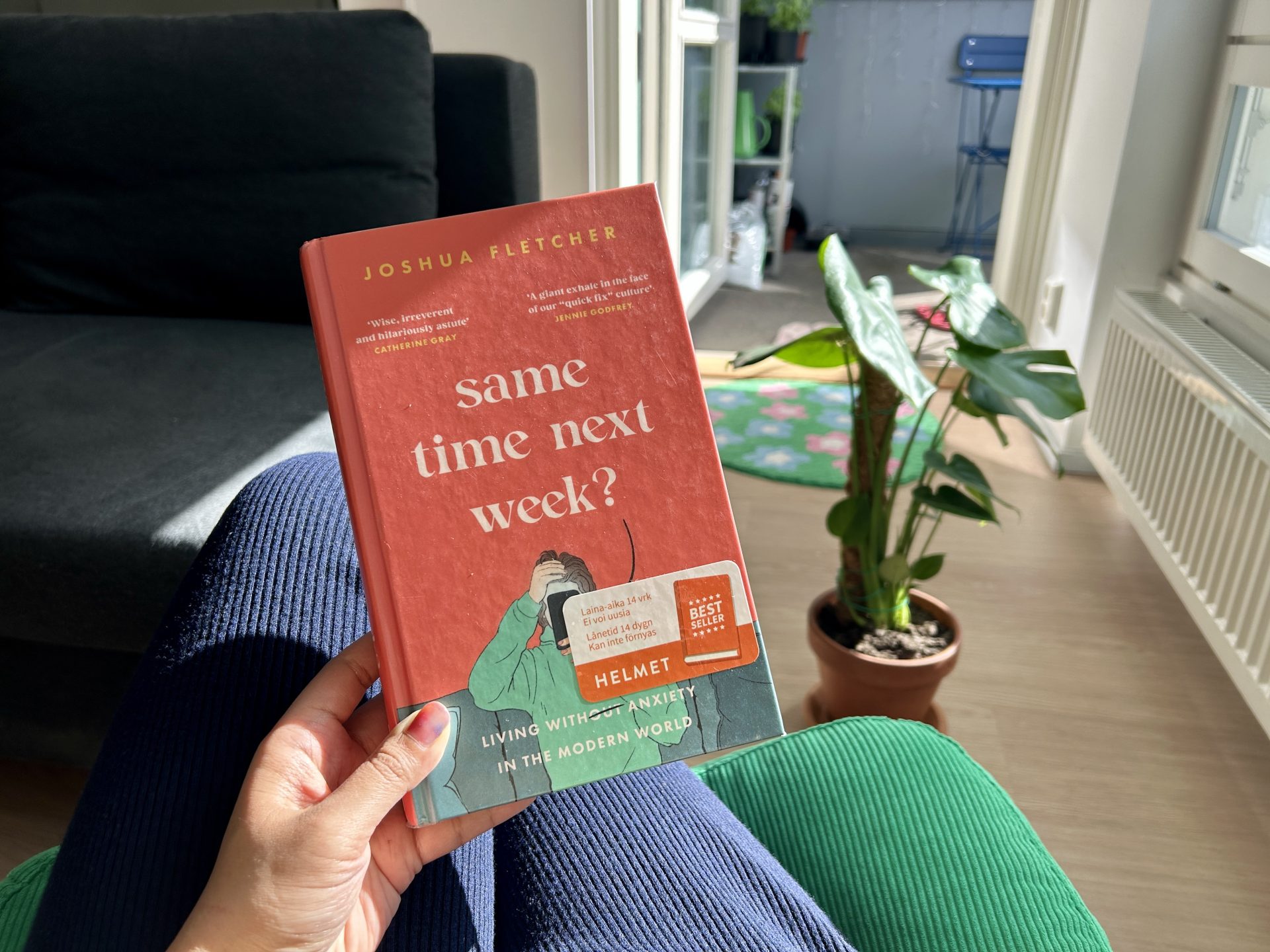
That’s the tension Joshua Fletcher wrestles with in Same Time Next Week? Fletcher is an anxiety therapist watching his clients walk into session after session holding more computing power and information in their pockets and still showing up feeling lost, overwhelmed, and cut off from themselves.
What the Book Is Actually About
This book talks about anxiety in a world that moves too fast and says too much, where wellness has turned into a desperate hunt for certainty inside a life that was never going to offer any. It looks at how we use technology to bury our shame under curated versions of ourselves, chasing instant fixes for human experiences that were never built for instant solutions. It asks what happens when self-optimisation becomes its own kind of performance, and when being “seen” online starts standing in for actually being witnessed.
Fletcher is interested in who we are in the gaps, the space between therapy sessions, between posts, between the moments someone’s watching and the moments we think we’re alone. He’s writing about the feelings that surface when no one’s looking, the ones we don’t put on display, the messy, unfiltered parts of being human.
The book moves through his four clients as well as his own perspective as an entire internal cast of characters: his inner anxiety, his inner critic, his inner analyst, and a handful of other voices that make up the noise most of us carry around in our heads.
The Part That Opened My Eyes: DPDR
One of the most insightful part of this book does is name conditions readers might be living with and never had a word for. Depersonalisation and derealisation, DPDR, is a great example. Depersonalisation is that sense of watching yourself from outside your own body. Derealisation is when the world around you starts to feel unreal, like you’re moving through a dream you can’t wake up from.
Fletcher draws a sharp line between DPDR and the mediated way most of us already live. We watch our own lives through phone screens, we build relationships out of text bubbles and curated photos, and somewhere along the way our culture normalised a version of derealisation without ever naming it that. Social media asks us to perform life for an audience and package our emptiness into something engaging. The gap between real experience and staged experience keeps shrinking, and we’ve been trained to treat our bodies like images and our thoughts like captions.
Here’s the part that really stuck with me: the harder you fight DPDR, the tighter its grip gets. Fletcher compares it to quicksand, the more you struggle, the deeper you sink. That’s exactly why he pushes back on those five-step grounding tutorials that treat DPDR like an enemy to be defeated instead of a signal worth understanding. In his view, DPDR is the mind’s strange, protective response to a problem*.*
The treatment, then, is about accepting the disconnection first. Once you stop trying to fix DPDR and start trying to understand it, that wall between you and yourself starts to thin out on its own.
Fletcher also gets into the neuroscience behind it. During DPDR, the prefrontal cortex ramps up control while the amygdala’s emotional circuits quiet down, which creates a strange mismatch, you can think clearly and see clearly, but nothing carries the emotional weight that would normally make it feel real. Meanwhile, regions like the insula and the temporoparietal junction, which stitch together your sense of body and self, can misfire and leave you feeling detached from both. It’s your brain running a defence mechanism, temporarily cutting the wire between sensation and emotion in order to protect you.
Reading that section, it’s hard not to wonder if DPDR is a clinical symptom and a kind of metaphor at once, for where we are as a culture, hyper-connected and somehow more disconnected than ever.
The Human Side of the Therapist
One of the things that makes this book great is how honest Fletcher is about being a professional who still deals with the same internal mess as everyone else. He doesn’t sugarcoat the treatment process either. At one point he talks about sitting on a panel of “sleep experts” tasked with helping clients hit some ideal version of sleep, and he’s upfront about how different every single person’s needs actually are, sleep included.
That honesty (and wittiness) runs through the whole book. Anxiety, in his view, isn’t something with a one-size-fits-all fix, and he calls out how obsessed we’ve become as a society with performing recovery and performing calm rather than actually living through either one.
It’s been a long time since I picked up a nonfiction book this good. Same Time Next Week? manages to be sharp, well-researched, and deeply human all at once.
Author: Joshua Fletcher
Publication date: 14 May 2026
Number of pages: 416 pages
Leave a Reply