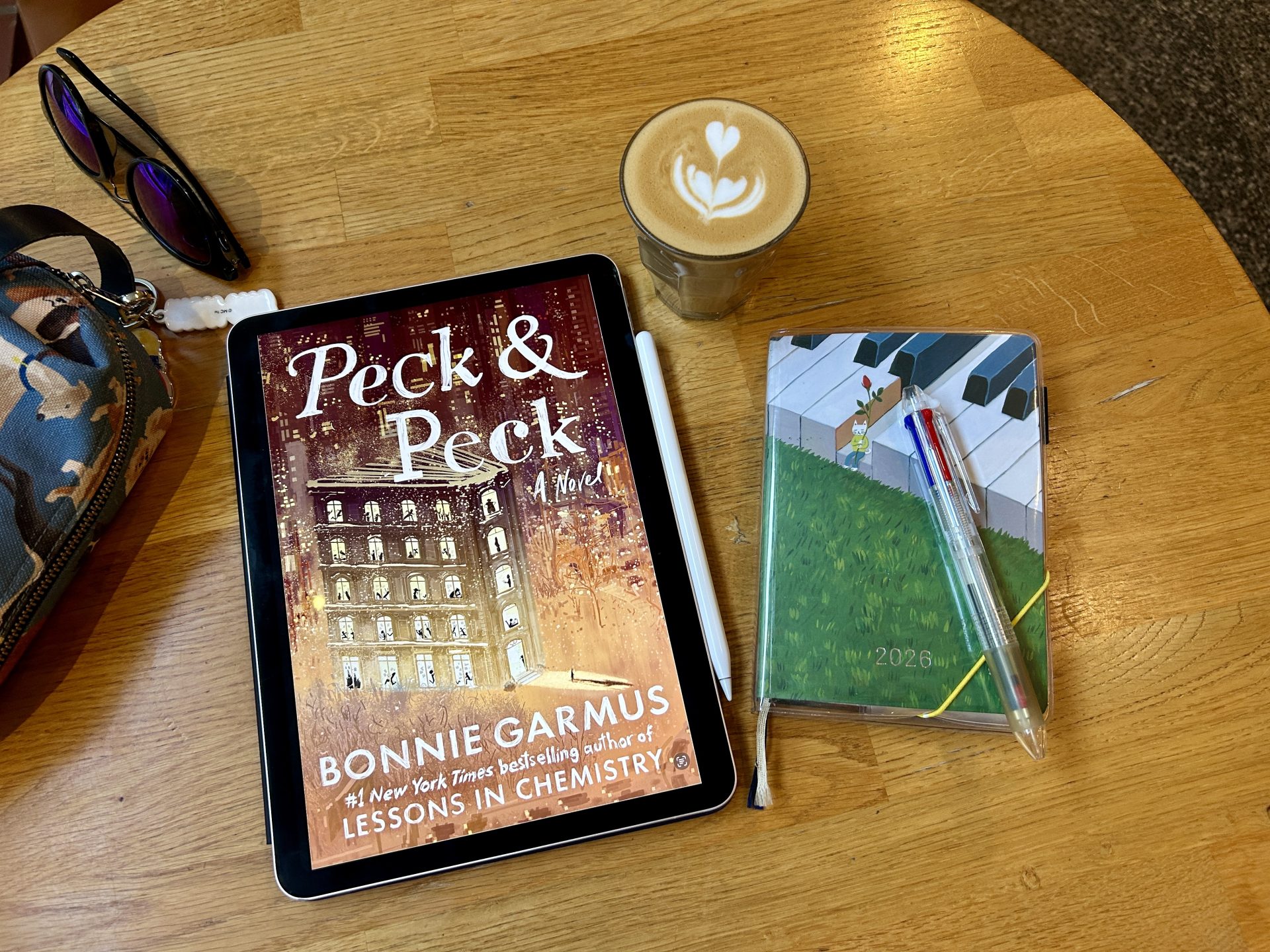
Peck & Peck by Bonnie Garmus drops us into New York City in 1982 and introduces our narrator, Batter Gray, named after his mother’s dog. Batter has been interested on poetry since he was a little kid. He wants to build his whole life around it, and almost nobody in his life agrees. His parents keep pushing him toward a “real” major. His best friend Paul wants him to snap out of his poetry daze. Even his college advisor tries to steer him somewhere more practical. So Batter bounces from major to major and somehow graduates with a prelaw degree he never plans to use.
The irony made me laugh. Batter struggles in his poetry classes, yet his prelaw professors love his work, and one of them happily offers to write him a recommendation. His best paper argues that the minimum wage isn’t a living wage. Where did that idea come from? A poem, of course. Langston Hughes’s “Mother to Son” taught Batter what hardship feels like and what it means to work hard while being underpaid and undervalued. He took that lesson and turned it into a sharp argument about wages.
I loved this part. It’s a lovely reminder of why poets matter. A good poem lets us feel what other people go through and opens our eyes to how society treats them. Poetry, and art in general, keeps us in touch with our own humanity. It’s what turns a crowd of human beings into humankind.
Inside Peck & Peck
Life eventually lands Batter at the door of Peck & Peck, the poetry quarterly he has adored since he was eleven. It’s the most respected poetry journal in the world, and he gets a job there. Well, sort of. He ends up in the basement copy room, running errands for the 39 editors upstairs.
From there, the book becomes a juicy, scandal-packed peek behind the curtain of a fictional poetry journal, woven together with Batter’s coming-of-age story.
The book also feels refreshingly honest and realistic. Even the biggest poetry lovers in it admit that poetry can be dull, a little snobby, and a tough sell for everyday readers. So while they fight to keep it alive, they also doubt themselves. Anyone who makes or loves any kind of art probably knows that feeling. Keeping art alive is hard work, and Garmus doesn’t pretend otherwise.
And of course, Garmus slips in some science (she did write Lessons in Chemistry, after all). I learned a brand-new term here: heteropaternal superfecundation. It happens when a woman releases two eggs in the same cycle and each one is fertilized by a different man, so the twins end up with different fathers. Releasing more than one egg at a time is called hyperovulation, and it’s what leads to fraternal twins and triplets. Twins pop up all over this novel, so the topic fits right in. Who says fiction can’t teach you a little real science along the way?
Where It Lost Me a Little
Now for the part that didn’t fully work for me. The story feels stretched, and its foundation feels a bit thin in places. The opening hooked me right away (Batter tells us early on that he’s ended up in prison, which is quite the way to start), so I went in with high hopes. Then the middle slowed down, and I’ll admit I felt a little let down. By the final stretch, the book had caught me off guard all over again. So this novel surprised me more than once, sometimes in a good way and sometimes in a “wait, where is this going?” way.
My biggest wish is a tighter story. Some scenes could easily be cut, and the book would feel more compact for it. As it stands, there were moments when I got bored or wondered what a certain scene added to the plot. Most of the time, the answer was very little. I don’t mind lighter filler chapters between the big moments, since every story needs some room to breathe. Here, though, those in-between parts came across as flat and a bit bland.
Peck & Peck is a love letter to poetry and to the stubborn, messy people who keep art alive. Batter is easy to root for, the office drama is a lot of fun, and I came away knowing far more about quail eggs and twins than I ever expected. The slow middle tested my patience, but that surprising ending made the trip worth it. If you enjoy literary fiction about words, books, and big-hearted misfits, give this one a try. You might even find yourself reaching for a poetry collection afterward.
My Favorite Bits
- ..humankind was neither human nor kind..
- My mother was big on both choice and action. As it turns out, morality requires both. But so does crime.
- Your father suffers from anxiety, Batter. Most historians do. This is because they’ve seen the past and know the future is going to be a repeat. (..) Because people never learn, honey.
- Anyone can be a hero; it’s just that most aren’t up for the sacrifice.
- Humans reached extinction because they no longer used their brains. Because they got lazy and created machines to think for them. While this type of error seems unimaginable by our standards, humans were renowned for their unprecedented levels of idiocy.
- Teaching history is hard. And you know what makes it even harder? Knowing that history is completely dependent on who’s telling it.
- College would have been a near-perfect environment if it weren’t for the way it ruined the whole thing by insisting everyone declare a major.
- That’s how I used poetry. To understand the world. To decode, analyze, interpret, think. Gave me a huge leg up.
- The truth finally came out, but it took forever. Justice is like that: slow. That’s why so many people who seek justice die waiting. Injustice, on the other hand is fast.
- You know how aging starts, Batter? By putting off the future. You know you’re getting old when you start saying stuff like ‘I could still run a marathon; I could still write that book.’ It’s the ‘still’ that gets you. You’ve got to do what you want to do right now. That way, when you have gray hair, you’ll be able to do what you need to do right then.
- Because the moment you hear yourself say, ‘It’s not too late,’ it is.
- It’s getting more and more rare to see something unexpected, something entirely original. We live in a time that encourages uniformity, worships the mundane, lives for the mall. Wherever you go, there you still are. But this building defied all of that.
- A living. A misused word if I’ve ever heard one. There’s often so little living in making a living.
- Obviously we need scientists and engineers and lawyers. Obviously, such paths lead to good jobs and more money; no one in their right mind would argue that we should ever cut back on these subjects or positions. But art, music, poetry, photography, design, literature, ceramics, textiles, theater—in a word, beauty—are equally important. Without them, our very humanity dies. We’re still birds, Banner, but with clipped wings. We have feathers but no longer fly.
- The only response I got was a sympathetic pat on the back, letting me know my youthful naïveté was starting to annoy everyone.
- Rejection can hurt, but it’s not fatal. You will get rejected, honey; there’s no way around it. A few will even tell you rejection is actually good for you—that it makes you stronger—although that bit of wisdom usually comes from the people doing the rejecting.
- Awful people succeed because nice people let them. This is the drawback of being nice. Nice people worry that it isn’t nice to take action against awful people because they don’t want to act awful themselves—they don’t want to ‘stoop’ to that level. But I think nice people have been stooping all along. The worst kind of stooping—because it isn’t stooping, it’s bending over.
- Still, finding your own way isn’t easy. We live in a society that rewards conformity. Follow this path, get this result. (..) But what I’ve learned is that for many of us, it’s just the opposite. We have to do something for which we feel unequipped—we have to break the shell and learn how to fly. Test our wings and follow our guts. We have to swoop, dive, plummet, change course, and ascend again. We have to make mistakes. We have to accept those mistakes. Because it’s only through acceptance that we can take off again—and eventually soar. And yes, I realize my employment of this strategy led me to a bomb shelter in Lower Manhattan and, in my case, the bomb actually went off. But I survived and so will you. It’s only when we do nothing that we fall to the ground.
Author: Bonnie Garmus
Publication date: 13 October 2026
Number of pages: 432 pages
Leave a Reply