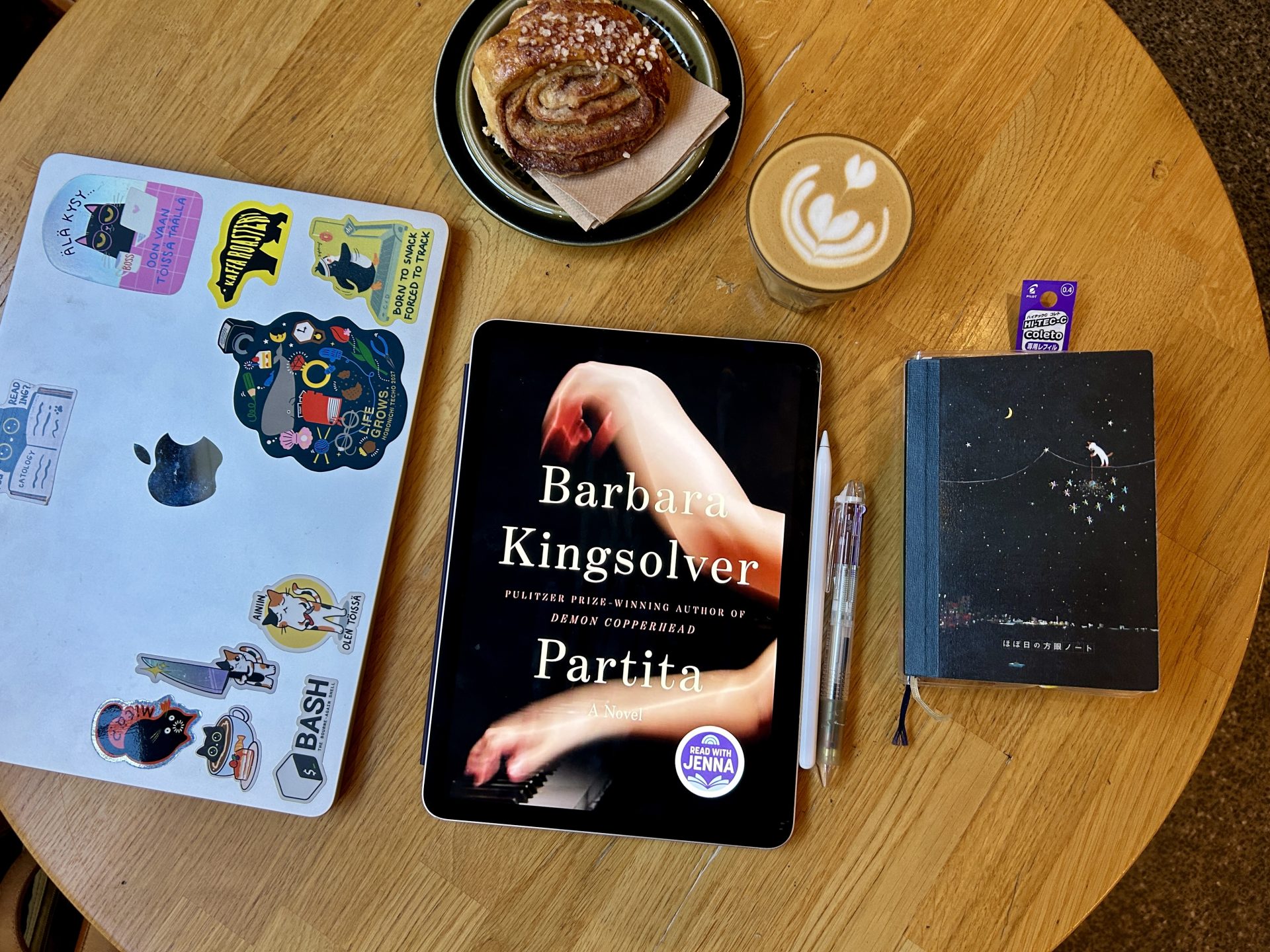
I fell head over heels for Demon Copperhead, so the moment I heard Barbara Kingsolver had a new novel coming out, I knew I had to read it.
Partita is a story of Livia Bohusz, a girl who grows up on a dairy farm in rural east Tennessee. When she is eleven, her brother Cyrus dies, and the loss settles over the family. Her mother turns harsh and cruel, the house goes silent, and Livia learns early how to get by on her own. The one thing that keeps her going is the piano. She practices for hours, pours every feeling into it, and grows into a real prodigy.
A music scholarship to college gives her opportunity to get out of the house. Taking it means leaving the farm and the mother who has always pulled her back, and Livia grabs the chance. She shows up at school with huge dreams. Somewhere on the road to those dreams, she meets Sigurd, a fiery young activist, and falls hard. Their love burns bright and, sadly, doesn’t last long. After he leaves, life keeps handing Livia one heartbreak after another, each one heavier than the last.
Kingsolver tells all of this through grown-up Livia’s eyes. Decades later, she’s Livia Cable, a piano teacher married to a farmer, when Sigurd calls out of the blue and asks to see her. She gives herself a week to decide, and while she thinks it over, the past comes flooding back.
I know next to nothing about music. Before this book, I had no clue what a partita even was; I just knew it sounded beautiful. Luckily, even Sigurd has no idea what a partita is, so Livia has to unravel the mystery for him, and for me along with him.
“When I told him it was a partita, I had to explain then what that is, a composition made of a lot of parts with different
paces and moods. A partita will never be all be happy rondos, or all andantes in a minor key. You’ll usually have a prelude, a thrilling allemande, maybe a slow, sexy sarabande—the contrast is the point. The parts are all different, and the artist’s work is to make them all add up to a something that feels whole.”
The chapters carry the names of musical movements, and Livia’s life plays out the same way, in parts that shift in pace and mood.
The way the story pulled me in reminded me of walking into the ocean from the beach. At first, only my toes were wet. I took my time, wading in step by easy step. Then, without warning, the sand dropped away and I was in over my head. That’s exactly how Partita got me. The opening chapters move gently, and before I noticed, I was completely under.
My favorite parts of the book are the conversations between Livia and Sigurd. They come from such different worlds, and their talks crackle because of it. One scene had me underlining like crazy. The two of them sit in their tiny kitchen over fried egg and tomato sandwiches, and Livia tries once again to describe the unspoken rule she grew up with: people with money and education get to run the lives of everyone who has less, and they might even be God’s favorites. Sigurd won’t have it. As Livia tells us, in his mind “class was not a prison.” He’s sure working people only need someone to show them the power they already hold. He’s kind about her parents’ gloomy acceptance of their lot, apologizes for sounding disrespectful, and admits he doesn’t know much about farming. Then he goes right ahead and files farmers under “petty bourgeoisie,” somewhere between the workers and the owners. It’s funny, tender, and a little maddening all at once, and it sums up their whole relationship over one plate of sandwiches.
That scene ties right into the theme I loved most: art’s place in a person’s life. In an ideal world, art helps us learn, grow, and live fuller lives, and Kingsolver clearly believes it belongs to everyone. Realistically, though, the world doesn’t work that way. Art takes time, money, lessons, and a family willing to let you chase it, and plenty of people never get those things. Livia has the talent, but talent alone can’t pay the bills or erase where she came from. Watching her fight for a place in a world that was never built for farm girls broke my heart a little.
Partita is a slower, more reflective read than Demon Copperhead, and I didn’t mind one bit. If you loved Kingsolver’s last book, if you enjoy character-driven novels about family, class, and lost dreams, or if you’ve ever had to let go of something you loved, please pick this up. And don’t worry if you can’t read a note of music. Neither can I, and I still finished it with a lump in my throat.
My Favorite Bits
- This is what I’d learned in college—people here ranked human worth in units of work overload and sleep-deprived exhaustion.
- I was so used to trying to stay in their narrow zone of approval, I’d lost faith in my own judgment. I did know people could care about worldly matters.
- Home was no place I could have named anymore.
- I would stay here and sort through whatever it was in my plain existence that had fallen so recklessly out of key.
- People change. Tragedy can turn people hard.
- We all accumulate. (..) That we hoard our wishes and our losses, hang onto them for dear life, even if it feels like it’s going to kill us. Even if it actually does.
- If you hate what you’re reaping, you should have tended better to sowing the seed. Where I come from, that’s adulthood. The rock-solid belief you’re living the fate you’ve earned.
- You’re not teaching Dickens so they can write novels. You’re teaching them how to broaden their lives with stories. They’ll have that forever.
- The point of art is to help you like your life better.
- I was the little stray cur, running behind the dumpster and then creeping back out to wonder again and again, What about me?
- When I accused him of being too busy saving the world to wash his own damn dishes, he countered that my apathy was a cop-out. To see the damages of injustice but ignore the work of changing it was perpetration. “If you’re not greasing the skids of this revolution, you’re a rock in its road.”
- Maybe the campus was full of itself, but it offered something precious. A long recess between childhood and adulthood in a playground for our hopes.
- One quote I loved especially: “Religion is the sigh of the oppressed creature, the heart of a heartless world and the soul of soulless conditions.” (..) What a beautiful thing for people to be given: Heart in a heartless world. A soul to see them through it.
- What lay ahead of me was a great emptiness. Namely, the rest of my life. As I weaned myself off the painkillers, I gently pushed my thoughts into that wilderness and it seemed best to leave false hopes at the door.
- They’re too poor to paint and too proud to whitewash.
- “There’s a lot those revolution guys never saw coming.” ”Like?” ”Robots, outsourcing. The knowledge economy taking over, making free trade policies that sent all the unionized jobs overseas, because people like us didn’t matter to the managerial class. We made our turn to industry just in time to watch them kill manufacturing and redirect the whole economy into finance and consulting”
Author: Barbara Kingsolver
Publication date: 6 October 2026
Number of pages: 408 pages
Leave a Reply