
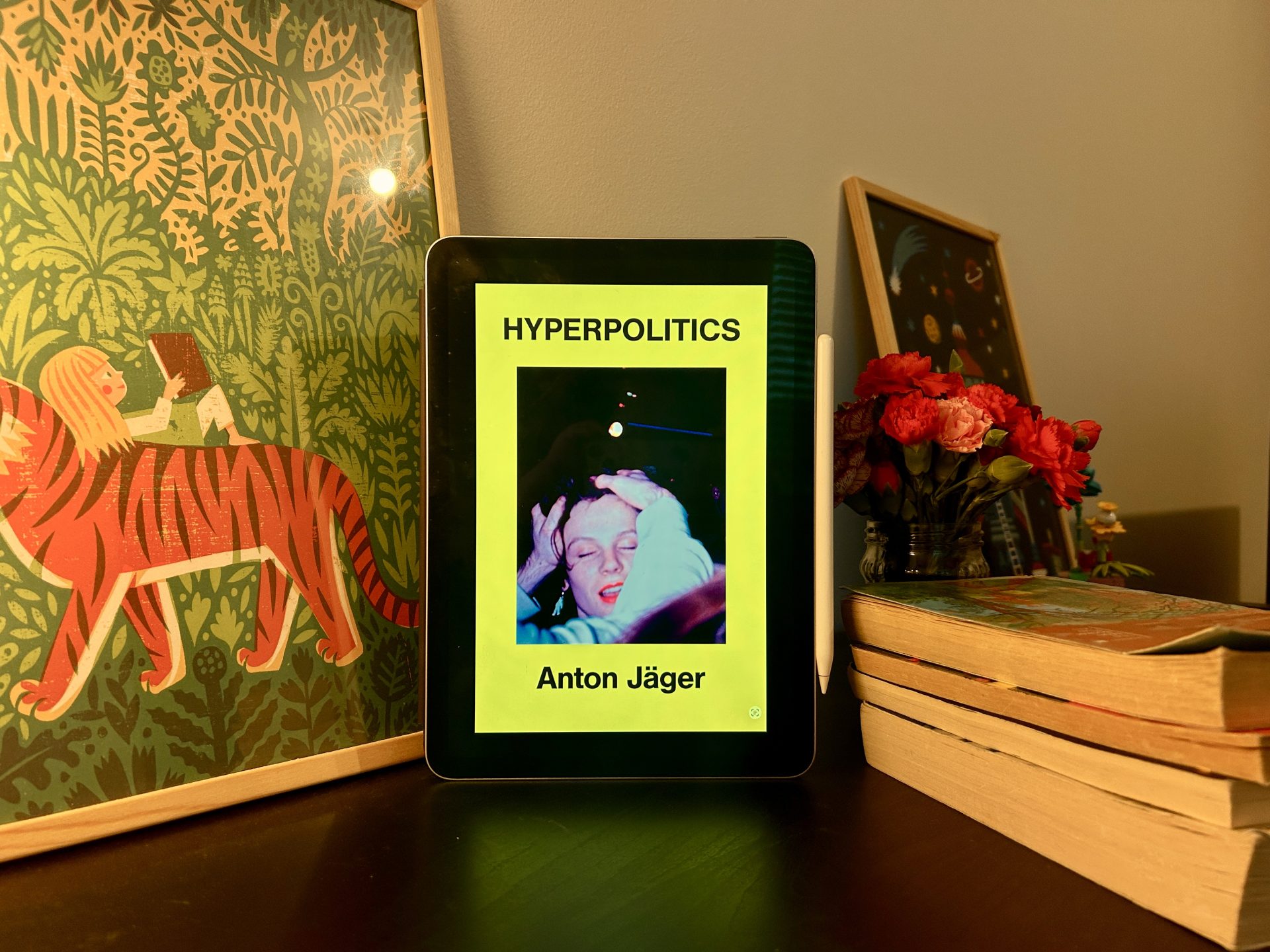
In Hyperpolitics, historian Anton Jäger sets out to define a political condition that shapes the world we live in today. “Hyperpolitics” is the phase that comes after mass politics of the short twentieth century (1914–1989), the postpolitical mood of the long 1990s (1989–2008), and the wave of antipolitics that marked the 2010s.
This book travels across more than four decades of political history. Jäger moves from the ideological battles of the twentieth century to the fragmented and often chaotic online conflicts that dominate our timelines now. His main argument is we live in an age of intense politicization, yet very little structural change follows. Public discourse is louder, faster, and more saturated than ever. Still, real alternatives struggle to form. We are caught in what he describes as an “eternal present” filled with extreme political engagement that rarely produces lasting political consequences.
Jäger explains hyperpolitics that acts like a strong gravitational pull in twenty-first-century politics. To understand it, he invites the readers to step back and look at the longer arc of history. He visualizes political change on a Cartesian plane with two axes: one measuring levels of politicization, the other measuring civic membership and social bonds.
When plotted this way, the years after the 2008 financial crisis show something striking. Political activity, such as voter turnout, protest movements, even political violence, rises. At the same time, civic engagement declines. Traditional forms of belonging weaken. In the era of mass politics, society was highly organized and deeply rooted in clear social groups and ideologies. In contrast, both antipolitics and hyperpolitics grow in a world where social ties are eroding. After the Great Financial Crisis, politics returns with force, especially among parts of the middle class. Yet this renewed energy unfolds in a landscape where collective structures have already thinned out.
Hyperpolitics, in Jäger’s view, reshapes the relationship between public and private life. It is intense and highly polarized. It thrives on speed. It mirrors the fluid and reactive nature of the online world. The boundaries between personal expression and political action blur, often through social media.
Why does this mode of engagement feel so attractive and persistent? Jäger points to deinstitutionalization. Popular participation has seen a resurgence over the past decade, yet involvement through formal institutions has reached historic lows. More people speak up. Fewer people organize through stable, long-term structures.
Online activism has lowered the barrier to entry. Anyone with a phone can jump into the conversation within seconds. That accessibility feels empowering at first. Yet the same openness has also splintered radical politics into scattered fragments. Instead of organized movements with clear direction, we often see loosely connected individuals reacting in real time, forming temporary alliances that dissolve just as quickly.Through our screens, we scroll past waves of emotionally charged content. Algorithms funnel us into narrower feeds, reinforcing what we already believe. Over time, shared spaces for discussion grow smaller. The next viral post demands attention, pushing long-term thinking to the background.
Reading that section reminded me of The Paradox of Democracy by Zac Gershberg and Sean Illing. In that book, they explore how social media reshapes public discourse. It gives everyone a platform, yet it also floods the space with noise, misinformation, and manipulation. The result is a system that amplifies voices while weakening meaningful exchange. Their argument lingers in the mind: democracy contains internal tensions that can destabilize it. The very features that make it open and participatory also expose it to distortion.
I also thought about Superbloom by Nicholas Carr, which examines how digital technology has transformed human interaction. Carr looks beyond communication tools and shows how technology reshapes the way we think, behave, and relate to one another as a society. When placed alongside Jäger’s idea of hyperpolitics, these books form an unsettling trio. They suggest that our digital environment does more than host political debate. It actively shapes the structure and limits of that debate itself.
I have to admit, this was a challenging read for me. Without a formal academic background in political theory, I had to move slowly and reread many passages to fully understand his arguments that most of them are written in theoretical terms. From that experience, I felt there is a noticeable gap between this book and general readers, like me. Jäger relies heavily on theoretical language and technical terms, which can make the ideas feel hard to understand.
Although the book is relatively short in page count, it carries the intellectual weight of a much longer academic study. It asks a lot from its readers, especially those who are not familiar with the field.
Hyperpolitics may not be an easy entry point into political theory, but it offers an insightful framework for thinking about why our current political climate feels so intense, so fragmented, and at times, so stuck.
Author: Anton Jäger
Publication date: 10 February 2026
Number of pages: 128 pages

Leave a Reply