
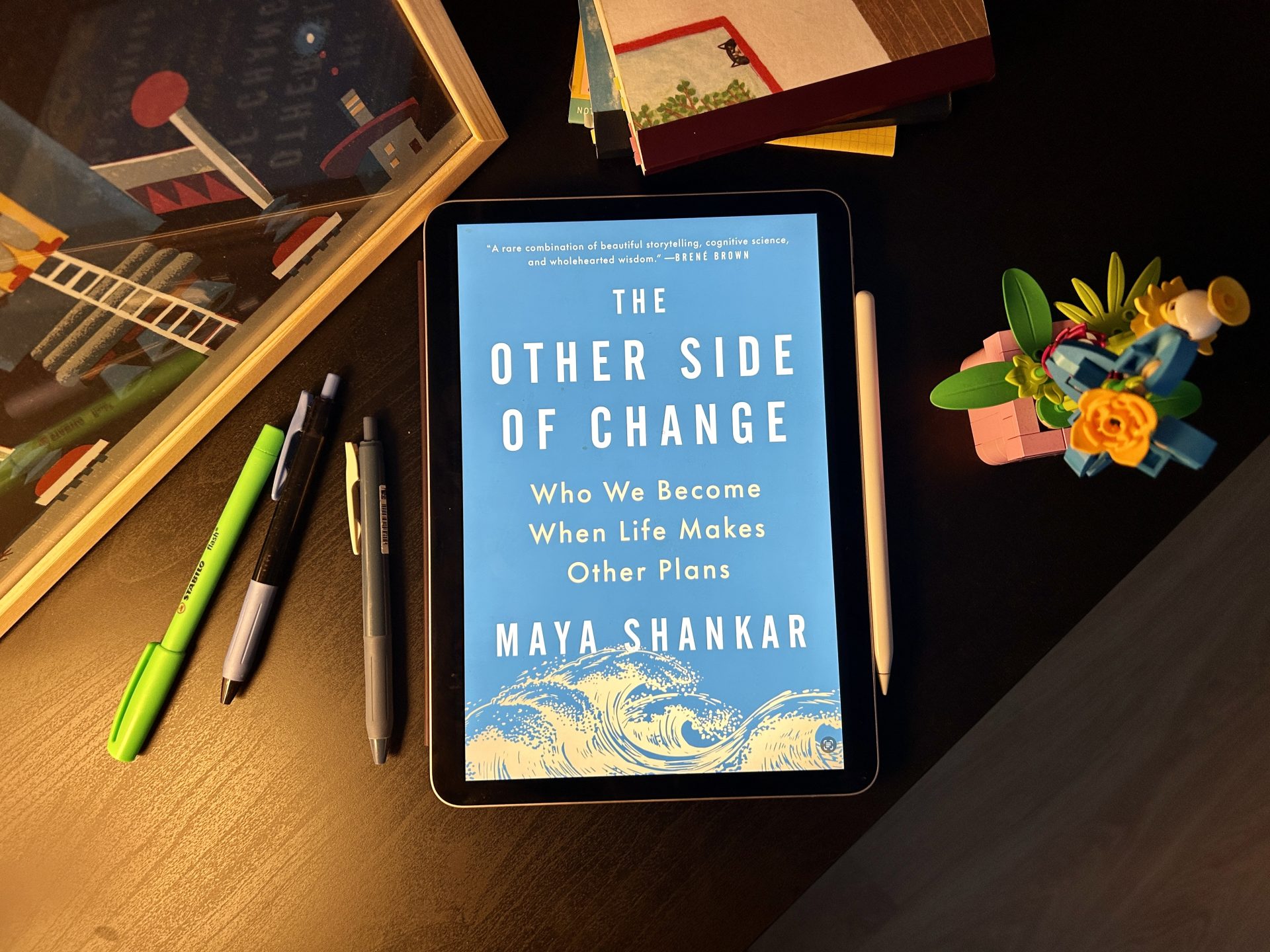
“We can’t control what happens to us, but we can control how we respond.” It’s a cliché life advice we’ve all often heard. The Other Side of Change by Maya Shankar takes that familiar suggestion and gives it more real human faces.
Built on long-form interviews and supported by psychological research, Shankar combines storytelling with science in a seamless and engaging way that is thoughtful. It reads partly like a collection of personal narratives and partly a practical guide for navigating life’s hardest moments. The research is there, but reading them does not like a heavy-lifting reading experience. Instead, it strengthens the emotional core of each story.
The first half of the book focuses on people who are forced to confront painful change. They wrestle with loss of identity, certainty, health, or direction. Their reactions are complicated and sometimes messy, which makes them feel human. Then, the second half shifts the lens outward. It explores how embracing change can reshape not only our inner world but also the way we relate to others and the wider world around us.
Through the stories in this book, we see individuals fall into familiar mental traps and slowly work their way through them. We’re given insight into the tools, perspectives, and shifts in thinking that helped them move forward.
I especially appreciated the nuance in each narrative. The Other Side of Change shows how science and humanity are deeply connected. Research helps explain our struggles, while personal stories remind us that behind every theory is a real person trying to make sense of their life.
Summary
The Illusion of Control: Why We Overestimate Our Influence
We often believe we have more control over outcomes than we actually do. We assume our plans, effort, and decisions are the main forces shaping what happens.
But when something bad happens unexpectedly, that belief can quickly fall apart. Sudden setbacks remind us that not everything is within our control—and that realization can be uncomfortable.
Recognizing this illusion helps us focus on what we truly can influence, instead of clinging to certainty that doesn’t exist.
Denial: A Shield That Protects Us, Until It Doesn’t
Denial appears when our identity feels threatened as well as come from fear, fear that we, or the people we love, don’t have the strength, skills, or resources to handle a difficult change. Sometimes it shows up because we worry about social stigma and how others might treat us.
In some situations, denial can actually help. It gives us a temporary sense of control, hope, and emotional protection. As one idea puts it, denial may be “nature’s way of letting in only as much as we can handle.” Research on heart patients found that those with higher levels of denial had better short-term outcomes during hospitalization, they spent less time in intensive care and reported fewer symptoms.
But this shield has limits. The same study showed that in the long run, high-denial patients were less likely to follow medical advice and were more often rehospitalized. Denial can protect us at first, but if it lasts too long, it may quietly work against us.
Identity: Why Change Feels So Personal
Our identity is often built on many moving parts: our roles, our jobs, our activities, and the communities we belong to. In that sense, identity is contingent. It depends on things that can change.
The problem begins when we anchor our sense of self too tightly to just one role or achievement. If that one thing is threatened or taken away, the impact can feel overwhelming. The stakes seem incredibly high. And that’s when denial can step in as a defense.
Self-affirmation helps soften this blow. When we remind ourselves that our identity is larger than any single role or loss, the threat feels less intense. We become more open to reality because we understand that who we are is not defined by one change alone.
Author: Maya Shankar
Publication date: 13 January 2026
Number of pages: 247 pages

Leave a Reply