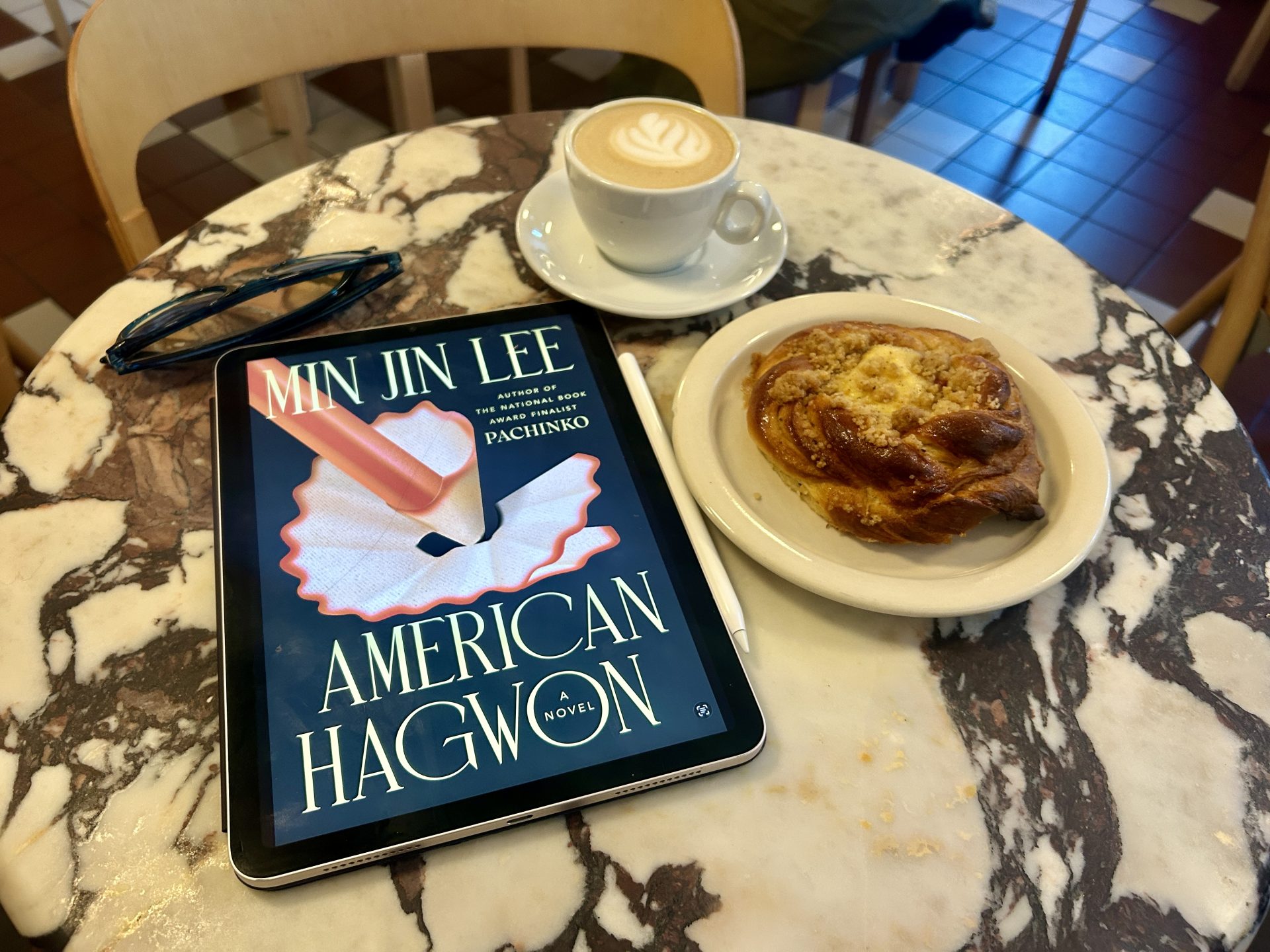
Nearly ten years after Pachinko, Min Jin Lee has returned with American Hagwon, one of the most anticipated releases of the year. Fans of her work have been counting down for this one, me included.
Before the story began, the epigraph had me hooked with James Baldwin’s quote about how a person who starts to become conscious through education starts to question the society that is educating them.
“The paradox of education is this—that as one begins to become conscious one begins to examine the society in which one is being educated.”
James Baldwin
I’m a fan of any book that talks about this issue, so that line felt like a promise of what was coming, and the novel kept it.
American Hagwon follows a Korean family and the way forces far outside their control keep redirecting the course of their lives, often suddenly. The hagwon, the private after-school academy, is the center of the story, along with the cultural pressure to succeed at any cost and the family dynamics surrounding it. Zoom out a little, and the book is really asking how much weight we put on children, and how far parents will push them to produce results from a system that squeezes very different kids into one box.
That box shows up most painfully in Bo’s storyline. He is smart, tough, and willing to work, and he still doesn’t make it into the university he wants. Part of the reason may be on his last try, he was exhausted on test day after helping a neighbor the night before. “All of us believe in you, Bo. We don’t believe in this exam.” That line represents the unfairness of education system. A single test, with a narrow set of values, is deciding what a whole human being is worth. And the book keeps pushing the question further, since even doing well in that system guarantees nothing about how life turns out.
The story is told through many eyes: the kids, the parents, the teachers. Each has their own education background, career, and ideas about building a life across cultures. They are all trying to survive, for themselves as well as for the people they love. Diaspora, immigration, ambition, family values, and education all get a turn, and I’d say each chapter could carry its own book club evening. Cultural differences, attitudes toward learning, and family relationships alone could fill hours of discussion.
The concern about education is what I’ll remember most from this book.These days, so many of us treat education as prestige, scores, and competition. Education should help people grow into thoughtful, independent, ethical adults who can adapt when life changes and keep going when it gets hard. It should give them the tools to tackle real problems, in a classroom and well beyond it. Learning also zigzags along the way, and that’s fine. One speech pushes back on “return on investment” being applied to young humans. It warns that children will chase trophies out of love for their parents, and that even the ones who reach top schools can break down once they arrive. Another line asks parents to remember that “our children should not have to save us.”
As an Asian reader who has lived in several countries and knows the pressure of Korea’s education culture, I wasn’t surprised by the themes Lee raises. They felt personally close. The family drama also reads like a Korean drama, with Danbi playing a big part in sending the family’s life in a sudden new direction.
That brings me to a complaint, which is the length. At more than 500 pages pages, it felt like a K-drama that ran for 50 to 100 episodes and picked up more twists than it needed. Most K-dramas wrap up in about 16 to 20-ish episodes, and I think a shorter version of this book would have been even more charming.
I closed the book thinking about a lot of things: all the issues, all the characters, and where they go from here. I even found myself thinking about the fictional parents and their real-world counterparts. Most of all, I thought about the crisis in education and what education is meant to do, which directly or indirectly affects humanity and civilization.
I recommend this book to anyone who wants a rich story, with layered characters, gripping conflicts, and issues that feel so close to what happens in the real world.
My Favorite Bits
- Now he knew too many children to break down the world into reductive categories of “rich kids are bad,” “poor kids are needy,” and “middle-class kids are normal”—none of that reasoning would suffice in the face of real children who had individual personalities and learning styles. His dataset was too large and varied. He could no longer operate in generalities.
- Remember that unfamiliar is not the same as impossible, or even difficult.
- Sometimes the things you wanted most and still don’t get are terrible things you’ve been delivered from.
- It’s easier to speak when I write my own words. (..) It had never occurred to her before that writing could make talking easier because writing could direct her thoughts and prepare her for when she’d eventually need to say something.
- Sometimes life isn’t fair. It’s harder for poor people to get to the next steps. It’s hard for people in this country. I’ve been lucky.
- I used to think my parents knew everything, but I don’t think they do. I used to think they were so wise. How do you live a wise life, I wonder. Mido, do you doubt your parents, too? They’re more educated than mine are. I wonder if that makes a difference.
- Focusing on outcomes doesn’t help you learn.
Author: Min Jin Lee
Publication date: 29 September 2026
Number of pages: 656 pages
Leave a Reply