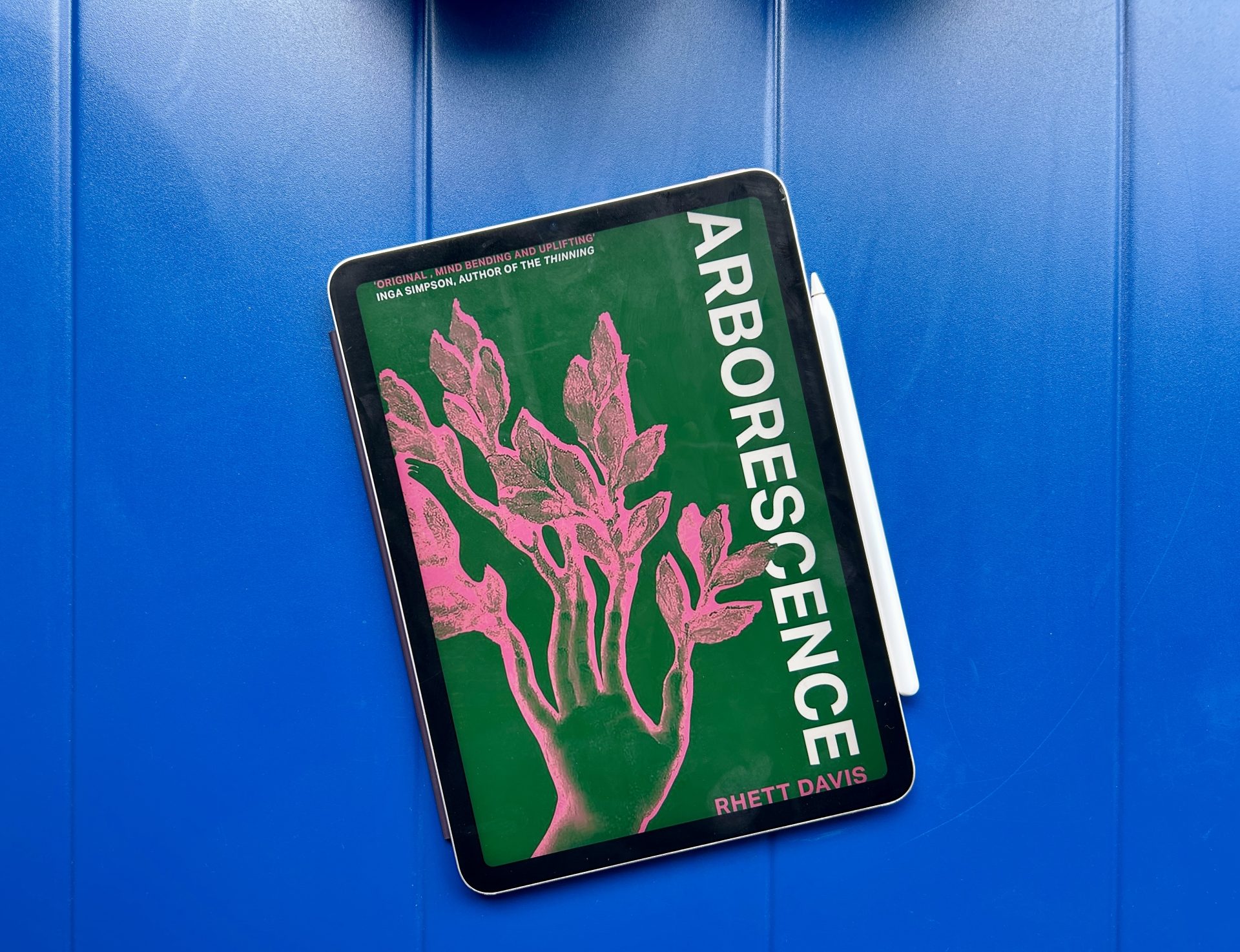
Pulled from Latin, arborescens means “turning into a tree,” and that is literally what this novel about.
Up to now, I’d never read speculative fiction that filters its grim future through the natural world, and Rhett Davis through the story of Arborescence pulled me in with a wild imagination that doubled as a reminder about where Earth is headed.
The story is set in a near-future world that looks much like ours except artificial intelligence has become a dominant employer. We follow our narrator, Bren, who works for an e-commerce site called Queue, a Temu-inspired company with an Orwellian “telescreen” interface. He shows up day after day to an offbeat gig titled “queue liaison” and he’s never met his colleagues, half-suspecting he’s just a cog feeding some artificial-intelligence machine.
We also have Caelyn, Bren’s partner, who drifts between dead-end jobs until a baffling new phenomenon grabs her, and she pours herself into studying it, eventually rising into a world-renowned authority on the subject.
Now for the strange heart of it all. Across the pages, ordinary folks set their sights on physically reshaping their bodies into actual trees. They aren’t a lonely fringe, either. Tiny clusters of believers crop up at home first, then ripple outward until they span continents. The book slides headfirst into the uncanny the moment these dreamers succeed and genuinely sprout roots.
Early on, the whole thing reads as touching, even, a wave of humans willing to surrender their forms to mend a world we’ve battered toward ruin and decay. But as the numbers keep swelling, a bleaker horizon drifts into view. The trees aren’t villains exactly; the trouble is that so many people walk away from being human that society itself begins to buckle. Metropolises crumble back into wilderness. Saplings burst through pavement and crown the rooftops of glittering towers. Those left behind wrestle with confusion, grief, and a world whose systems are quietly falling apart around them. Even as the greening planet hints that this might be the kindest thing that’s ever happened to Earth.
Looking for the ideal season to crack open a story tangled up in machine intelligence, ecological dread, sweeping illness, and planet-wide turmoil? Look no further. You’ll find yourself wrestling with your own convictions about machines, the living world, and whether the two can ever truly belong to the same home.
It’s really about consumption, attachment, and what we’re willing to give up.
My Favorite Bits
- As it turns out, capitalism refuses to die. They come up with all sorts of other names for it, try to claim it’s something else now, something worse. It doesn’t matter what it’s called, she says, momentarily distracted from her crisis. We’ll still eat the earth until there’s nothing left. I wish aliens would invade?
- Whatever it is were doing, there’s little humanity in it.
- What if you don’t need to have cybernetic implants to be a robot, you just have to live in a computer world, which is kind of what we’re doing – you know, like we’re being told what to do by algorithms and stuff. Like with your job. You’re kind of like a robot within a robot.
- I say that I think everything is strange, the entire world is one strange thing that shouldn’t exist, like what are we even doing here at all, how are trees even a thing, what is movement?
- Life, on the other hand, is sneaky. Hidden. It turns up where you least expect it. It flourishes where it shouldn’t. Life will continue. Yes, entropy and death will win here today. But it hasn’t won the war. And you will be remembered, in the signals you have sent out to space, in the atoms you have shed and the energy you have expended. You will not be consumed, you will be transformed. You will find other paths, other ways, other waveforms, other stars, other lives. All is not lost, my friends.
- ..the day we run out of coffee is the day we’ve officially landed in a dystopia. Fucking zombies will be everywhere.
Author: Rhett Davis
Publication date: 15 January 2026
Number of pages: 251 pages
Leave a Reply