
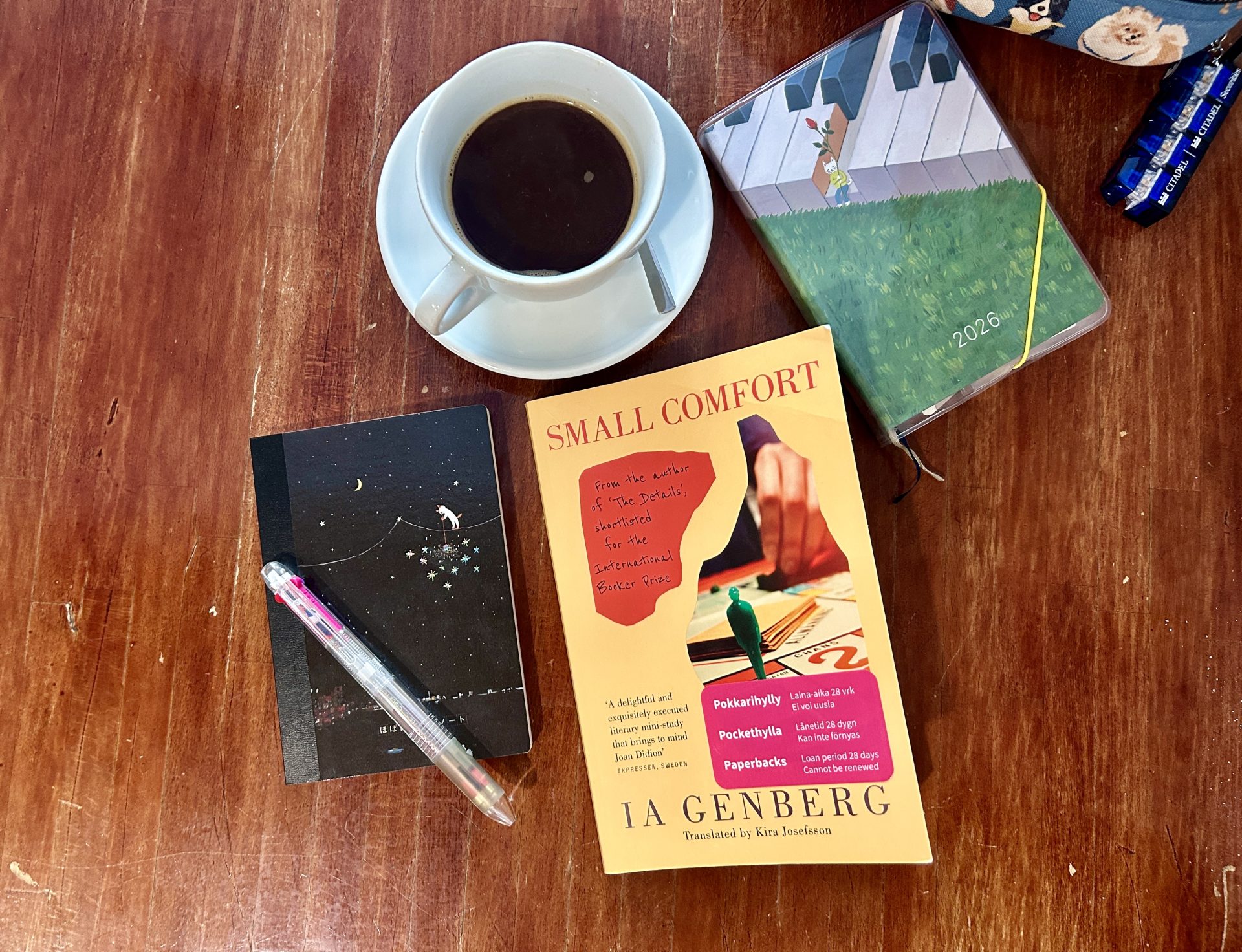
Small Comfort by Ia Genberg is so good that I’m a little annoyed nobody put it in my hands sooner. I finished it days ago and I’m still thinking about it.
Small Comfort is a collection of five interconnected stories, all circling the same subject: money. You travel from a once-successful child actor who’s now a failing thief, to an actor hired to deliver a speech at a stranger’s wedding, to a couple performing wedded bliss so they don’t lose their inheritance. Each story is packaged in a various writing style. One reads like an interview transcript, another is a researcher’s notes, another like a speech with a twist waiting at the end. That shifting format keeps every chapter feeling fresh, and getting bored never really becomes an option.
To make the reading experience better, Genberg absolutely nails the pacing. The stories move at a speed that gives your brain zero downtime to wander off, and yet they never rush you out the door before you’ve settled in with the people on the page. You get room to sit with these characters, to feel them out and being care.
Then there’s how grounded the whole thing feels, which might be the part I love most. Genberg writes the kind of touch-the-grass reality that a lot of us could stand to be reminded of. Simple yet critical things. The sort of truths that get buried under our competitive, sprint-everywhere lives until we forget we ever knew them. And she serves it all with a side of irony, the bitter kind that lands because it’s honest.
There are lines in here that work like little mirrors, held up to society and to yourself at the same time. Take this one:
So you write about happy things in a sad world. (..) And what if that happiness isn’t real? Or if it’s not enough? What if Greger Johnson, the lead character who was promised a bright future full of success and riches, the incredible child actor with the crooked physique, what if his success never came? What if there is a Greger-shaped hole in that successful future, a hole nobody saw unless their attention was drawn to it? What if all that talk about success was, in fact, a little push in the opposite direction?
That hits home for anyone who bloomed early. You know the type, and maybe you are the type: the kid everyone expected the world from. The thing is, life happens. It happens to all of us eventually. And when you’ve been the golden child, the fall tends to land harder, because the gap between the promise and the reality is just that much wider. Then there’s this:
A million kids wanted to be Zlatan and only Zlatan became Zlatan. Everyone else didn’t. They became highway or water engineers, homeless, PR consultants, prematurely retired. They live quiet lives. They remember their dreams with some sense of embarrassment. They don’t like to talk about them. Our lives unfold forever in the shadow of our past dreams.
Oof. Here’s a bitter slice of life that hardly anyone bothers to teach. Most grown-ups won’t go anywhere near it. They live through it, deny it ever happened, and then turn around and hand the next generation the same comforting lie. Genberg just says the thing out loud, and there’s something freeing about reading it on the page.
It tracks that two of my favorite authors have Genberg’s back. Flip the cover over and you’ll spot praise from Fredrik Backman and Hernan Diaz, which feels exactly right. The money-and-society angle pulls me straight to Diaz’s Trust, where he picks apart the long-standing myths around American financial power and the histories that get conveniently buried beneath them. So many stories about wealth and the “self-made man” skip the awkward question of where the money actually came from, and what had to be true for that success to exist at all. Backman, meanwhile, is a fellow Swede who has long made a habit of tucking hard-won life wisdom between the lines of his plots. Genberg belongs in that company.
A few facts worth knowing before you go hunting for a copy. Small Comfort first appeared in Swedish back in 2018, the English translation by Kira Josefsson arrives in 2026, and the book is longlisted for the International Booker Prize.
I’m surprised more people aren’t already talking about it. Small Comfort deserves a far bigger audience. Do yourself a favor, pick it up, and see what Genberg is up to in these pages.
There’s a blurb from Mark Haddon on the cover that sums up my whole experience better than I could: “So good that I kept underlining passages so I could reread them later.” I did exactly that. My pen got a serious workout. Here are some of the lines I’ve gone back to the most:
My Favorite Bits
- What makes you different from one another is luck. Pure chance. The tiniest little things with enormous consequences. And we only look at the consequences when we try to determine how different we are from each other. Otherwise, we wouldn’t able to bear it.
- But I remember that I understood how she was able to write those books. She saw things from below. It’s not about the stories, but the perspective. (..) Because it’s the only way it can be written. Because this kind of thing is always written that way. It’s in the nature of the thing. I’m sure it will be empathetic, thoughtful, sensitive, spot. on, with a few zingers. But from the above. It’s inevitable.
- I’m saying that you can live two kinds of life. One in the general muck of things. And another that’s true. It’s not that one of them is better or happier than the other, that it somehow gives you more points, but one of them is true. The other is not.
- What the revolution might look like now that the poor no longer think about each other or those who are even worse off than themselves. When they think of themselves and themselves only. When thoughts, ideas, dreams about the future, when everything needs to be transformed into money. Since that’s the only currency. Since this is where we are now.
- Merited coincidence. A balanced achievement that came in the right moment.
- Systematic liars are rarely effective in the long term. They end up in prison, they are publicly embarrassed, they have their compulsive relationship to truth mocked and scrutinised. They turn into criminals and losers. Systematic shit-talkers, however, produce the terms that shape the culture; they create a world with no content, only gleaming details, and they can use five loaves of bread to feed five thousand people with nothing but air. Somewhere underneath the shit-talk the listener can sense a promise, which is why we unconsciously gravitate towards the shit-talker and shy away from both the liar and the truth-teller. Moments when we feel familiar and comfortable, when we listen to stories about the world that we like and relate to, when we feel in control—those moments tend to be the ones where we are knee-deep in shit-talk.
- If you try to catch a shit-talker in a lie—if you make the mistake of collapsing the two concepts—you’ll find yourself pulled into a rhetorical epicycle so far from your initial comments that you’ll no longer remember the original question, what inspired it or who was meant to answer. You get to a point where you just want to get out, leave, go home, be comfortable.
- We choose our history, each other. We choose what we remember and what we don’t, what we hold and what we forget. We negotiate with ourselves. We manage our guilt. (..) And I’m thinking about the world and everyone who’s like you. And about the rest of us, who keep silent.
- He votes left, but personally benefits from a right-wing government; he writes about immi-grants, but knows very few of them; he’s got an idiosyncratic way of pronouncing ‘the working class’, the object of many of his studies, in definite form, always definite form.
- No matter how important a scientific finding is, it just flickers by. Nothing’s going to change. People will read something in the news about it, move on to the next thing, and immediately forget about it. We live in a world that doesn’t let itself be affected by the kind of research we do, since the only reasonable conclusion, if we really took our findings seriously, would be some kind of revolution.
- A person who enjoys success within one area believes that this success can be generalised; a sort of universalised victory is attached to the victor, even if the original success was both random and temporary, creating a more self-satisfied attitude and drastically diminished empathy. Behaviour gets orientated towards self-satisfaction, while the most basic social rules are broken, often without the individual noticing.
- The phenomenon of ‘generalised superiority’ can be psychologically explained by the way an experience in one area tends to spill over into other areas that are close in concept or time. (..) This behaviour is based on the tendency to explain success using reasons that are related to the individual’s own capacity, such that even random success (or, as in this case, wealth) is experienced as well-deserved. It’s a pattern that makes success palatable to reason, even as it produces an overestimation of one’s own ability, and an underestimation of other people’s ability. Because success is viewed as well-deserved, the individual feels they deserve other benefits too, e.g. the majority of the cookies on a plate.
Author: Ia Genberg
Publication date: 12 March 2026
Number of pages: 367 pages
Leave a Reply