
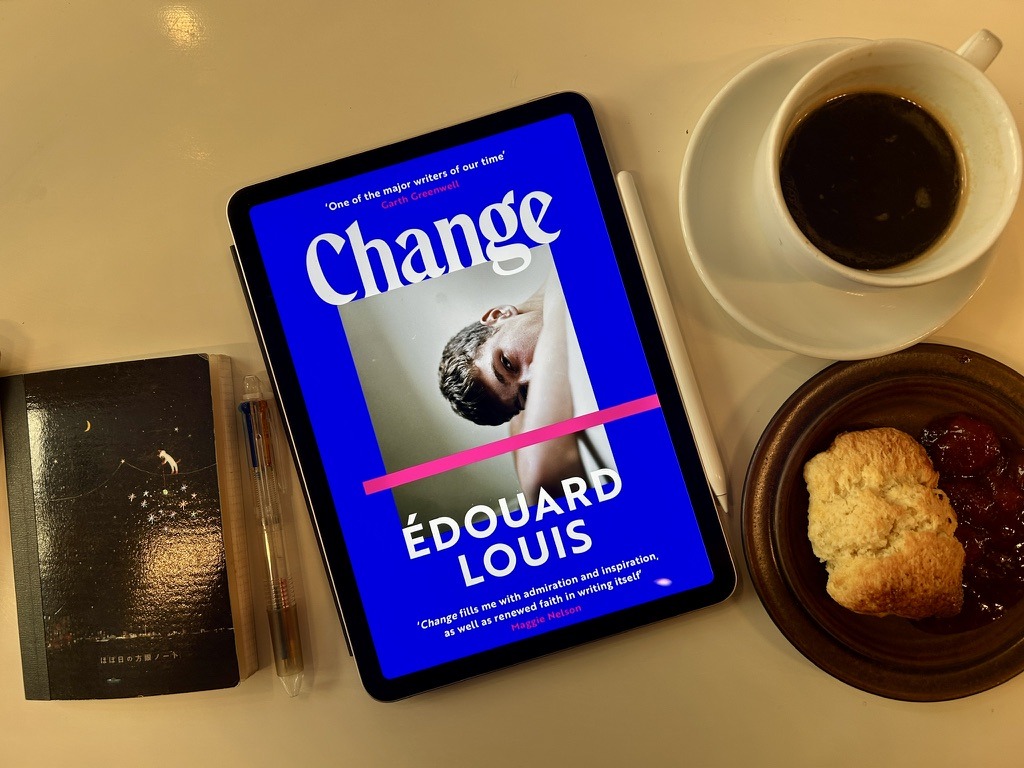
In a globalized era, moving from one place to another has become a common part of many people’s lives. New cities, new countries, new environments. With every move, something inside us also begins to shift. Our personality evolves. Our tastes change. The way we see the world slowly expands as we meet people whose lives look very different from the one we knew growing up. Along the way, we also start noticing the gaps between our past and our present. That realization can bring excitement, but it can also create a deep internal conflict.
Reading Édouard Louis’s Change brought these thoughts to my mind. The book follows Louis’s attempt to reshape his life while carrying the complicated weight of where he comes from. His story traces the transformation of a young man who leaves behind the social world of his childhood and begins navigating spaces that once felt distant and unfamiliar.
The narrative begins with his years in high school and university in Amiens. During this time, Louis encounters the work of French sociologist and writer Didier Eribon, a moment that influences his intellectual path. Through study, literature, and new friendships, he begins imagining a life beyond the limits of his working-class background.
As his world expands, Louis also starts moving closer to the French bourgeoisie. This transition introduces him to new cultural codes and social expectations. One of the main relationships taken in in the story is his friendship with Elena, a girl from a bourgeois family in Amiens. Through her and her family, he experiences a lifestyle that once felt far removed from his own. Their conversations, habits, and environment open a window into a different social universe. Yet the relationship carries moments of discomfort as well, shaped by subtle tensions and unspoken judgments.
The friendship eventually fractures when Louis leaves Amiens for Paris. The move marks another stage in his transformation. Paris offers freedom, opportunity, and the possibility of building a new identity. At the same time, the distance from his past becomes more visible. The journey toward belonging in a different social class brings along feelings of guilt, doubt, and loss.
Throughout the book, Louis returns again and again to a difficult question: how much of a person changes when they build a life far away from where they began? His path toward cultural and intellectual recognition is driven by ambition, yet it also brings up uneasy questions about loyalty, belonging, and what is left behind.
On my first read, I found myself frustrated with Louis’s thoughts and actions. At times, his perspective felt self-centered, especially in the way he spoke about the people he left behind during his transformation. He often frames himself as the perfect victim of his upbringing, and that framing initially made it hard for me to connect with him.
However, looking back at the book with some distance, I began to read this narrative differently. The way Louis tells his story also reveals the mindset shaped by his experiences. As a writer, he does not hide his contradictions or flaws. Instead, he is strikingly direct in showing the perspective of someone shaped by poverty, bullying, ambition, class mobility, and even sex work, treating these experiences with a sense of humanity.
By stirring strong emotions in the reader (which certainly happened to me), the narrative asks us to reflect on the person Louis becomes after his transformation and the complicated sense of entitlement that seems to follow him.
Change tells a deeply human story about social mobility and personal reinvention. It captures the complicated emotions that come with crossing social boundaries and trying to find a place in a world that once felt out of reach.
My Favorite Bits
- Most people would say that my life is ahead of me, that nothing has started yet, but for a long time now I’ve been living with the feeling that I’ve lived too much; I imagine that’s why the need to write is so deep, to fix the past in writing and, I suppose, to get rid of it, or maybe, conversely, the past is so anchored in me now that I’m forced to talk about it, at every moment, on every occasion, maybe it has won out, and by believing I’m getting rid of it I’m only bolstering its existence and its ascendency over my life, maybe I’m trapped – I don’t know.
- I grew up in a world that rejected everything I was, and I experienced that as an injustice because – as I repeated to myself a hundred times a day, to the point of nausea – I didn’t choose what I was.
- It wasn’t not being chosen that hurt, but being seen by the others as the one who hadn’t been chosen.
- I internalised the rhythm of this silence, its necessity, in my body, every day. It became a part of my biorhythm, something I’d never experienced because such a silence had never existed at home.
- I write because I think that sometimes I regret having distanced myself from the past, sometimes I’m not sure that my efforts came to anything. Sometimes I think that the whole struggle was in vain, and that in escaping I fought for a happiness I never obtained.
Author: Édouard Louis
Publication date: 5 March 2024
Number of pages: 256 pages
Leave a Reply