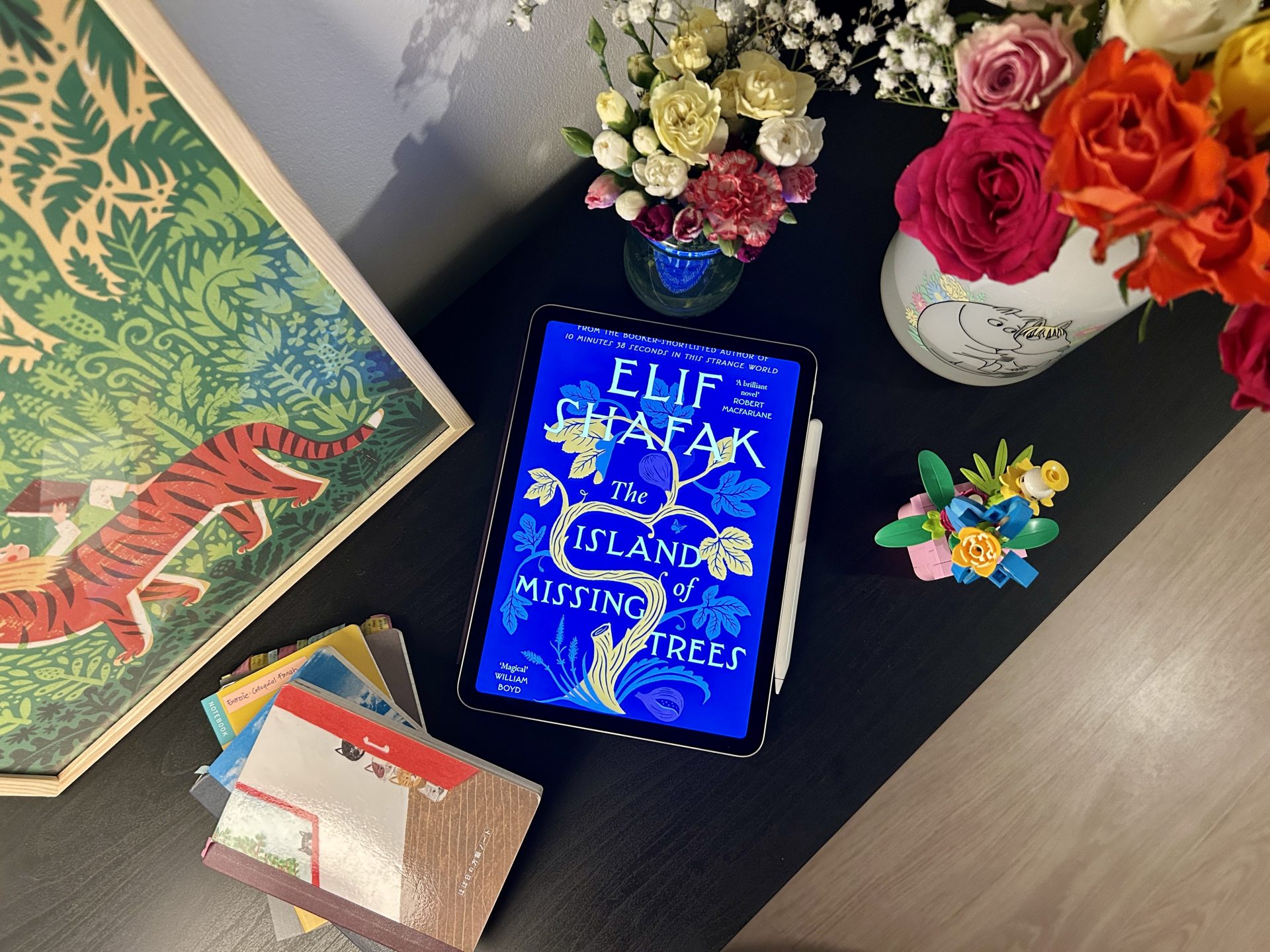
The Island of Missing Trees is the third book by Elif Shafak that I’ve read, and by now I thought I would recognize her patterns. Because, usually, when I read several works by the same author, I begin to sense where the plot might lead. With Shafak, I never do. The only consistent thread is her gift for building layered characters with strong, distinct personalities. The direction of the story always surprises me in a satisfying way.
The novel moves between Cyprus in the 1970s and London decades later. The main plot is a forbidden love story set against the backdrop of the island’s political unrest and eventual partition. If you are unfamiliar with Cyprus’s turbulent history, this book gives a human way to approach it. Through intimate family narratives, we see how war fractures communities, how religion and politics divide neighbors, and how migration reshapes identity. The historical context lives and breathes through the characters’ choices, losses, and longings.
And then there is the fig tree, one of the most unusual and unforgettable narrators I’ve encountered.
I never imagined I would become emotionally attached to a tree in a novel. Yet Shafak writes the fig tree with such care that it becomes a witness, a keeper of memory, and a symbol of endurance. The tree observes human love and violence. It travels across borders. It survives.
“I wish I could have told him that loneliness is a human invention. Trees are never lonely… With their roots tangled and caught up underground, linked to fungi and bacteria, trees harbour no such illusions. For us, everything is interconnected.”
I was kinda touched in the part where the fig said that part above. Having read nonfiction about tree communication (like The Wisdom of Trees and The Hidden Life of Trees) and underground fungal networks (such as Entangled Life), I immediately recognized the science behind this idea. Seeing it come alive through fiction suddenly lit up something in my brain. The tree is not merely symbolic. It reflects a truth about interconnectedness of how lives remain entangled even when history tries to sever them.
Kostas’s careful tending of the fig tree adds another emotional layer. His devotion to preserving it mirrors his attachment to the homeland he left behind. The act of nurturing the tree becomes an act of preserving memory. Roots matter. So do the branches we graft when we begin again somewhere new.
The Island of Missing Trees explores displacement, grief, inherited trauma, and the search for belonging. It also holds space for tenderness, for young love, and for hope that persists through generations. The structure shifts across timelines, allowing the past to echo into the present. Love and loss exist side by side. So do destruction and renewal.
My Favorite Bits
- What I lack in beauty and popularity, I make up for in mystery and inner strength.
- People assume it’s a matter of personality, the difference between optimists and pessimists. But I believe it all comes down to an inability to forget. The greater your powers of retention, the slimmer your chances at optimism. (..) It is a curse, an enduring memory. (..) So I guess it is in my genes, this melancholy I can never quite shake off. Carved with an invisible knofe into my arborescnet skin.
- As you aged, you cared less and less about what others thought of you, and only then could you be more free.
- The human species’ appetite for novelty is insatiable and I’m not sure it does them much good.
- Her anger softened into sorrow, and sorrow into resignation, and resignation into a sense of numbness, swelling thickly, filling the emptiness inside.
- Because that is what migrations and relocations do to us: when you leave your home for unknown shores, you don’t simply carry on as before; a part of you dies inside so that another part can start all over again.
- In all the myths and fairy tales, a woman who breaks social conventions is always punished. And usually the punishment is psychological, mental. Classic, isn’t it?
- Life below the surface is neither simple nor monotonous. The subterranean, contrary to what most people think, is bustling with activity. As you tunnel deep down, you might be surprised to see the soil take on unexpected shades. Rusty red, soft peach, warm mustard, lime green, rich turquoise … Humans teach their children to paint the earth in one colour alone. They imagine the sky in blue, the grass in green, the sun in yellow and the earth entirely in brown. If they only knew they have rainbows under their feet.
- Wisdom consists of ten parts: nine parts of silence, one part of words.
- Even so, based on personal experience, I can tell you one thing about humans: they will react to the disappearance of a species the way they react to everything else – by putting themselves at the centre of the universe.
- Humans are strange that way, full of contradictions. It’s as if they need to hate and exclude as much as they need to love and embrace. Their hearts close tightly, then open at full stretch, only to clench again, like an undecided fist.
- There is one thing I have learned: wherever there is war and a painful partition, there will be no winners, human or otherwise.
- The cruelty of life rested not only in the injustices, injuries and atrocities, but also in the randomness of it all
Author: Elif Shafak
Publication date: 5 August 2021
Number of pages: 354 pages
Leave a Reply