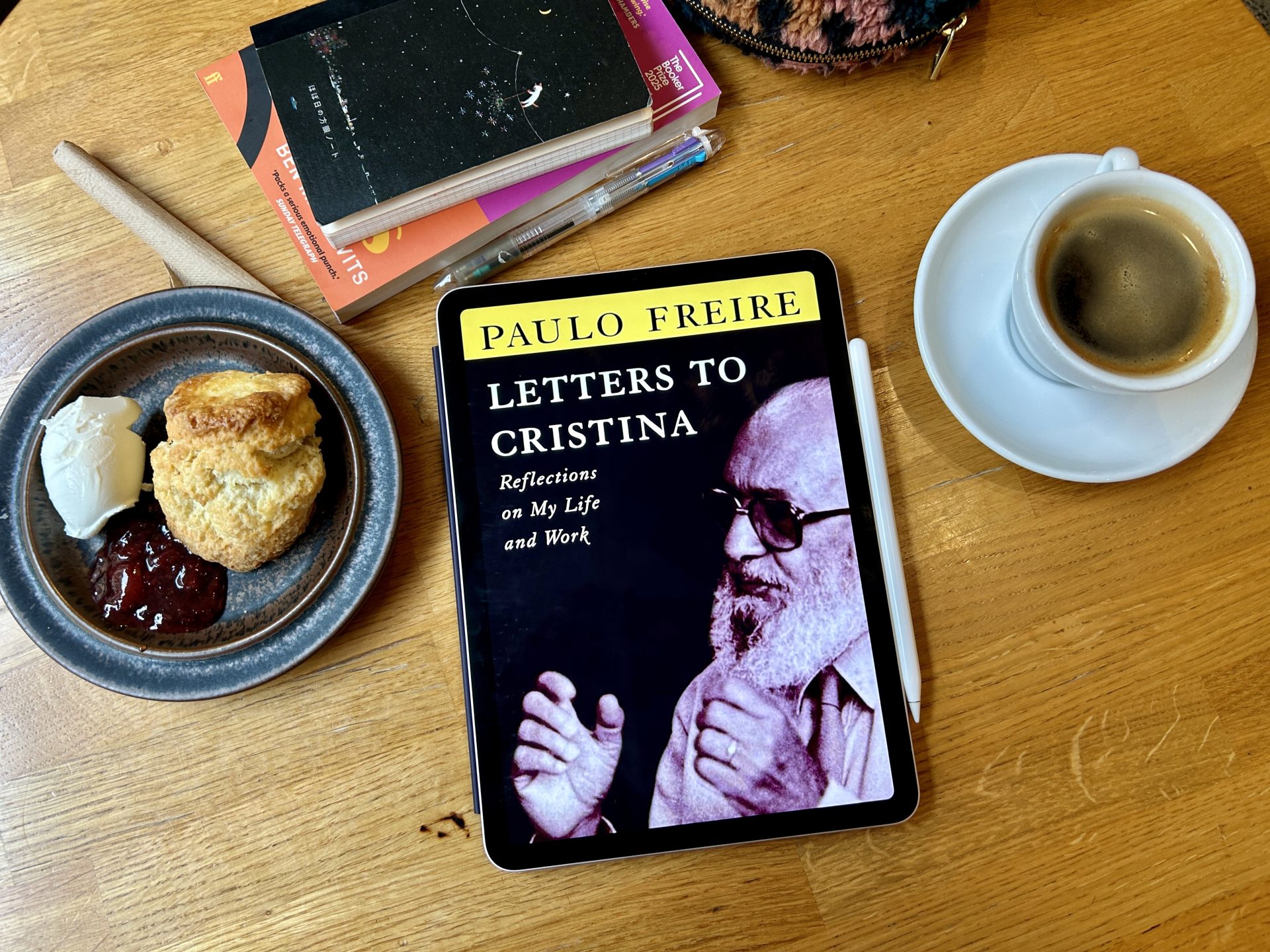
Letters to Cristina is a series of letters written by Paulo Freire addressed to his niece, Cristina, and through these letters he reflects on his childhood in Northern Brazil, his intellectual journey, and the ideas that shaped his work.
I read this alongside Pedagogy of the Oppressed and I could sense the “behind the scene” of Freire’s thoughts, even, at some point, his deeper thoughts. That well-known theoretical of Freire’s work suddenly gained a personal backdrop. I could see how his early experiences in Brazil shaped his views on education, democracy, and social transformation. Concepts such as conscientization, utopia, “reading the word,” and critical awareness felt less abstract. They were rooted in lived experience.
Freire writes with the intention that a young person can understand him. That choice itself reflects his pedagogical practice. He teaches even through the act of writing. He realized that these letters carried more than private reflections. They traced the development of his educational practice over the years. Collecting and publishing them became a way to document both his personal growth and the evolution of his thinking.
Beyond memoir, this book also lays out several core principles of education that Freire consistently returned to. He emphasizes the importance of pedagogical space, the environment where learning takes place. Education is shaped by context, relationships, and atmosphere.
He also speaks about the existence of subjects in education: educators and learners. They are not identical in role, yet both are active participants in the learning process. Education is relational.
Freire underlines the importance of content, or the object of knowledge. Since educational practice is cognitive by nature, it requires something to know, question, and reflect upon. Learning always revolves around an object of understanding.
He insists that education is always directed toward a goal. It carries a dream, an image of a different future. In other words, education is inseparable from a sense of utopia.
And finally, Freire argues that education can never be neutral. There is no such thing as an “asexual” or value-free educational practice. Every educational act carries assumptions, values, and political dimensions.
I was already drawn in from the foreword where Freire’s reflections on why writing mattered so deeply to him set the tone for the entire book. Writing, for him, was part of thinking, part of teaching, and part of becoming.
Letters to Cristina reads like both an intellectual autobiography and an accessible guide to his philosophy. If Pedagogy of the Oppressed presents the architecture of his ideas, this book reveals the soil they grew from.
My Favorite Bits
- To read what I have written makes it possible for me to improve what I have already written, while stimulating me and animating me to write what I have not yet written.
- I do not write simply because it gives me pleasure. I write because I feel politically committed, because I would like to convince other people, without lying to them, that what I dream about and what I speak about and what causes me to struggle are worth writing about.
- When we write, we cannot ignore our condition as historical beings. We cannot ignore that we are beings inserted into the social structures in which we participate as objects and subjects.
- Whenever people are asked about their professional background, they tend to answer by emphasizing their academic preparation. Rarely do people take into consideration their more existential experience.
- To be radical without becoming sectarian. To be strategic without being cynical. To be skillful without becoming opportunistic. To be ethical without becoming puritanical.
Author: Paulo Freire
Publication date: 19 June 1996
Number of pages: 268 pages

Leave a Reply