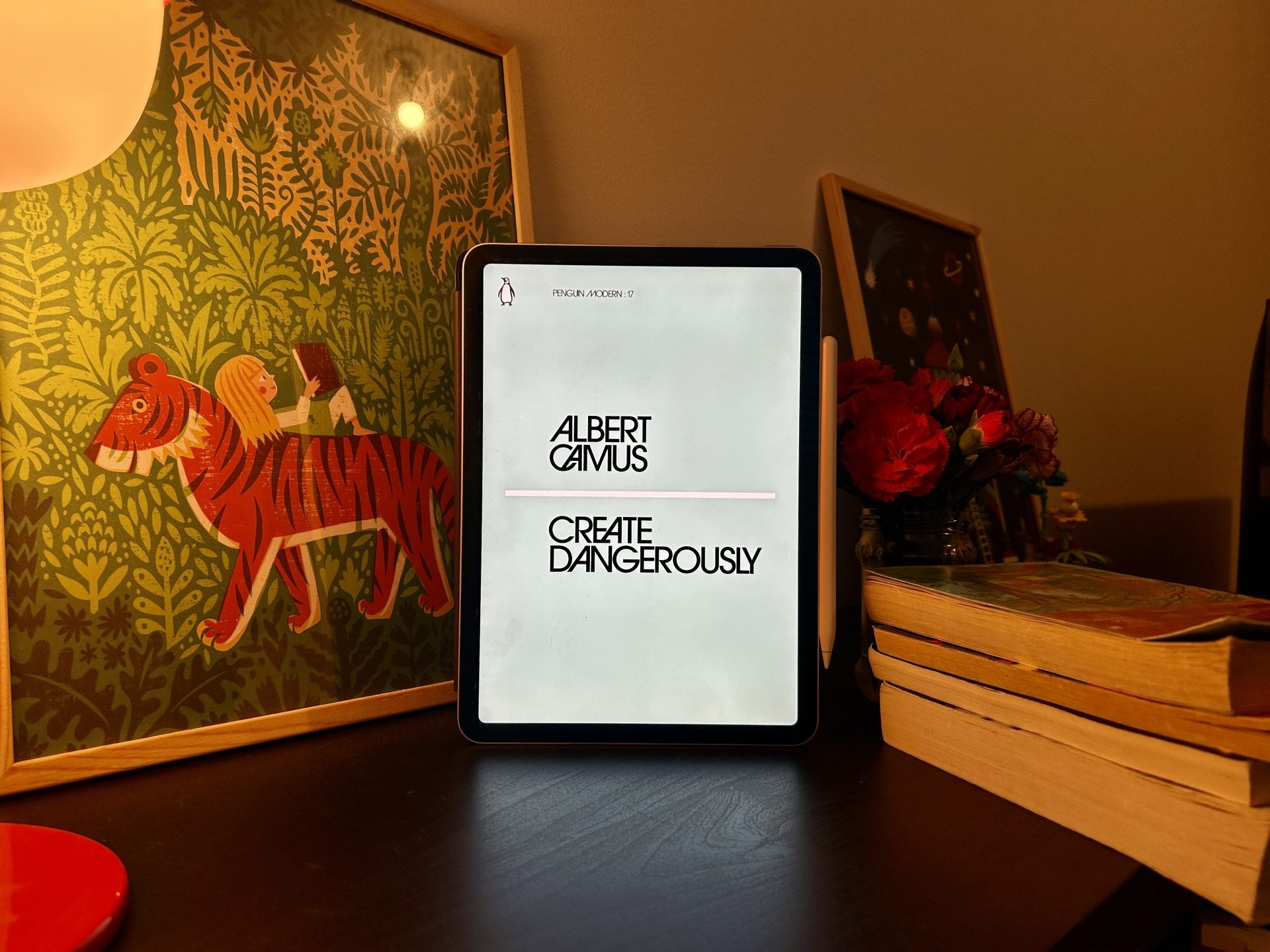
I have a love-and-hate relationship with Camus’ work, though love wins most of the time. His works always find a way to push me as a reader. His ideas can be tough to digest, and I often reach that point where I think, why am I doing this to myself? Still, I keep going because his writing carries a strange pull. It rattles my certainty, rearranges my thoughts, and leaves me seeing the world a little differently. That mix of challenge and clarity is exactly why I come back to his books (my favorite is The Stranger, also known as The Outsider). And yes, I fell into the same reading experience again with Create Dangerously.
Create Dangerously comes from the 1950s, when artists were trying to breathe again after the shadow of fascism, while also facing new pressure from the Soviet Union’s demands for “social realism.” Camus writes straight into that atmosphere, and he keeps returning to one urgent question: what does it mean to create freely when politics, fear, and public opinion keep closing in?
He claims that society’s hatred of art stays strong partly because artists help keep it alive. He talks about the doubt artists carry, such as how it is about feeling like your words might be pointless when the world is full of suffering. In his view, the modern artist can feel like they’re “lying” if they create without acknowledging history’s pain. Meanwhile, mass society grows louder and harder to ignore, making it even more difficult for artists to work in peace or privacy.
Camus seems especially focused on the tense relationship between the artist and the public. Art no longer belongs to a small circle. It has to exist in a crowded space shaped by trends, politics, and pressure to “take a side.” He describes a world where an artist is pushed toward two uncomfortable paths: creating work that serves a cause, or getting pulled into popularity and dilution. Either way, the freedom to create starts to feel fragile. The era of artistic isolation fades, because the crowd is always present now.
Reading this in 2026 felt almost unsettling. The language comes from another time, yet the themes land right where we live: propaganda, consumer culture, class divides, and the way capitalism can drain our attention until art feels like a luxury we’re too exhausted to reach for. I didn’t expect a speech from 1958 to feel so current, and that surprise kept me turning pages in between the complicated and challenging words of Camus.
Create Dangerously is definitely not an easy and light read (event though it is less than 100 pages). However, the way it asks you to take art seriously again as something tied to freedom, responsibility, and courage are more than a good reason for you to read this book. If you’ve ever felt frustrated by the world and wondered what place creativity can still have inside it, this one is worth picking up.
My Favorite Bits
- If they speak up, they are criticized and attacked. If they become modest and keep silent, they are vociferously blamed for their silence.
- Today everything is changed and even silence has dangerous implications.
- To create today is to create dangerously. Any publication is an act, and that act exposes one to the passions of an age that forgives nothing. Hence the question is not to find out if this is or is not prejudicial to art. The question, for all those who cannot live without art and what it signifies, is merely to find out how, among the police forces of so many ideologies (how many churches, what solitude!), the strange liberty of creation is possible.
- The most misrepresented value today is certainly the value of liberty. Good minds (I have always thought there were two kinds of intelligence—intelligent intelligence and stupid intelligence) teach that it is but an obstacle on the path of true progress. But such solemn stupidities were uttered because for a hundred years a society of merchants made an exclusive and unilateral use of liberty, looking upon it as a right rather than as a duty, and did not fear to use an ideal liberty, as often as it could, to justify a very real oppression.
- There is no need of knowing whether, by pursuing justice, we shall manage to preserve liberty. It is essential to know that, without liberty, we shall achieve nothing and that we shall lose both future justice and ancient beauty. Liberty alone draws men from their isolation; but slavery dominates a crowd of solitudes. And art, by virtue of that free essence I have tried to define, unites whereas tyranny separates.
- “Let us rejoice.” Let us rejoice, indeed, at having witnessed the death of a lying and comfort-loving Europe and at being faced with cruel truths. Let us rejoice as men because a prolonged hoax has collapsed and we see clearly what threatens us. And let us rejoice as artists, torn from our sleep and our deafness, forced to keep our eyes on destitution, prisons, and bloodshed. If, faced with such a vision, we can preserve the memory of days and of faces, and if, conversely, faced with the world’s beauty, we manage not to forget the humiliated, then Western art will gradually recover its strength and its sovereignty.
- The freedom of art is not worth much when the only purpose is to assure the artist’s comfort. For a value or a virtue to take root in a society, there must be no lying about it; in other words, we must pay for it every time we can. If liberty has become dangerous, then it may cease to be prostituted.
Author: Albert Camus
Publication date: 14 December 1957
Number of pages: 58 pages

Leave a Reply