
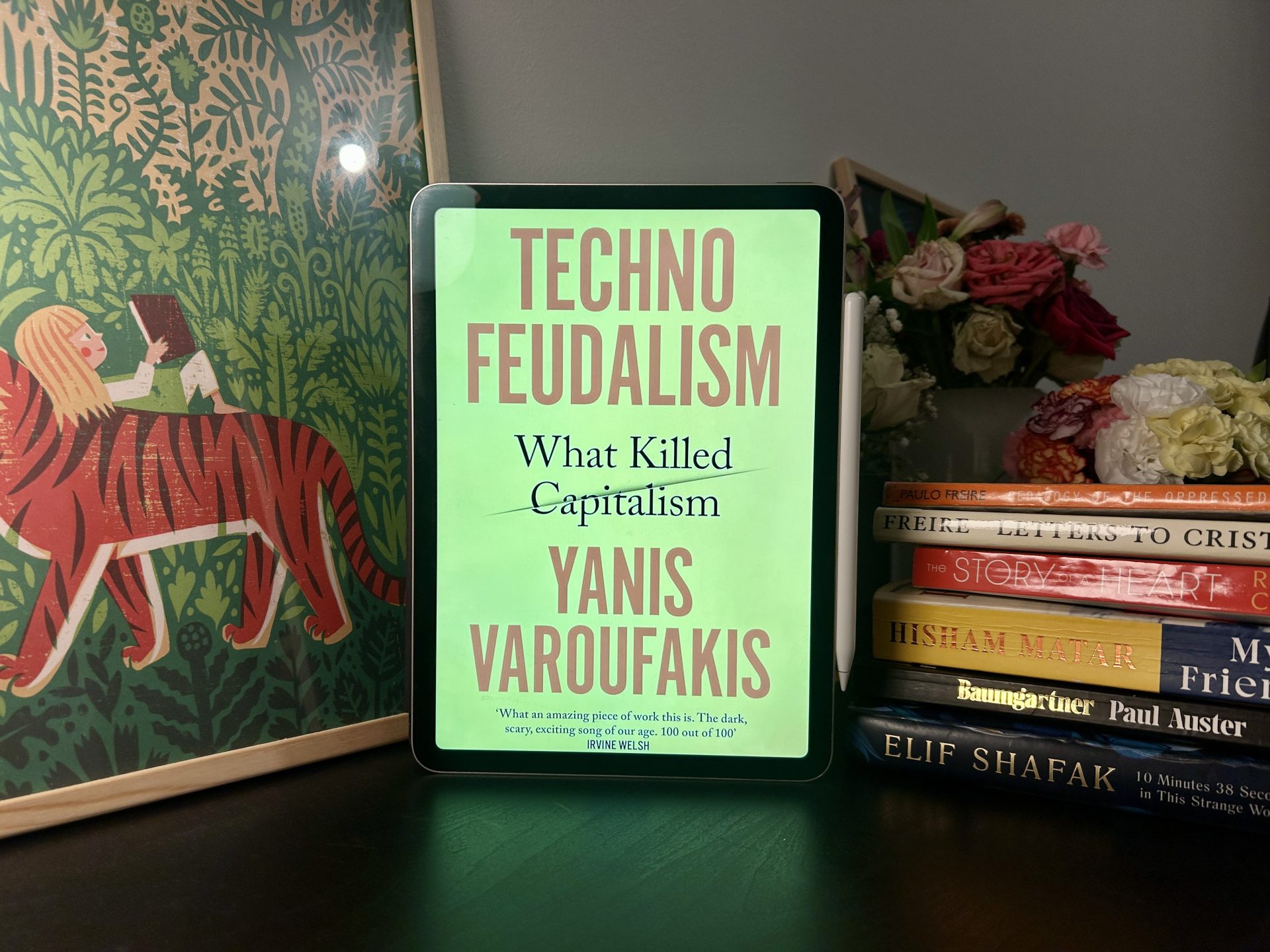
Yanis Varoufakis opens Technofeudalism with a claim: capitalism, as we understand it, has already ended. In its place stands a new system that feels strikingly similar to the feudal order of Medieval Europe. He calls it technofeudalism. So basically, capitalism itself doesn’t end. It transforms.
According to Varoufakis, traditional capitalism, which is built on market competition and profit, has been gradually displaced by what he names cloud capital. This transformation accelerated with the rise of the internet and deepened after the 2008 financial crisis, when governments and central banks reshaped the global economy in ways that strengthened large digital and financial powers.
The center of this new system are Big Tech platforms. These companies no longer simply participate in markets; they structure the space in which economic life unfolds. Shopping, communication, entertainment, mobility, even parts of governance now pass through digital infrastructures owned by a handful of firms. Economic activity flows through their platforms.
The logic has shifted as well. Innovation and competition no longer sit at the core. Instead, access does. Users and businesses pay fees, either directly or indirectly, to enter and operate within digital environments controlled by platform owners. These spaces function more like private estates than open marketplaces, governed by algorithms and enforced by code.
Varoufakis also traces this shift back to capitalism’s long history of turning shared or experiential aspects of life into commodities. Over time, more and more spheres of human activity were assigned prices. In the digital age, even attention, data, and online behavior have become sources of extraction.
Reading this from the perspective of someone without formal background in economics, I found the book as an attempt to name current complicated condition many people sense but struggle to define. The term “technofeudalism” offers a framework for describing the dominance of digital platforms in everyday life.
At the same time, the book has sparked debate. Some economists and scholars question whether the concept overstates the break from capitalism or repackages existing ideas under a striking new label. Whether one agrees with Varoufakis or not, the argument invites readers to rethink the economic system shaping their screens, their work, and their daily routines.
Summary
How Big Tech and the 2008 Crisis Reshaped Modern Capitalism
Capitalism has mutated. Over the past two decades, a new form of capital has emerged, more powerful and more dominant than traditional industrial capital. Instead of factories and machines, this new capital is rooted in digital platforms, data, and financial systems.
Two key developments drove this shift. First, the privatization of the internet placed enormous power in the hands of American and Chinese tech giants, turning data and online behavior into major sources of profit. Second, Western governments’ response to the 2008 financial crisis, through bank bailouts and large-scale money creation, stabilized the economy but further strengthened financial concentration and corporate dominance.
Together, these forces transformed capitalism into a new system, one increasingly driven by digital control and financial power rather than traditional production.
When Attention Became a Commodity
The struggle to capture attention is ancient. From a peacock spreading its feathers to emperors staging grand parades, humans and animals have always competed to be noticed. Attention has long been tied to survival, attraction, and power.
What changed in the twentieth century was this: attention became something that could be sold.
With the rise of commercial television, a new market emerged alongside the labor market: the attention market. Shows themselves had cultural and entertainment value. People watched them for enjoyment. But what truly generated profit was not the content. It was the viewers’ attention.
This created a dual structure. On one side, there was the spectacle as an experience, meaningful and engaging, but not directly tradable. On the other side, there was captured attention, measurable, sellable, and highly valuable in the marketplace.
From that moment on, attention became an economic asset.
From Capitalism to Cloud Feudalism
Capital has evolved into what can be called cloud capital and this shift has weakened the two core pillars of capitalism: markets and profit.
Over the past twenty years, traditional markets have slowly been pushed aside. In their place stand massive digital platforms. They may look like markets, but they do not function like open spaces where buyers and sellers freely compete. Instead, they operate more like private territories, controlled environments governed by platform owners.
Profit has also changed form. Rather than earning primarily through producing goods and competing in markets, dominant firms now extract rent. This “cloud rent” is the price paid for access: access to platforms, data, digital infrastructure, and the online spaces where economic life now happens.
As a result, economic power has shifted. Owners of factories, machines, and industrial infrastructure still make profits, but they no longer sit at the top. They depend on digital platforms to reach customers and operate efficiently. In this new hierarchy, the true power lies with the owners of cloud capital.
We contribute not only through paid work as well as unpaid digital activity, such as our data, attention, clicks, and content, strengthening the wealth of this new ruling class.
Author: Yanis Varoufakis
Publication date: 1 January 2023
Number of pages: 224 pages

Leave a Reply