I believe a lot of the chaos in the world begins with a mistake in how we slowly changed our view of education. Learning has become strongly tied to exams, degrees, and job security. Somewhere along the way, the deeper purpose of education started to fade.
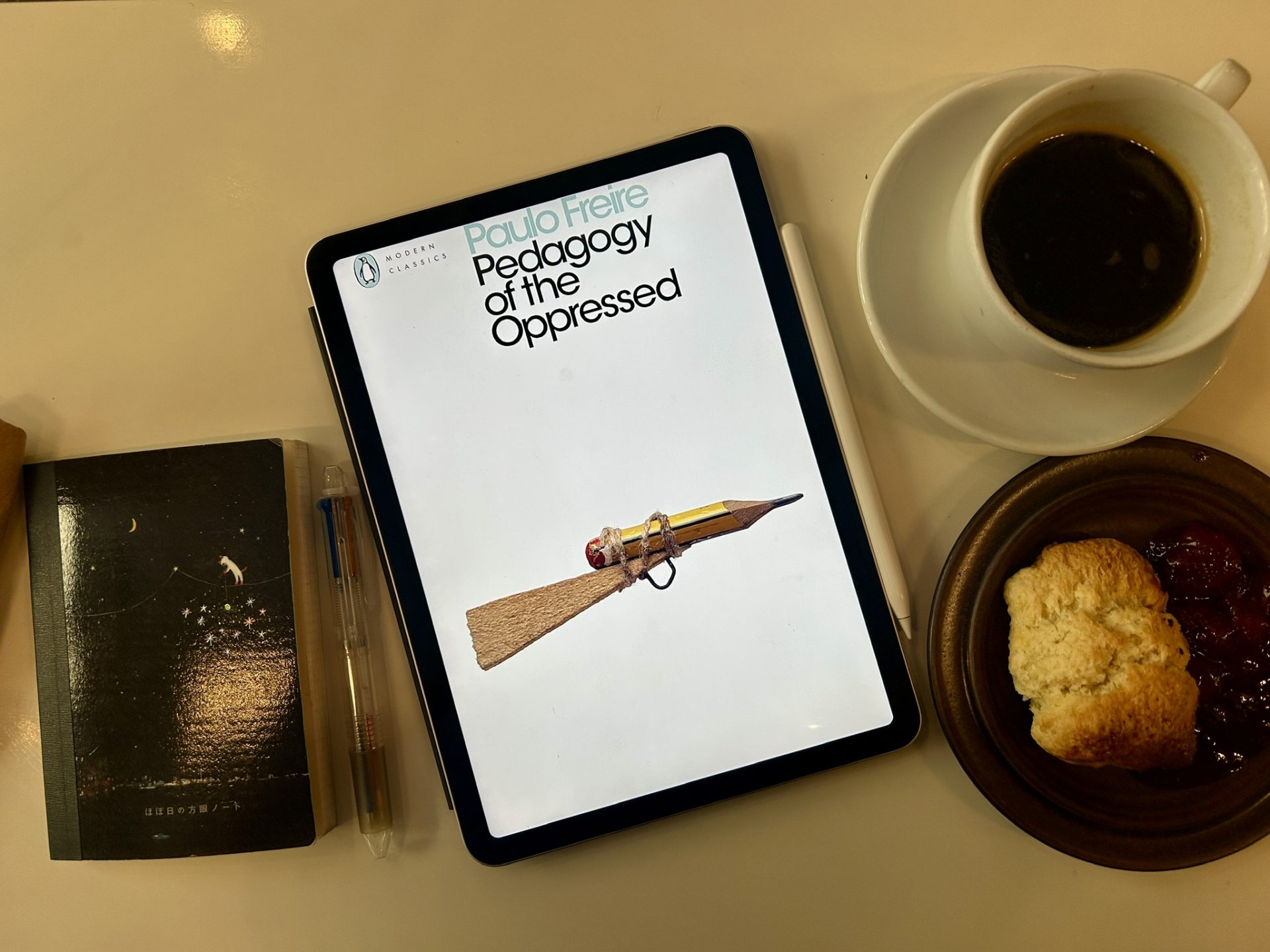
Reading Pedagogy of the Oppressed made me think about somewhere along the way, education started to lose a deeper purpose. We forget that learning is about how to improve the world, strengthen our humanity, and make space for voices that are often pushed aside.
Pedagogy of the Oppressed grew out of Paulo Freire’s years in political exile, shaped by the lessons he gathered from both displacement and his earlier educational work in Brazil. That context gives the book a strong sense of urgency. It feels rooted in lived experience.
Freire’s ideas keep returning to that deeper meaning of education. To be educated, in his view, is not simply to collect information. It is to think for ourselves, communicate clearly, question the world around us, and become better at listening as well as speaking. It is also about developing the courage to hold opinions and reflect on them critically.
Freire believes that education helps people reclaim their voice. He writes about each person winning back the right to say their own word and to name the world, especially when he describes illiterate peasants discovering a new sense of self through learning. Their responses are touching because they show education as awakening, dignity, and possibility. In those moments, learning becomes something alive. It helps people see themselves differently and gives them hope that they can take part in shaping their own lives.
Unfortunately, in my view, Freire’s ideas are so idealistic that most probably difficult to apply in practice. Even so, I think that idealism has value. It gives energy to the possibility of change, even if that change begins with nothing more than recognizing that something in our education system is wrong and have to be fixed.
This is also one of those books that asks to be read slowly. The language can be demanding, and nearly every page pushes you to rethink your assumptions about education and the way modern society treats it. It is challenging in both style and substance, yet that challenge is part of why the book feels so important. Pedagogy of the Oppressed is the kind of read that stretches your thinking and leaves you looking at education in a completely different way.
Summary
Education and the Power to Speak: Why Learning Is Never Neutral
Modern technology has built an advanced society that runs with impressive efficiency. Yet it also shapes how people think and behave. Many of us slowly turn into objects within the system, guided by its logic and routines. Without noticing, we begin to adapt to it. Over time, this produces something troubling: a culture of silence, where people lose the habit and sometimes the courage to speak in their own voice.
There is a strange paradox here. The same technology that encourages conformity also helps people recognize what is happening. New media expose ideas, conversations, and perspectives that earlier generations could not easily access. As old forms of authority weaken, many young people become more alert to the pressures around them.
They sense that something important has been taken away: the right to express their own words and shape their own thinking. For them, reclaiming that voice becomes a serious struggle. At the same time, they begin to question the institutions that shape their lives. The education system, from kindergarten classrooms to university lecture halls, often appears less like a space for freedom and more like a machine that trains people to fit the system.
This leads to a powerful idea: education is never neutral. It always serves a purpose.
One path treats education as a tool for maintaining the current system. Students learn to adapt, follow rules, and reproduce the existing order. Conformity becomes the goal.
The other path sees education as the practice of freedom. In this approach, learning helps people question the world around them. Students learn to think critically, explore ideas creatively, and understand how they can participate in changing their society.
Education, then, becomes more than the transfer of knowledge. It becomes a way for people to understand reality and to imagine how it could be transformed.
When the Oppressed Copy the System: Why Liberation Is Harder Than It Looks
In the early stages of a struggle for freedom, something surprising often happens. People who live under oppression do not always aim for true liberation. Instead, many begin to dream of becoming the ones who hold power.
This pattern grows from the environment they have lived in for so long. Their thinking has been shaped by the system around them. If the only model of success they have seen is the oppressor, then that model starts to look like the definition of being fully human.
Power becomes the standard.
Because of this, some oppressed people adopt what Paulo Freire calls an “adhesion” to the oppressor. They internalize the same values and worldview that once dominated them. Instead of imagining a different kind of society, they picture themselves stepping into the same role at the top.
This mindset makes it difficult to imagine a truly new future. A liberated person—the “new man” or “new woman” should emerge when oppression is replaced by freedom. Yet within this way of thinking, liberation simply means switching positions. The oppressed become the new oppressors.
The vision remains individualistic. People do not yet see themselves as members of a shared class or community struggling together. They view freedom through personal advancement.
Freire gives a clear example. Some people demand land reform. At first glance, this seems like a call for justice. But the deeper motivation may be different. The goal is not always freedom for everyone. Sometimes the goal is simply to own land themselves and become landowners, taking the same position once held by those who dominated them.
Real liberation requires a deeper shift. It asks people to move beyond copying the old system and begin imagining a completely different one. Only then can freedom replace domination instead of repeating it.
My Favorite Bits
- “I was naïve, and when I found out how naïve I was, I started to get critical”
- Men and women rarely admit their fear of freedom openly, however, tending rather to camouflage it—sometimes unconsciously—by presenting themselves as defenders of freedom. They give their doubts and misgivings an air of profound sobriety, as befitting custodians of freedom. But they confuse freedom with the maintenance of the status quo; so that if conscientização threatens to place that status quo in question, it thereby seems to constitute a threat to freedom itself.
Author: Paulo Freire
Publication date: 1 January 1968
Number of pages: 183 pages

Leave a Reply