
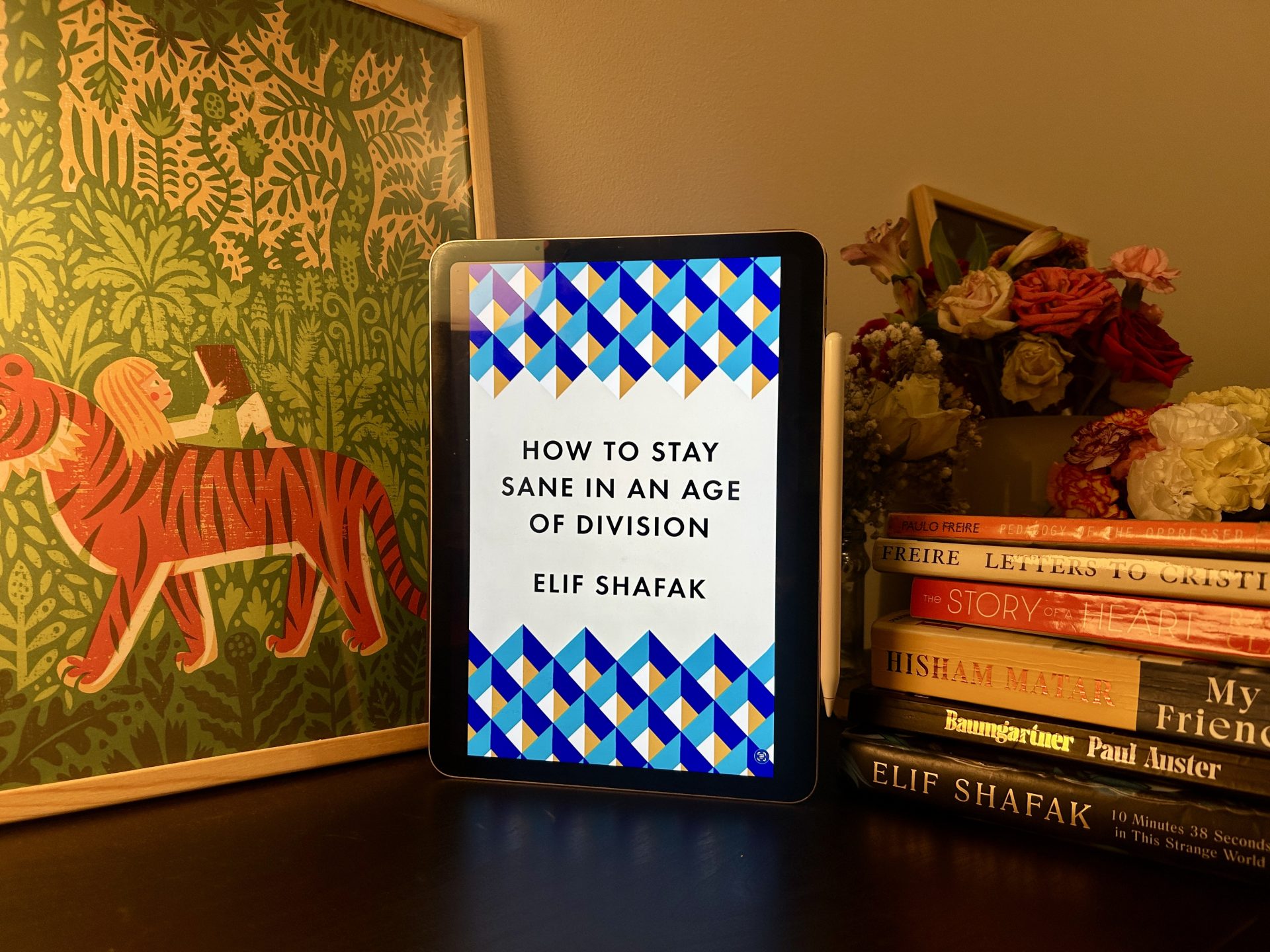
After reading three literary fiction novels by Elif Shafak, I became deeply curious about how she would approach nonfiction. Her storytelling style has always felt poetic and reflective, so I wondered how that would translate into essays. And then I found out that she writes a nonfiction one, How to Stay Sane in an Age of Division. My favorite literary fiction author write a nonfiction book that mirrored a question that has been sitting in my mind for years? I was so excited to read it.
The book is very short, less than a hundred pages. I finished it easily in one sitting. Those opening pages immediately drew me in by giving a sense of someone had reached inside my head and carefully arranged my scattered thoughts into clear, structured sentences. Thoughts about the state of the world. About the emotional exhaustion many of us carry. We are exhausted by anxiety, consumed with anger, our minds and defences all too often overwhelmed.
Shafak captures today’s atmosphere precisely. She writes about the urgency of empathy, the traps of echo chambers, the rise of collective narcissism, and the growing sense of disillusionment. Everything feels tense as well as fragile. As if we are constantly standing on uncertain ground.
One of the questions she raises has similarity with mine: what does education actually guarantee anymore? The older generations believed education was a reliable path toward a better future. If each generation worked harder and improved what they inherited, life would steadily improve. That belief once felt realistic. Yet, we live in a time shaped by insecurity and downward mobility. Now it feels shaky. Opportunities feel limited. Expectations are shrinking. Many of us are trying our best, yet the promise of stability no longer feels certain. So where do we go from here? What should we do?
Shafak also highlights something I strongly relate to: the crisis of meaning. Beyond political and economic instability, we are struggling to redefine basic concepts: democracy, normalcy, happiness. Even success. The pandemic intensified many of these questions, but the confusion actually did not begin there. It has been building for years.
Of course, How to Stay Sane in an Age of Division does not offer a step-by-step guide on how to stay sane in turbulent times. It is a complex issue that we have to deal with. However, it reminds us that we are living in an era of crossroads. A moment of deep transition. And perhaps recognizing that complexity is the first step toward navigating it.
Summary
Escaping Echo Chambers: Why Repetition Kills Real Wisdom
Groupthink and social media bubbles thrive on repetition. They keep feeding us the same ideas, the same opinions, and the same voices. It feels comfortable, but comfort does not challenge us. And without challenge, we do not grow, mentally, emotionally, or behaviorally.
Echo chambers narrow our world. They ration knowledge and limit wisdom. And wisdom is more than information; it connects the mind and the heart, strengthens empathy, and allows us to truly listen and learn from others.
Moving from one bubble to another is not a solution. Instead, we are encouraged to become intellectual nomads: to keep questioning, keep learning, and step beyond our familiar circles. Real change, after all, often begins at the margins, not at the center.
Collective Narcissism: How “We Are the Best” Is Tearing Societies Apart
Narcissism is a personal trait and a group mindset at once where there is a shared illusion that we are at the center of the world.
In a complex and confusing world, collective narcissism helps people cope with frustration, failure, and uncertainty. It shields us from disillusionment and bewilderment by giving us something simple to believe: our group is special, superior, chosen.
As Erich Fromm observed, this mindset often hides behind nationalism or religious identity. People feel important not because of who they are individually, but because they belong to “the greatest group on earth.” The individual may feel small, but the group feels grand and that borrowed greatness is deeply satisfying.
The problem is the cost. When societies define themselves this way, coexistence weakens. Politics becomes bitter and polarized. Democracy, which depends on compromise, negotiation, and pluralism, struggles under constant suspicion and hostility.
It is no accident that authoritarian leaders thrive in such conditions. Polarization is not a side effect. It is often deliberately inflamed.
My Favorite Bits
- Not to be able to tell your story, to be silenced and shut out, therefore, is to be dehumanised. It strikes at your very existence; it makes you question your sanity, the validity of your version of events. It creates a profound, and existential anxiety in us. In losing our voice something in us dies.
- We are exhausted by anxiety, consumed with anger, our minds and defences all too often overwhelmed.
- Unlike what nationalist demagogues claim, belonging is not a once-and-for-all condition, a static identity tattooed on our skin; it is a constant self-examination and dynamic revision of where we are, who we are, and where we want to be
- Sometimes, where you genetically or ethnically seem to fit in most is where you least belong. Sometimes you are at your loneliest among people who physically resemble you and seem to speak the same language
- The question ‘where are you from?’ has always mattered to me, and felt deeply personal, albeit equally complicated. For a long time it was the one question I dreaded being asked. ‘I am from multiple places,’ I wanted to be able to say in return. ‘I come from many cities and cultures, plural and diverse, but I am also from the ruins and remnants of these, from the memories and forgettings, from the stories and silences.”
Author: Elif Shafak
Publication date: 1 August 2020
Number of pages: 96 pages

Leave a Reply