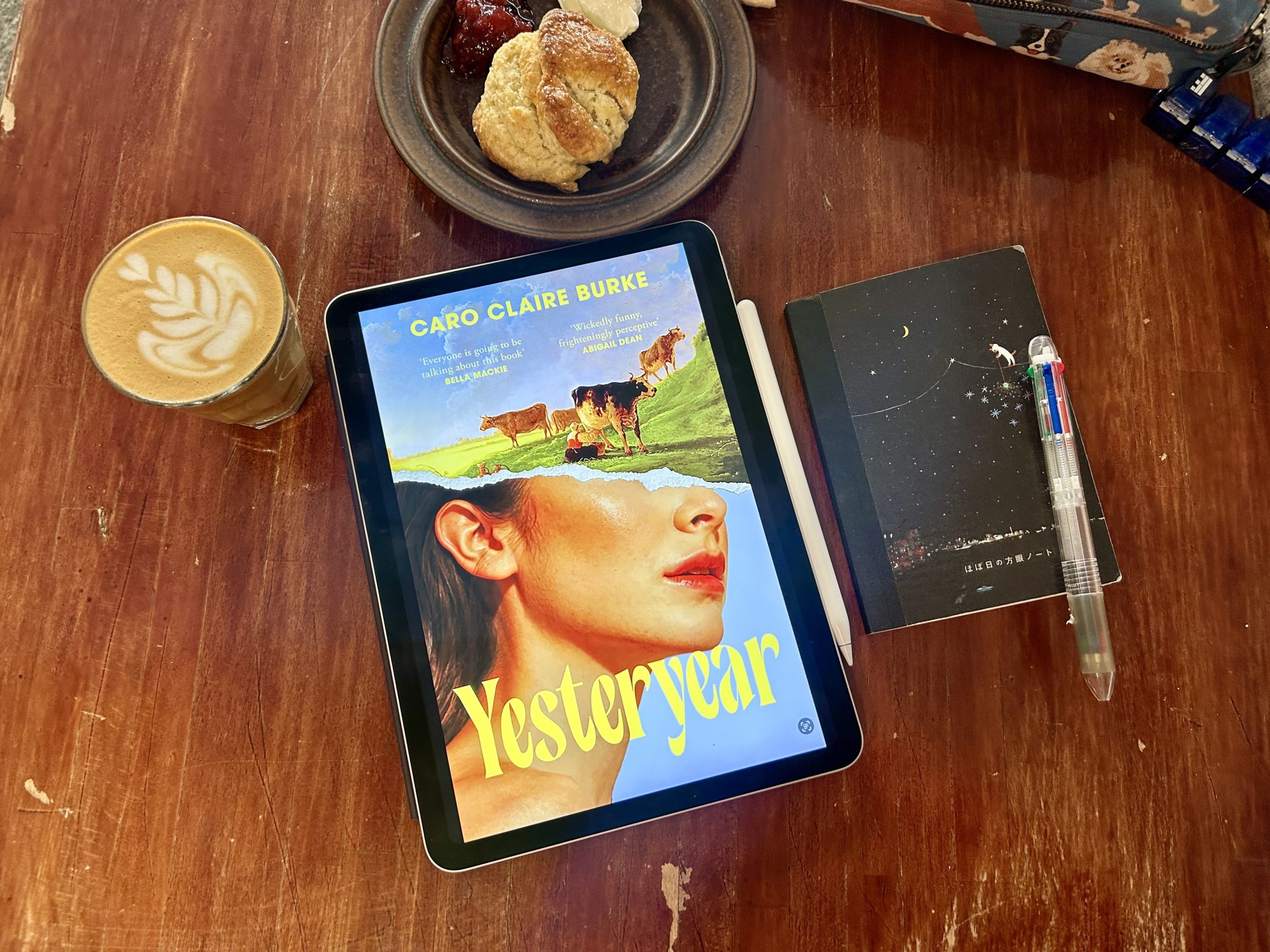
Picture your favorite tradwife influencer: the one milling her own flour, sewing pinafores for her kids, and pulling in millions of views while she’s at it. That’s the energy walking into Yesteryear and the premise alone had me hooked: a wildly successful tradwife content creator gets forced to actually live the life she’s been selling to her followers. So, I expected a satire, one with a biting critique of gender roles and online performance.
Early on, the novel pulls off some affecting moments. The narrator’s voice opens up real questions about how the world has traditionally framed womanhood, especially through the lens of motherhood. There’s a passage where she reflects on always assuming she’d glide into the role because she was told it was natural. She thought, it was nature itself, an infinite relay of God’s glory passed from one woman to the next. Then she steps into motherhood and feels none of that. “Nothing felt natural about this,” she admits. It’s a line that lands the weight of identity crisis it where the disorientation of catching her reflection and finding a stranger is one of the book’s more grounded threads.
I also enjoyed how the story stages the friction between modern and traditional ideas of womanhood. That internal tug-of-war between what the narrator was raised to want and what she actually experiences gives the book its emotional pulse.
Now, about that plot twist at the end. I genuinely did not see it coming. (Maybe I’ve been reading too much dystopian fiction lately, because even with my radar up, the turn caught me off guard.) The setup promised one kind of story, and the reveal pivots into something else entirely. My issue is that the connective tissue between the opening premise and the twist feels shaky, like the story was poured in a hurry, and the middle section doesn’t quite know what kind of book it wants to be.
In addition, the novel’s lack of depth really begins to show. It raises bold, provocative ideas, such as patriarchy, religion, influencer capitalism, and these themes are likely what draw many readers in (like me). Unfortunately, the execution doesn’t engage with them with the rigor they deserve. The 1855 setting, which had every opportunity to serve as a sharp social critique of gendered labor and economic dependence, ends up functioning functions as nothing more than a symbolic set of story. I also struggled to understand what the author was trying to say through characters who live across two different eras. The exploration of these dual timelines, and the perspectives they offer, feels underdeveloped. A real disappointment in a book with such promising ideas.
Yesteryear has one of the most potential intriguing storyline I’ve come across in a while, and there are flashes of real insight scattered throughout. Sadly, the novel doesn’t fully commit to the critique it sets up, though, and the result is a story that flirts with sharpness without ever landing the cut. Worth picking up for the concept and the conversation it sparks, but I closed the final page wishing the book had been deeper.
My Favorite Bits
- Motherhood is its own kind of curation. Which is to say: every woman I know lied to me about what it would be like, before I became one myself.
- The way some women so willingly compromised every ounce of themselves in the name of building a life for themselves that they didn’t enjoy.
- Why worry over inevitability? All my life, I’d understood and accepted that I was brought into this world for the explicit purpose of eventually bringing other lives into this world, like a never-ending baton pass, an infinite relay of God’s glory. I’d assumed I would step into the role naturally since the role itself was natural, was nature. But nothing felt natural about this.”
Author: Caro Claire Burke
Publication date: 7 April 2026
Number of pages: 394 pages
Leave a Reply