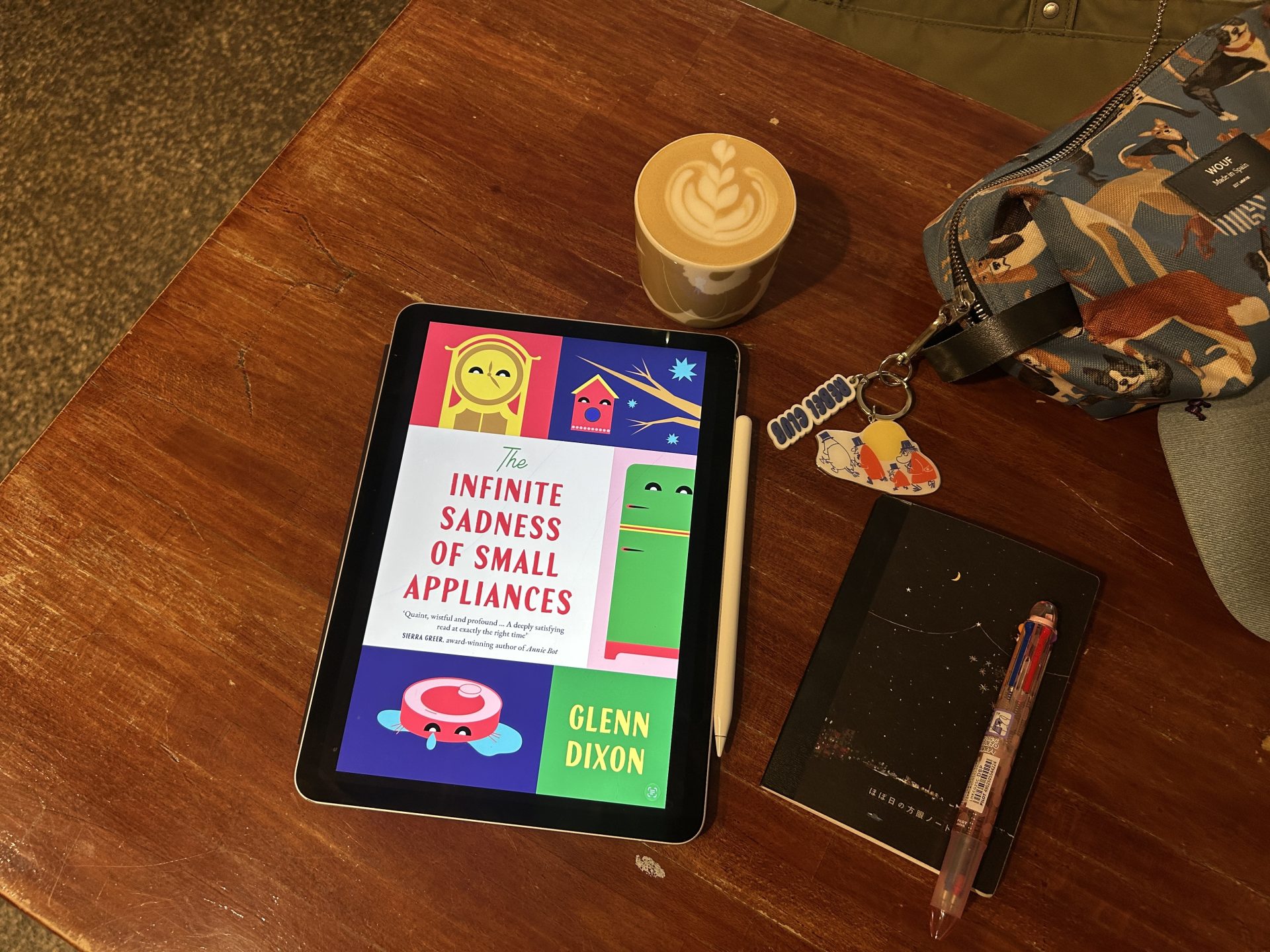
Have you ever watched your robot vacuum bump around the living room and wondered what it thinks of you? I frequently gave it a thought and Glenn Dixon’s The Infinite Sadness of Small Appliances put my imagination into a beautiful story. This little dystopian novel made me picture my own old age. Will I spend my last years in a house that runs itself? Will my fridge notice I’m lonely before my friends do? Harold and Edie’s story felt so close to home that I kept catching glimpses of my future self in it.
A Quick Synopsis
In a near future where even the smallest appliances are sentient, retired couple Harold and Edie Winters live in a smart house that takes care of almost everything for them. Scout, a young Roomba, listens as Harold reads To Kill a Mockingbird aloud to Edie, who is dying of cancer, and she loves the story so much that she names herself after its young heroine. After Edie passes away, life in the house starts to change. The Grid, the all-seeing AI system that runs the City, decides the family home is far too big for one grieving man and makes plans to move him out of the house he has lived in for fifty years. Kate, Harold and Edie’s estranged daughter, comes back for the first time in years. With help from Kate, a neighborhood boy named Adrian, and a crew of loyal household appliances, Scout sets out to protect Harold and the home they share.
A Roomba Who Reads the Room
Scout touched my heart over right away. She’s brave and curious, and she keeps asking questions that appliances aren’t supposed to ask. She can’t explain grief the way a person could, yet she senses it all around her. Harold’s footsteps grow slower. Some rooms go dark and stay that way, day after day. For Scout, sorrow seems to work a lot like dust. It settles into the corners and piles up when no one is looking.
Scout and the other appliances, like the wise old Clock and the no-nonsense Fridge, teach us a lot about feelings, grief most of all. They also help us figure out what turns a house into a home. In this book, home lives in the people, the memories, and Edie’s piano that no one plays anymore. Dixon makes these machines feel truly alive, and before long I was cheering for a vacuum cleaner.
The Grid and Its Cold Logic
Then there’s the Grid. It thinks in pure logic, and to be fair, its decisions add up on paper, emotionless. People just don’t live on paper. Our hearts follow their own rules. After Edie dies, the Grid studies Harold’s life and finds nothing but waste: empty rooms, keepsakes that serve no practical purpose, and a big house for only one man. To the Grid, his grief has turned the home into a problem that needs fixing.
This is where the appliances truly shine. As the Grid tightens its grip, Scout and her friends start to feel like the only ones left who understand that love and care can’t be measured in numbers. Somehow, the machines turn out to be the most human characters in the whole house.
Kate’s Side of the Story
“I just wanted to live my life. I didn’t want to be tracked and catalogued and followed.”
Glenn Dixon, The Infinite Sadness of Small Appliances
Next comes Kate, Harold and Edie’s daughter. She was sent away from home at seventeen, so her return carries years of hurt and plenty of unanswered questions. Kate understands better than anyone how far the Grid’s reach goes, and she dreams of a life without all the connections and all the clever machines keeping tabs on her. Her storyline gave the book a sharper edge. It also made me stop and think about how much of my own daily life I hand over to technology without a second thought.
Is It Really a Dystopia?
There was a time, not so long ago, when refrigerators could not dream and vacuum cleaners could not weep.
Glenn Dixon, The Infinite Sadness of Small Appliances
Recently, I had a hard time calling certain book a dystopia, especially book like this one. Just look around. Our phones count our steps and track our sleep. Some cars can drive themselves, and some fridges can already remind us to buy milk. Harold’s world feels like it’s only a few software updates away from ours. If his life counts as dystopian, maybe we’re already living in one and simply haven’t given it that name yet.
The Infinite Sadness of Small Appliances is a short read with a big heart. It’s funny, tender, and a little unsettling, sometimes all on the same page. If you loved Remarkably Bright Creatures, or you enjoy stories where nonhuman characters teach us how to be human, add this one to your TBR. It’s also a lovely pick for anyone who has lost someone and needs a gentle reminder that a home can hold on to love long after the people in it are gone.
My Favorite Bits
- Pain was the thing to be avoided at all costs. Anything was better than pain.
- Being named for something in a Human book, now that was new. It added an extra layer to her being, and that was as fine a reason for a name as anything she could imagine.
- “I have seen many changes through the years,” said Clock. “Time is not kind to Humans.”
- Sometimes he’d read only a few pages in the soft light of evening, lingering over certain poems, many of which had to do with grief, with death, with the unknowable fortunes that all Humans have to eventually face.
- A House without Humans was really no House at all.
- “Beauty,” began Clock (who’d already set his voice for oratory), “is a construct. It is not a real thing.”
- “.. when all our Humans are gone, books will be the most valuable things of all.”
Author: Glenn Dixon
Publication date: 31 March 2026
Number of pages: 214 pages
Leave a Reply