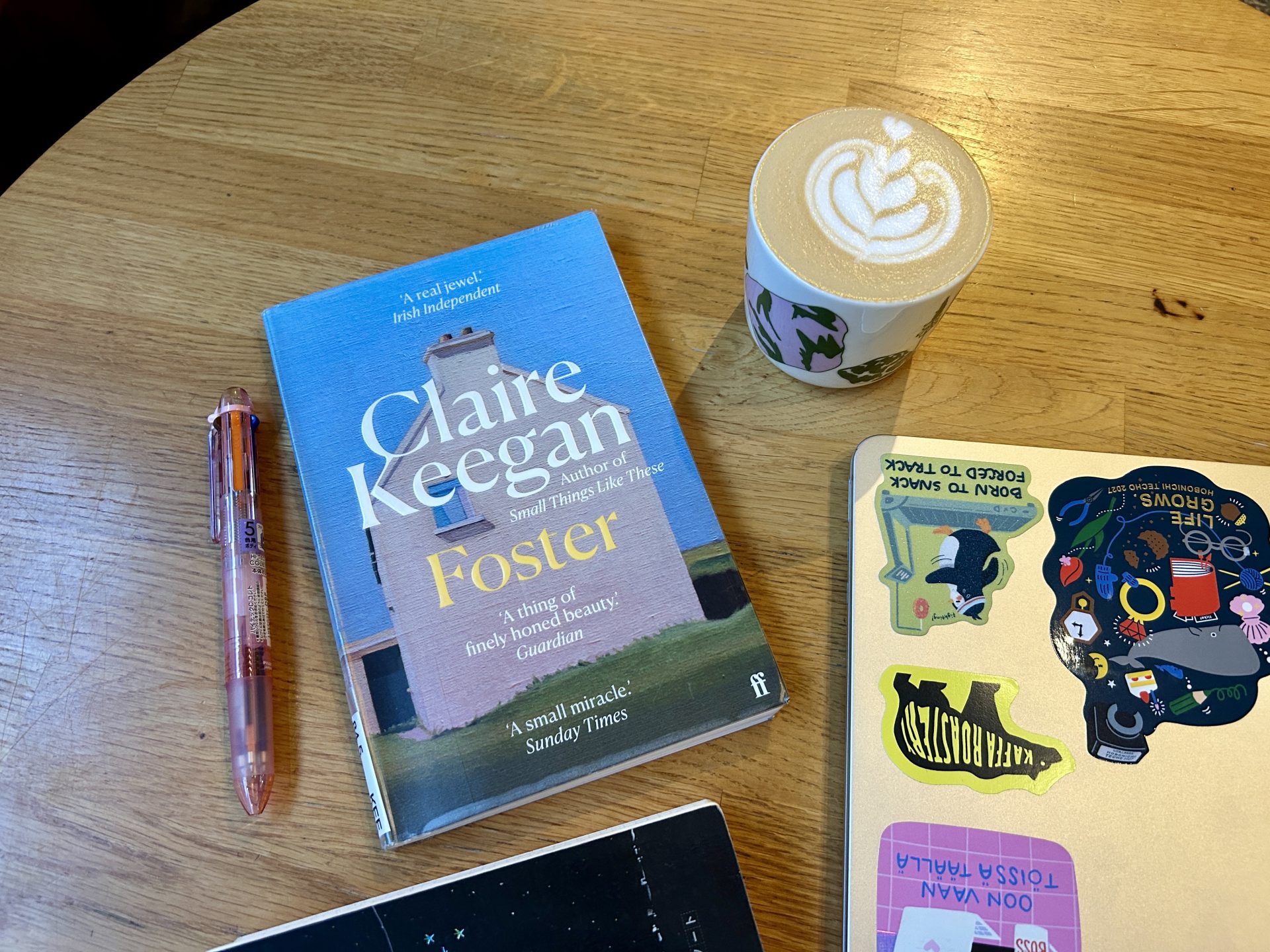
Claire Keegan has a real talent for writing very short books that leave a very deep meaning. My first read of her work was Small Things Like These, and I finished it feeling surprised that such a thin book could mean so much and stir up so many emotions at once. So when I picked up Foster, I wondered if she could pull off the same magic twice.
Well, she did. Foster gave me that same mix of tenderness and heartache, packed into a tiny book.
What Foster Is About
The story begins on a Sunday morning in the summer of 1981. After Mass in Clonegal, a young girl’s father skips the usual drive home. He heads deep into County Wexford instead, toward the coast where her mother’s family comes from. The girl tells the story herself, and she never shares her name. She has no clue what’s waiting for her at the end of that drive.
All she’s been told is that she’ll stay with a couple called the Kinsellas, relatives on her mother’s side whom she doesn’t really know. Nobody says how long she’ll be there. Nobody says whether she’ll ever go back home.
Back at the house, her mother, Mary, is expecting yet another baby and is close to her due date. New babies seem to arrive in that family about as often as the seasons change. Money is tight, the hay still isn’t saved, and there are more children than her worn-out parents can handle. So they decide to send one of them away for the summer.
A Summer at the Kinsella Farm
Once the girl arrives at the farm, some details start to show us how hard her life at home has been. A warm bath, clean clothes, regular meals, an adult who takes the time to explain things: the Kinsellas treat all of this as normal, and to her it’s brand new. At first you can almost feel her bracing for a scolding, waiting for the catch.
Edna and John Kinsella have no children of their own, and their home runs on care and routine. Day by day, the girl starts to loosen up. She helps with the chores, learns the rhythm of farm life, and finds out that grown-ups can be gentle and patient. Slowly, she blossoms. For the first time, she gets a glimpse of what a home is supposed to feel like.
The outside world drifts in now and then too. The evening news carries reports of the 1981 hunger strikes in Northern Ireland, a reminder of the troubled times beyond the farm gate. And the Kinsellas have a history of their own, which Keegan lets surface a little at a time. I won’t say more, because discovering it yourself is part of the experience.
Keegan’s Writing Style
Keegan’s writing is the cherry on top of this book. Every word feels carefully selected, and every scene holds more feeling than you’d expect from a few short paragraphs.
Keegan also trusts her readers to fill in the gaps. Characters rarely say exactly what they feel, so meaning comes through a pause, a glance, or a small act of kindness.
For such a slim book, it’s packed with beautiful lines. I kept stopping to reread sentences, and my list of favorite bits ended up much longer than I expected.
If you love Small Things Like These, make this your next Keegan read. It’s also a lovely pick for anyone who enjoys Irish fiction, character-driven stories, or tender tales about childhood and family. And if you’ve watched The Quiet Girl, the Oscar-nominated film based on this book, the original story deserves a spot on your shelf too.
My Favorite Bits
- ‘Where there’s a secret,’ she says ,’there’s shame — and shame is something we can do without.’
- ‘I feel at such a loss for words but this is a new place, and new words are needed.’
- ‘I have learned enough, grown enough, to know that what happened is not something I need ever mention.’
- ’You don’t ever have to say anything,’ he says. ‘Always remember that as a thing you need never do. Many’s the man lost much just because he missed a perfect opportunity to say nothing.’
- She wants to find the good in others, and sometimes her way of finding that is to trust them, hoping she’ll not be disappointed, but she sometimes is.
- Eventualities. A good woman can look far down the line and smell what’s coming before a man even gets a sniff of it.
Author: Claire Keegan
Publication date: 2 September 2010
Number of pages: 101 pages
Leave a Reply