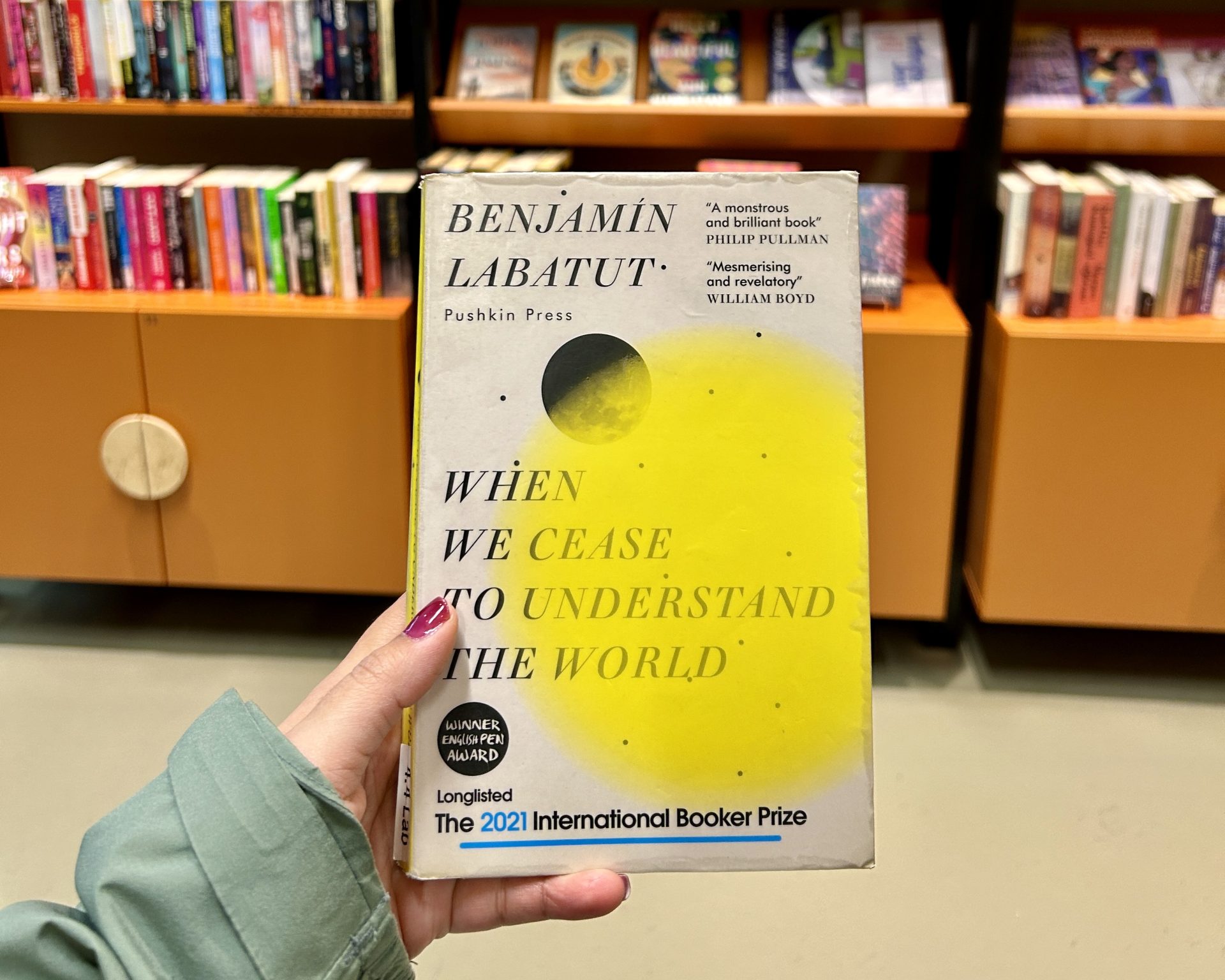
The title is what made me pick up: When We Cease to Understand the World. It sounded mysterious and unsettling. I wanted to know what kind of book would carry a title like that.
Benjamín Labatut is a Chilean writer, and this book first came out in Spanish in 2020 as Un verdor terrible. Adrian Nathan West translated it into English. It made the shortlist for the 2021 International Booker Prize and was a finalist for the 2021 National Book Award for Translated Literature.
Part essay, part fiction
This book is so unique that it is hard for me to categorize in one box. It starts with an essay that feels like pure nonfiction, moves into two short stories and a novella, and ends with a short epilogue, circle the same question: what do big scientific breakthroughs do to the minds of the people who make them, and to the rest of us?
Most of the discoveries come from the 20th century, when physics and mathematics turned our picture of reality upside down. Labatut said the book is about “what happens when we reach the edges of science.” He wanted to explore the moment we run into something we simply can’t grasp, and what happens to a mind that pushes past the limits of thought.
A gorgeous blue with a dark side
The first chapter, “Prussian Blue,” begins with cyanide, probably the most notorious poison in history. Labatut traces it back to Prussian blue, the first modern synthetic pigment. It’s the same deep blue you’ll find in Hokusai’s The Great Wave and the well-known Van Gogh’s The Starry Night. From there, one fact leads to another.
Fritz Haber, the German chemist, who figured out how to pull nitrogen from the air and turn it into fertilizer. His discovery eased the old fear of mass famine. Today, nearly half the people on Earth eat food grown with the help of his process.
Then the chapter turns dark. The same Haber led Germany’s poison gas program in World War I and was there when chlorine gas was first released at Ypres in 1915. His institute’s research on cyanide pesticides also helped pave the way for Zyklon B, the gas the Nazis later used to murder about 1.1 million people, most of them Jews, in the gas chambers of Auschwitz and other camps.
Where fact fades and fiction grows
In the acknowledgments at the back of the book, Labatut admits that “Prussian Blue” has only one invented paragraph. After that, he gives himself more and more freedom with each chapter. The science stays, while the scientists’ inner lives become more imagined, full of obsession, madness and strange.
The chapters that follow belong to some brilliant and deeply troubled minds:
- “Schwarzschild’s Singularity” follows Karl Schwarzschild, who solved Einstein’s equations while serving in World War I and landed on the idea that would become black holes.
- “The Heart of the Heart” tells the story of mathematician Alexander Grothendieck, woven together with Shinichi Mochizuki, a Japanese mathematician whose famous proof almost nobody can follow.
- “When We Cease to Understand the World,” the title novella, pits Werner Heisenberg against Erwin Schrödinger as they race to make sense of quantum mechanics.
The more pages I turned, the harder it got to tell where history stopped and Labatut’s imagination took over.
Science that saves and destroys
Almost every discovery in this book cuts both ways. Haber’s fertilizer feeds billions, and his gases killed thousands of soldiers. Quantum mechanics changed physics forever, and Heisenberg went on to lead Nazi Germany’s nuclear program. Labatut sets the bright side and the dark side next to each other and leaves us to reflect with the discomfort.
I couldn’t stop thinking about how timely that feels right now. We’re living through the rise of AI, and a lot of us start the day wondering what it will be able to do next. Which jobs might vanish? How are we supposed to keep up? Reading about scientists who built things they couldn’t fully control made those everyday worries feel very real.
An ending that ties it all together
The book closes with “The Night Gardener,” a short epilogue told in the first person. The narrator lives in a small Chilean village and sounds a lot like Labatut himself. There he gets to know a man who tends gardens at night. This gardener used to be a mathematician, and he walked away from math because he grew afraid of what it could do.
Their conversations drift back over the big ideas and some of the scientists from earlier chapters, so it reads like one last look at everything we’ve just been through. The gardener also describes how citrus trees die, collapsing under too much fruit at once. That image echoes the book’s Spanish title, Un verdor terrible, “a terrible greenness.” It’s an eerie, haunting finish, and it rounds the whole book off beautifully.
When We Cease to Understand the World is a fascinating book. It honors everything science has done for us as a species, and it keeps reminding us of the price. If you love history, science, or stories that blur fact and fiction, add this one to your list. Just be ready to see the world a little differently when you close it.
My Favorite Bits
- Reality, they said to those present, does not exist as something separate from the act of observation.
- A perspective is by nature limited. It offers us one single vision of a landscape. Only when complementary views of the same reality combine are we capable of achieving fuller access to the knowledge of things.
Author: Benjamín Labatut
Publication date: 1 January 2020
Number of pages: 193 pages
Leave a Reply