
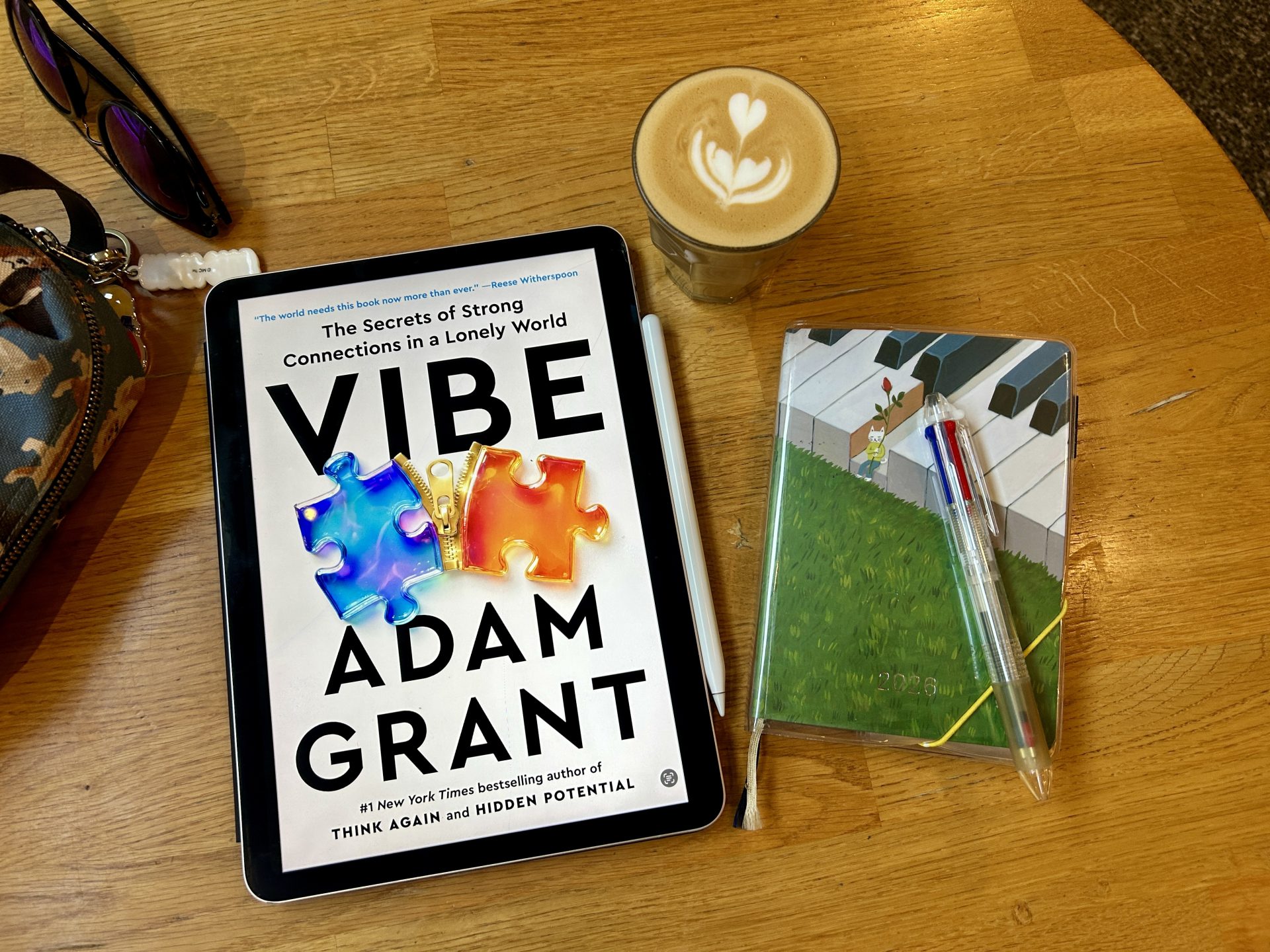
I have always adored Adam Grant’s books. One of his books, Think Again, even sits on my list of books to reread every year, because it reminds me to think, unlearn, and rethink, which are handy habits in a world that changes this fast. So I was excited when I heard Grant had a new book out.
“I love people, but for a long time, I struggled to connect with them.” That’s the first line of Vibe by Adam Grant, and it read like something written from my own reflections, a sentence that felt familiar and resonated with me. Reading it was like finding a door left ajar, a hint that I could learn a lot from this book.
We live in a modern world designed around convenience, and that leaves little room to vibe. Most of our interactions now happen on screens, and trading face-to-face chats for them can dull our ability to read social and emotional cues, while making it easy to judge people in a hurry. Handing our messages to chatbots may leave us on autopilot, without the skills to build real ties. Social skills behave like muscles, and they shrink without exercise. Even our social norms can box us in. Think about the scripts we follow with strangers, such as asking what they do for work instead of what they love doing. Sociologists call these patterns interaction rituals, and they can make or break a vibe.
In Vibe, Grant reminds us of the value of compassion and the cost of snap verdicts. The more situations we share with someone, the more chances we get to find matching needs, interests, goals, and values. AI raises the stakes. The more we hand our conversations over to machines, the less practice we get with uncertainty, complexity, and conflict, and the harder those become to face.
Grant sets out to map the ingredients of connection across every kind of relationship. The first part of the book looks at the catalysts for connection and busts three myths: that we must be similar to bond, that chemistry happens fast, and that closeness takes a long time. The second part moves on to sustaining connections, or how to keep a bond alive once it begins. The third part zooms out to scaling connection and finding belonging in groups.
Grant also describes the purpose behind a bond as both a mirror and a map. Knowing it helps you see where friends, relatives, neighbors, and colleagues fit in your life, so you know what to give and what to expect from each one. It also explains something many of us have wondered about: why we often feel happier with friends than with partners or kids. The reason is what we do together. With partners and children, we do the chores and handle discipline. With friends, we plan the fun. If families spent more time in “pal mode,” the vibe would probably get better. The research is blunt about the flip side, too. People on different wavelengths often end up disappointed or even betrayed, and in about half of our conversations, what we want and what we get don’t match.
Of course, nobody turns into a connection expert by reading one book, and Vibe doesn’t claim otherwise. Grant himself states in the book,“This is an idea book, not a self-help book, but I still hope it’s helpful.” For me, it was. It gave me fresh ideas, a few insights that I share below, and a clearer view of the boundaries in human relationships. I hope to put them to use wisely in real life.
Summary
What Is Vibe?
- A vibe is the feeling of being “in sync” with another person. The word comes from the Latin vibratio, meaning vibration. When two people click, they move to the same rhythm.
- Science can actually spot it. Brainwaves and heartbeats of connected people begin to line up. You feel it too: talk flows easily, ideas take off, trust deepens, and the hours slip by unnoticed.
- It goes deeper than attraction. Liking someone is only the start. A true vibe leaves both people changed.
- Good vibes power a happier, more successful life. They sit behind our most treasured family moments and our best evenings with friends.
- They also soften the blow of stress.
Pebbling, Why We Send Memes
- Pebbling is a small act of care. It means offering a little gift or gesture that says, “I thought of you.”
- It helps bonds grow stronger and last longer. This works especially well with people we don’t know very well yet, when a relationship is still fragile and new.
- The idea comes from penguins. When some penguins look for a mate, they search for pebbles and bring them as gifts. The best ones are smooth and shiny, and they’re good enough to help build a nest together.
- We do the same thing online. Today’s pebbles are memes, links, and short videos we send to someone because we think they’ll enjoy them.
- The value is in the personal touch. The item itself is small. What makes it matter is that someone picked it out just for you.
The 4 Types of Connection
- We can tune in to people on four different “wavelengths.” Each one is a different kind of bond, and each runs on its own purpose.
- Associates: the give-and-take crowd. These ties are practical. You talk mainly to swap something useful, and the relationship stays fair because both sides keep trading.
- Allies: the mission partners. You’re pulled together by a shared goal. It could be volunteering, worshipping, or building a startup side by side.
- Pals: the fun crew. You click because you love the same kind of good time. Simply put, you enjoy doing the same things.
- Companions: the safe place to land. These bonds rest on care. You open up to each other and lean on each other for comfort. They’re the ones you call when everything falls apart, and you’re the one they call when their world goes quiet.
- Each wavelength has its own focus. With associates and allies, what matters most is the result of your time together. With pals and companions, what matters is the experience itself. If the moment feels joyful or meaningful, the vibe pays off even with nothing to show for it.
- Some bonds are chosen, and that makes a difference. We pick allies because we walk the same path, and we pick companions because we share the same values.
- This may explain family clashes. Parents and siblings are expected to be companions, yet nobody chooses their relatives. Without shared chemistry, the closeness people expect can be hard to find.
Can One Person Be Your Everything?
- Real relationships rarely fit in one box. Most of us vibe with certain people on several wavelengths at once. Sticking to a single one can be useful at times, but it can also feel limiting.
- More wavelengths usually means a stronger bond. Your favorite teammates are likely both allies and pals: you enjoy their company, and you’re working toward the same goal. Your closest friends are usually pals and companions, people who share both the laughs and the hard moments.
- The ideal partner covers all four. A romantic partner at their best can be your associate, ally, pal, and companion all at once.
- Spreading out your emotional needs pays off. Several studies found that people who lean on different friends for different kinds of support are happier than those who rely on one friend for everything.
- Connection is about sharing, not exclusivity. No single person has to be everything to you. Knowing the four wavelengths gives you a map for building and deepening the bonds you already have.
Sonder: Do You Really Know Them?
- Sonder is the sudden realization that everyone has a whole life you can’t see. Each person you pass carries years of hopes, fears, loves, and heartbreaks that you will never hear about.
- Every moment of sonder works two ways. It’s a thrilling nudge to keep discovering new sides of old friends and close companions. It’s also a humbling reminder of how little we know about the people around us, whether we love them or can’t stand them.
- We tend to blame character, not circumstances. Psychology has shown again and again that when someone behaves badly, we assume it’s who they are rather than what they’re going through. The trick is so common that it has a name: the fundamental attribution error.
- Quick judgments close doors. Once we label someone, we lock them into the role of rival or stranger. We never stop to imagine that they could become an associate, ally, pal, or companion one day.
- The person is easy to see, but the situation often isn’t. Someone’s behavior stands out in front, while the pressures behind it stay hidden. We also measure what they just did against our own usual habits, even though we have never watched theirs.
- To read people well, watch them in different settings. One moment tells you very little. A range of situations tells you much more.
- First impressions are shortsighted. They hide the ways people change from one situation to the next. The better we know someone, the more of those shifts we notice, and each one opens a new way to connect.
Self-Expansion: How Close Bonds Help Us Grow
- Self-expansion happens when a relationship widens who you are. It shows up when someone broadens your perspective, sharpens your skills, or simply helps you become a better person.
- Sharing is the start, but growing together is the real bond. Telling each other about your lives can create a tie. Changing and growing side by side is what transforms it.
- We absorb the strengths of the people we love. A reliable, disciplined partner offers more support and sets better habits, and over time we start to take on some of those qualities ourselves. Their interests rub off on us too.
- Growth is both a result and a driver of a strong vibe. In one finding, couples who grew more over six months of time together also showed more brain synchrony and felt closer.
- Hope for growth keeps people committed. We feel happier and more loyal when a relationship seems capable of helping us grow, and even more so when our partner actively helps it happen.
- This works beyond romance. Listen to people describe their closest allies and pals. They rarely stop at “we enjoy each other.” The story they tell is how much they’ve changed one another.
Other books by Adam Grant:
Author: Adam Grant
Publication date: 15 October 2026
Number of pages: 309 pages
Leave a Reply