
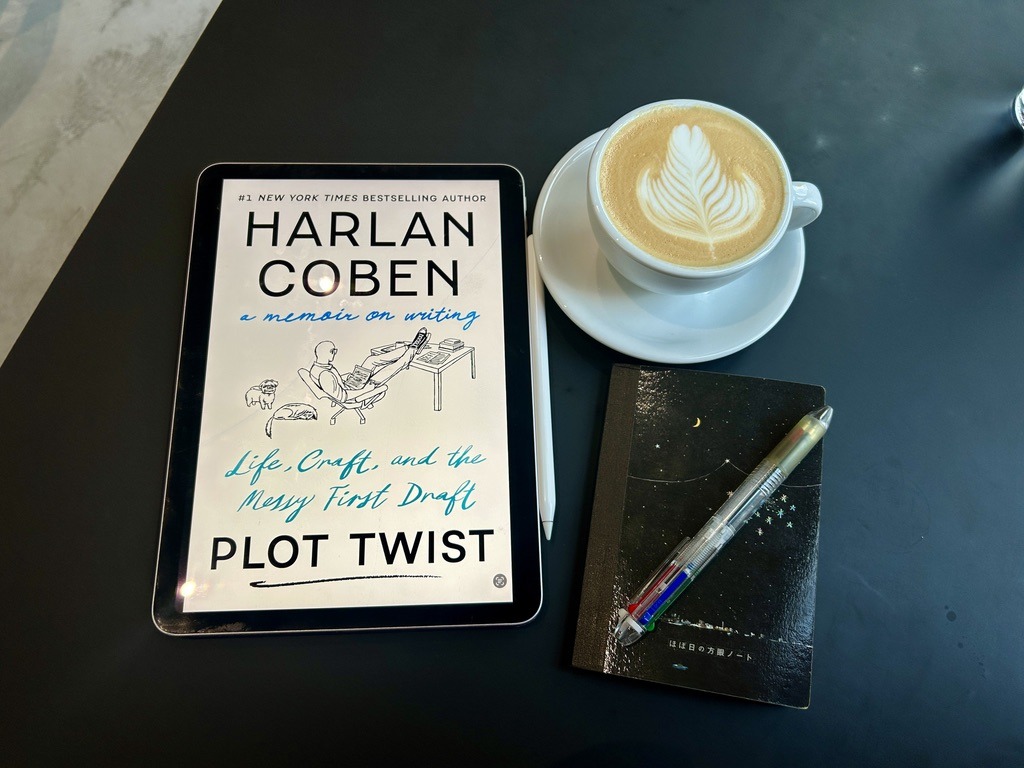
Harlan Coben has been writing twisty thrillers for years, and in Plot Twist, he finally shows us how he does it.
Mostly, it’s a guide to writing and creativity. Coben thinks your life and your creative work go together, so some parts read like a memoir. He doesn’t let the personal stories take over, though. He also shares life advice and parenting tips he’s picked up along the way.
He gives plenty of tips, but he also lets you make your own choices. He pokes fun at a lot of the old writing rules and says you might not agree with him.
He’s honest about the writing life, too. For him, writing is a job. You show up, do the work, and keep going. He also talks about desperation, that strong urge to write even when you can’t explain why. If you dream of being a writer, this real-talk approach feels so refreshing and realistic, at once.
If it helps me produce pages, good. If it doesn’t, bad.
Harlan Coben, Plot Twist
He keeps the same easy attitude in the chapters about where his story ideas come from. He explains how his brain wanders from one thought to the next until a story appears, and he reminds us that the real process is a lot messier than it sounds. I liked that he didn’t pretend it was neat and tidy.
If you loved On Writing by Stephen King, put Plot Twist on your TBR. New writers and longtime Coben fans will absolutely both enjoy it.
Summary
Two Common Mistakes in Books on Writing
- Writing is one whole, not separate parts. Many guides split writing into character, plot, and setting. But these elements are connected, and each one shapes the others.
- Your life experience matters. Don’t treat what you’ve lived through as irrelevant. It’s a key ingredient in your writing.
How to Think Like a Writer
- Everything is material. To a writer, daily life is full of story prompts. A stranger’s odd hat can spark a whole character.
- The payoff goes beyond writing. Thinking this way makes you more observant, empathetic, and creative in everyday life.
The 3 Things Every Writer Needs
- Inspiration: You need a story you want to tell and the drive to keep hunting for ideas.
- Perspiration: Thinking about writing isn’t enough. You have to sit down and do the work.
- Desperation: This is the deep urge to write, even when you can’t explain it. It’s what pushes you past fear and doubt.
Where Do Story Ideas Come From?
- “What if” questions: Simple prompts can spark a whole story.
- Your own life: Personal memories and experiences are rich material.
- The news and what you read: Real events, true crime, and books can all plant a seed.
- Mixing ideas: One idea rarely carries a story. Blend several together.
Incremental Ambition: Small, Achievable Goals Help Writers Succeed
- Start with one clear goal. The author began writing in the 1980s, before self-publishing took off. His only dream was to become a published novelist.
- Ambition is normal. Every successful creator has it, whether they admit it or not.
- Aim for the next step, not the summit. Set goals you can actually reach, then take time to celebrate each one before moving on.
My Favorite Bits
- It’s the butterfly effect. It’s sliding doors. We like to pretend that we completely steer our own fate—that luck and timing aren’t huge influences—because the alternative is hard to accept: None of us are that special. Stay humble.
- There is something magical about pen to paper, something freeing, something nostalgic. If you delete something on a computer, it’s gone from view. But with pen to paper, you can squint and see through your cross-outs. You can draw arrows and lines, sketch in the margins, circle paragraphs, even doodle. It’s free-flowing. Your notebook is a portal, a gateway to communing with your inner child.
Author: Harlan Coben
Publication date: 6 October 2026
Number of pages: 320 pages
Leave a Reply