
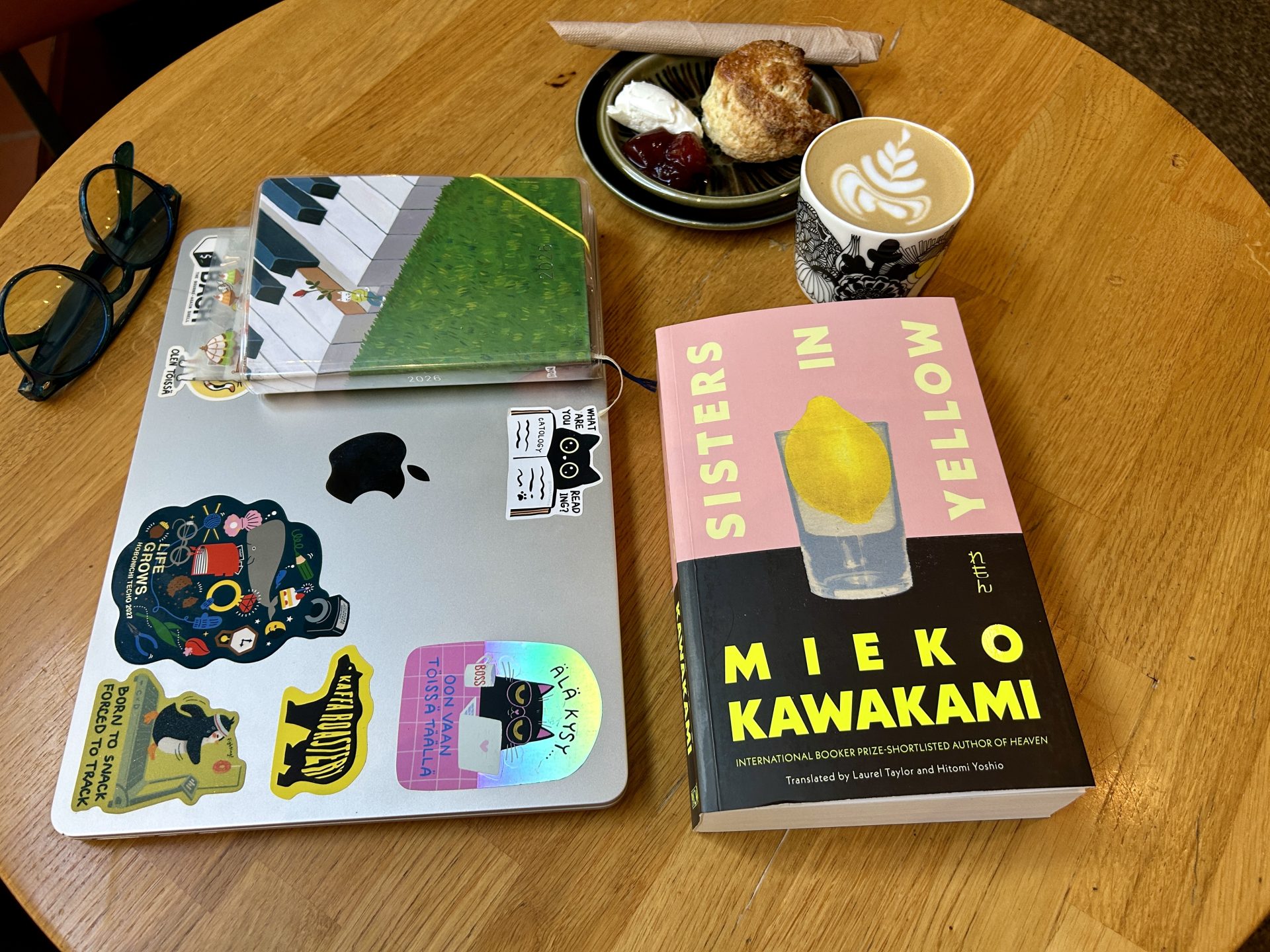
Hana is in her early forties when a news article online intrigues her. It’s about Kimiko, a woman she knew as a teenager. Kimiko was a friend of Hana’s mother, and at a rough point in Hana’s life she took Hana in and cared for her. Seeing that name again pulls Hana back decades, to her young years with Kimiko and two other young women, Ran and Momoko. That’s where Sisters in Yellow by Mieko Kawakami begins. It follows these women through the world of Tokyo’s nightlife, a world run largely by women and edged with criminal underclasses. It shows a side of the city that rarely gets attention, and it feels lived-in rather than glamorized.
Hana is looking back across decades, so her version of the past can never be fully pinned down. Through this plot, the book turns your trust in memory upside down. Events that seem simple at first grow more tangled the further you read, and you start wondering where the truth ends and interpretation begins. That uncertainty makes the story feel real, since real life rarely hands out clean, settled answers.
The story is held by two main things: yellow and money. Hana believes yellow attracts fortune, luck, and cash. It’s a powerful color, and it’s what draws them into each other’s lives and into the story itself. Money is the other big presence. It shapes their choices, their friendships, and what they’re willing to do to hold on to what they have.
Kawakami also fills the book with characters who live on the edges of society. You get a picture of who gets pushed aside, who finds ways to survive, and what those survival strategies cost.
This is the second Kawakami book I’ve read after Heaven, and I’m starting to spot her signature moves. She hooks you instantly in the opening chapters, then leaves a question dangling in your mind. From there, the story stretches out through the middle, and you sink into her imagination and her characters. Her concerns about society come out in the dialogue. Then, as the ending approaches, the answer to that early question finally arrives.
Sisters in Yellow is a layered read about friendship and betrayal, with a lot of thought-provoking ideas packed in. If you like character-driven stories with a social edge, or you want a darker, more grown-up look at Tokyo, this one should be on your next book to read.
My Favorite Bits
- In this world, the people who can do everything end up doing everything, so there’s no point in dwelling on it. It’s a waste of time. Smart people are the ones who end up working their asses off.
- There are happy people out there, for sure. But they’re not happy because they have money or a job. They’re happy because they don’t think.
- Rich people die rich and poor people die poor because that’s the way those fuckers want it. People with money make the rules to help themselves, and poor people get sucked dry. And when you’re all dried up, when you’re nothing but dregs, they make you think it was your fault your fault you failed at life. They make it sound like you had a chance. Well, fuck that. We get wrung out by the system, and all we are, all we can ever be, are dregs.
- Money is power, and poverty is violence. Poor people are beat down from the start, which means they don’t even know they’re being beaten. They’re trampled and brutalized until their minds and bodies are wrecked. They’re raised to believe that’s just the way things are. That’s why they don’t know anything.
- Money gives you time. Time to think. Time to sleep. Time to get sick. Time to wait.
- Countries are like people, you know. The good times don’t last long. The springtime of youth, when you don’t have to worry and you can laugh everything off, it only lasts a second. Gone just like that. Sure, we live longer now, but the longer you live, the more your head fuzzes out, goes blank.
- Besides, I wouldn’t be able to prove if the predictions were right or wrong until the future came, which meant I could believe what I wanted and set aside the bad parts. (..) it’s more important to believe, to let your belief sustain you, because then you can tell yourself that everything’s going to be okay.
- It’s when you don’t know anything, that’s when you start cruising. (..) It comes down to attitude. People don’t need reason or truth. See, when you’re cruising, you feel like everything is going great, like it’s all good. People like feeling that way. That’s how the cruisers get the people, the money, the luck, too. And power. The guy who knows the least, he’s cruising the most, and whatever he says becomes the most true thing in the world, at least for that moment.
Author: Mieko Kawakami
Publication date: 20 February 2023
Number of pages: 448 pages
Leave a Reply