
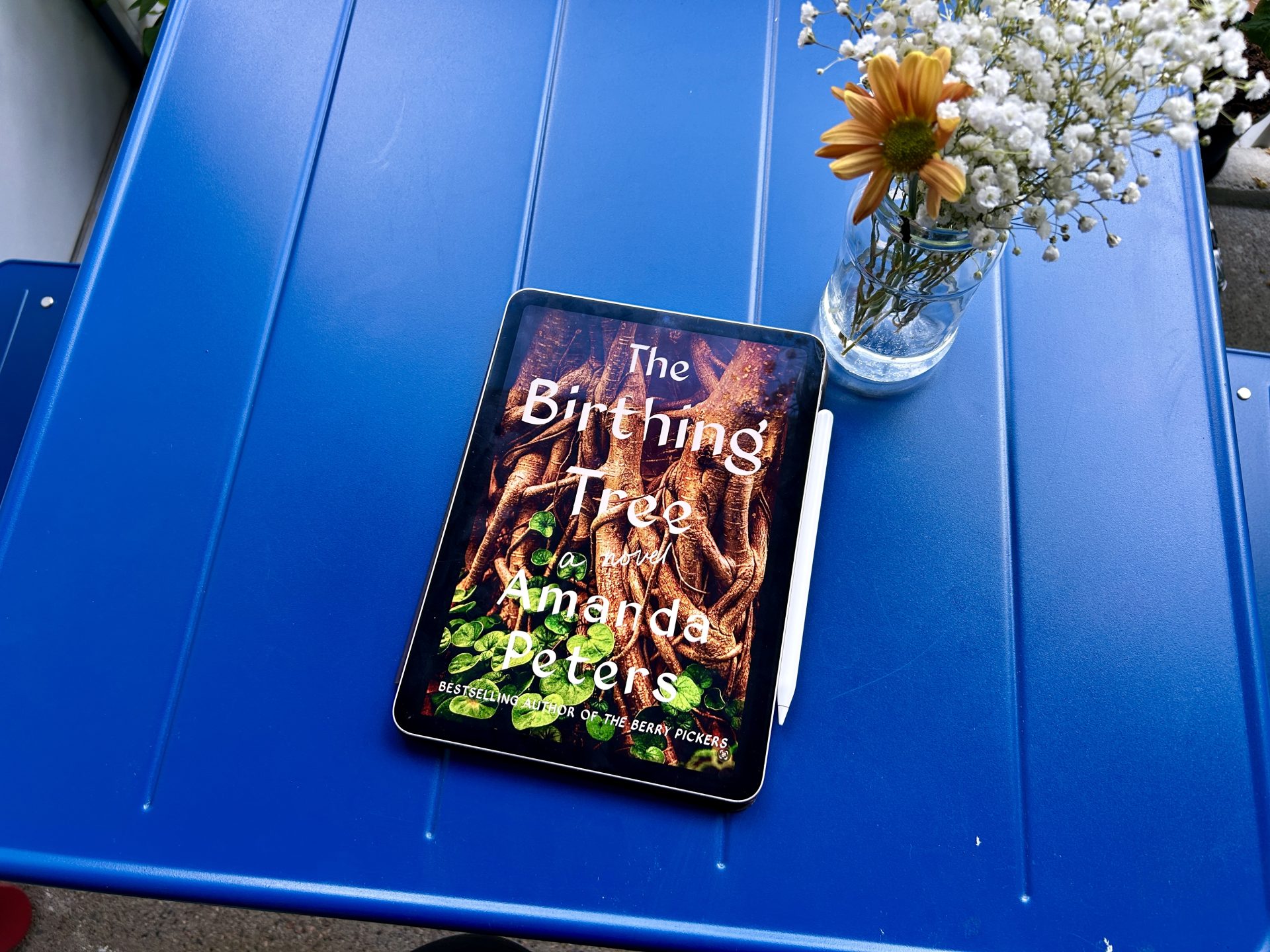
The Birthing Tree by Amanda Peters is a novel about a daughter grieving her mother, a granddaughter grieving her grandmother’s world, and an entire family grieving a home and a set of traditions that modern life keeps chipping away at, piece by piece.
A Tree That Held Generations
As the title of the novel, it is about a tree, literally the birthing tree, where, for generations, Mi’kmaw women have given birth. It’s a setting and practically a character at once, carrying the weight of every birth and every loss that happened beneath its branches.
Aliet was born under this tree. Her grandmother, Kiju, was the midwife who guided those births, the woman who helped generations of Mi’kmaw mothers bring their children into the world under that same tree. And it’s under that tree, during a summer thunderstorm with no rain in sight, that Aliet’s own mother dies. Kiju’s grief takes a strange shape in that moment. She says the earth cursed itself by refusing to cry for her daughter’s death. Through several lines, you can sense how deeply Kiju’s world and the natural world are tangled together. Even after the tree stops serving the purpose she once held sacred, she keeps tending to it anyway, because letting it go would mean letting go of everything it once meant.
Tradition Versus “Progress”
As the story moves forward, modern medicine arrives, and with it comes social pressure. After Aliet’s mother dies under the tree, the community starts pushing for births to move into hospitals instead. They’re told about the wonders of modern medicine, about “proper education,” about how their children shouldn’t be filled with what outsiders dismissively call Indian nonsense and superstition. Kiju herself gets blamed for her daughter’s death. Still, none of it stops her. She keeps talking to any woman who’ll still hear her out, but the harder she pushes, the more families seem to pull away from her instead of toward her.
“We need to hold on to the threads that connect us to our past. Without knowing our past, we won’t know who we are. That scares me. It should scare you. We can still be bold in this world but keep our own traditions.“
The Birthing Tree, Amanda Peters
Kiju’s worry about modern medicine runs deeper than pain relief. What troubles her is that those medicines steal memory. And if a mother can’t remember her own child’s birth, how does she ever pass that story down? How does a child ever learn where they came from, and who they came from, if the very memory of their arrival gets erased by the medicine meant to make things easier?
Growing Up Between Two Worlds
As Aliet gets older, fewer and fewer women come to give birth under the tree. But instead of that discouraging Kiju, it seems to light a fire under her. The fewer people who show up, the more determined she becomes to pass everything she knows on to Aliet — midwifery, healing, the plants, the medicines, all of it. In one of the book’s quieter reveals, Kiju tells Aliet that her mother had once dreamed of becoming a nurse, maybe even a doctor. She had a gift for the plants and for making medicine long before any of this division between “traditional” and “modern” ever entered the picture, a detail that reframes the whole conflict. This was never really about old ways versus new ones. It was about a family, and a community, being forced to choose between two things that maybe never needed to be enemies in the first place.
Amanda Peters takes something as intimate as childbirth and turns it into a lens for looking at the controversy of cultural erasure and the grief of watching your traditions get labeled as backward by people who never bothered to understand them. Aliet’s point of view carries the story through generations of women: her mother, her grandmother, herself. By the end, you’re left thinking hard about memory, and how much of who we are depends on someone choosing to hold onto it.
If you’re drawn to stories about Indigenous resilience, complicated inheritance, and the ways grief can reshape a family’s relationship to home, The Birthing Tree should be on your TBR list.
My Favorite Bits
- Knowing something is going to happen and being ready when it does happen are two completely different things. Knowing is not readiness.
- Maybe I wouldn’t be welcoming newer generations, but I would protect the history of those who had been born here.
- We all lived on the edges, a testament to our place in the world. Never at the centre, always on the periphery, easily forgotten, easily ignored.
- The cut on my face slowly started to heal, the bruises, so many bruises, started to fade, but my mind wasn’t healing the same way my body was.
Author: Amanda Peters
Publication date: 1 September 2026
Number of pages: 284 pages
Leave a Reply