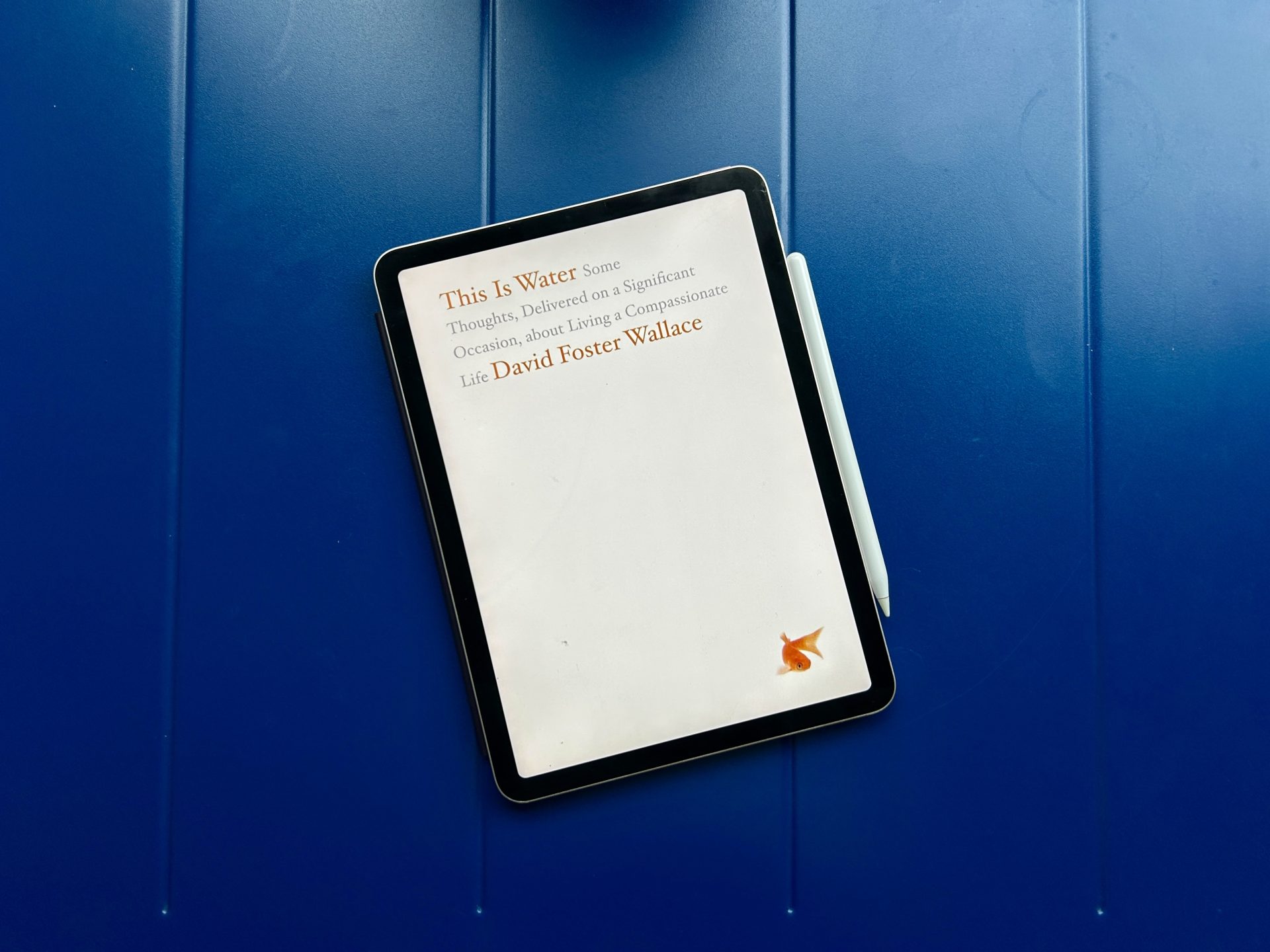
This Is Water is a tiny book printed from the commencement speech David Foster Wallace gave at Kenyon College back in 2005, and it holds only a few sentences on each page. You could absolutely finish it in one sitting. Chances are you won’t want to rush, though, because every word hypnotizes you to slow down and sink into it. Imagine reading it by the window on a rainy day. By the time you turn the last page, there’s still plenty of afternoon left to sit with what Wallace told you, the grey, gloomy drizzle keeping you company the whole way through.
Don’t let the size fool you. It’s easy to judge at a book this thin (138 pages with e few sentences in each page) and file it away as a keepsake instead of a real read. Yet these small sentences travel deeper into you than plenty of thick books ever manage.
So what’s it actually about? How to think, and what to pay attention to. Wallace took one of the hardest yet simplest things in the world for us to do today, pay attention, and wrote about it in a form short enough that we actually can. I find it kind of brilliant because he knew we struggle to focus, that our minds wander off halfway down the page, so he made his case in a book you can hold in your palm and finish before you realize it. On top of that, he delivered every words beautifully.
For Wallace, paying attention becomes a choice you keep making, over and over, about where your mind goes and how you decide what your experiences mean.
“Learning how to think” really means learning how to exercise some control over how and what you think.
This is a book about what education is supposed to be. Wallace argues that the real payoff of an education, the kind those graduates in front of him had just earned, lives in the choice of what to think about, far more than in raw brainpower.
Here’s the irony that gets me. Most of us tend to assume a degree equals a person who knows how to think. Yet plenty of people finish school and sail right past the lesson Wallace is pointing at. He describes the whole “teach me how to think” promise as really meaning something humbler: learning to be a little less arrogant, to hold some honest doubt about yourself and your own certainties, because so much of what we feel automatically sure about turns out to be flat wrong. Some people walk away from their education even more arrogant than they arrived, leaving no room in their thinking for all the uncertainty this world is packed with.
If you have someone in your life about to graduate, or anyone trying to figure out how to move through this wide, wild world as a thinking human being, put this book in their hands. It’s small enough that they’ll actually read it, and big enough on the inside to stay with them long after the last page.
My Favorite Bits
- As if how we construct meaning were not actually a matter of personal, intentional choice, of conscious decision.
- Most days, if you’re aware enough to give yourself a choice, you can choose to look differently.
- If you’ve really learned how to think, how to pay attention, then you will know you have other options.
- The freedom of real education, of learning how to be well- adjusted: You get to consciously decide what has meaning and what doesn’t.
- The only choice we get is what to worship. And an outstanding reason for choosing some sort of god or spiritual-type thing to worship (..) is that pretty much anything else you worship will eat you alive.
- The really important kind of freedom involves attention, and awareness, and discipline, and effort, and being able truly to care about other people and to sacrifice for them, over and over, in myriad petty little unsexy ways, every day.
- The capital-T Truth is about life before death. It is about making it to thirty, or maybe even fifty, without wanting to shoot yourself in the head.
Author: David Foster Wallace
Publication date: 14 April 2009
Number of pages: 138 pages
Leave a Reply