
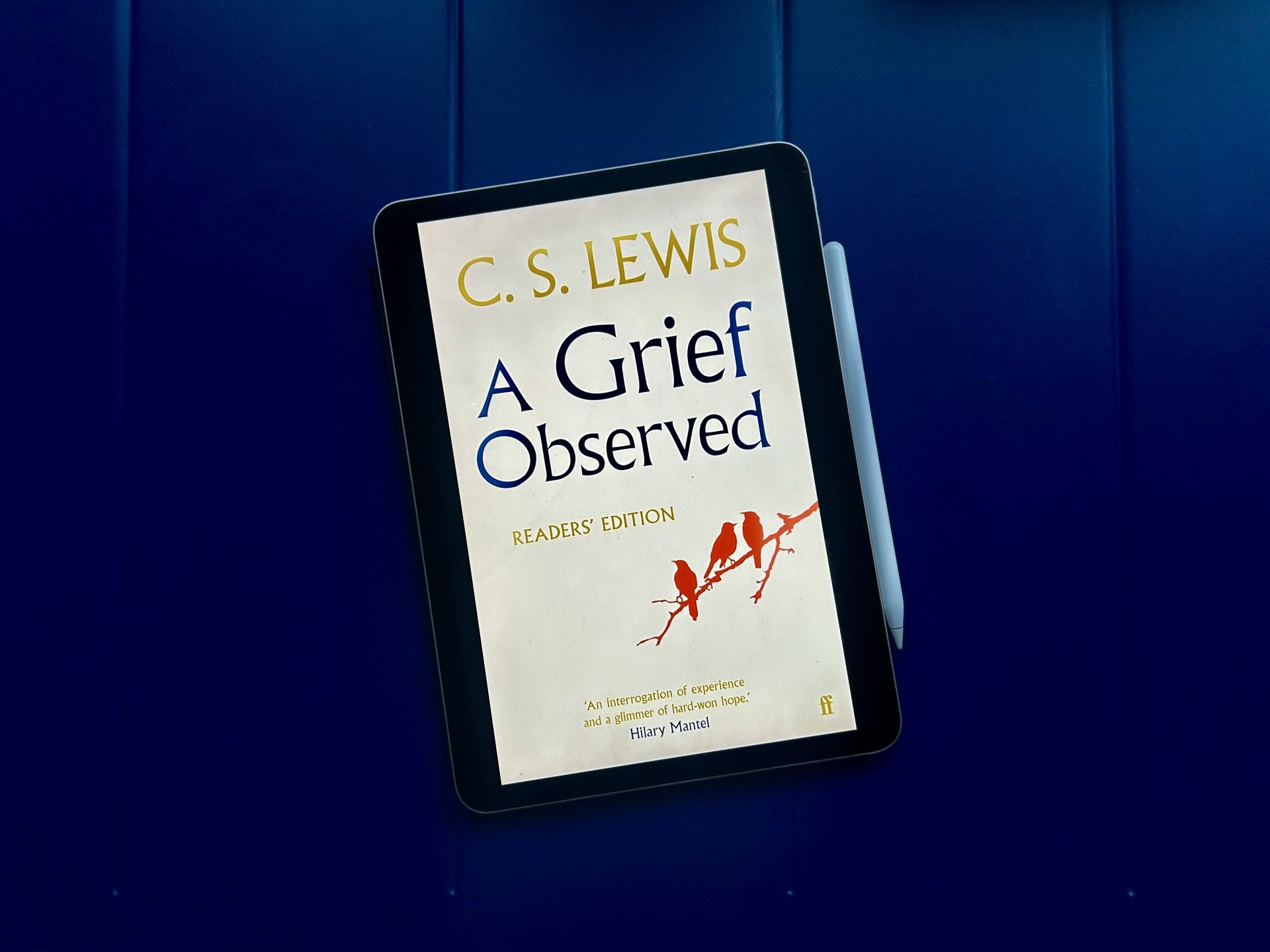
I’ve read a lot of books about grief over the years, and the more I believe that it might be the hardest emotion there is to pin down. Everyone carries it differently. Some people fall apart out loud, some go silent for months, and to make it even harder, society still hasn’t figured out how to sit beside a grieving person without nudging them toward “moving on.” So after all those other books, both fiction and nonfiction, I didn’t expect one thin book to show me a side of grief I hadn’t seen before, in a deep touching way. A Grief Observed did exactly that. Lewis writes about loss in a way that’s raw, aching, and somehow beautiful, and for me it is belong to the very best books ever written on the subject.
A little background, Lewis married Joy Davidman, she was already in the hospital, dying of cancer. He knew exactly what he was walking into. Barring some unexpected accident, she was going to die first, and probably soon.
Most of us step into marriage picturing decades ahead, growing old together, building a life, and facing death only somewhere far down the road, as the natural close to a long story. Lewis said “I do” to a woman knowing the ending was already close. That’s a kind of love, courage, and sacrifice that’s hard to wrap our head around.
Because of that, this book was never going to be a neat little guide to getting over loss. Grief doesn’t work like that, and Lewis knows it better than anyone. Every person’s grief is its own strange country. So he hands you a record of his own: the confusion, the flashes of anger, the doubt, and the slow way his view of the world kept shifting under him. He scribbled these pages while he was still in the thick of it, using the writing as a way to make sense of the chaos spinning around in his head.
Lewis lets us see the doubt, even the moments when his faith felt like a fortress under attack. The deeper the love, the bigger the hole it leaves behind. His mind gets stretched to a tension most of us would struggle to hold, and he writes straight through it.
It’s a really short book, but it shows how deep and complicated grief can be, even more than most longer books do.
My Favorite Bits
- I had yet to learn that all human relationships end in pain—it is the price that our imperfection has allowed Satan to exact from us for the privilege of love.
- No one ever told me that grief felt so like fear. I am not afraid, but the sensation is like being afraid.
- There is a sort of invisible blanker between the world and me, I find it hard to take in what anyone says. Or perhaps, hard to want to take it in. It is so uninteresting.
- Meanwhile, where is God? this is one of the most disquieting symptoms. When you are happy, so happy that you have no sense of needing Him, so happy that you are tempted to feel His claims upon you as an interruption, if you remember yourself and turn to Him with gratitude and praise, you will be—or so it feels—welcomed with open arms. But go to Him when your need is desperate, when all other help is vain, and what do you find? A door slammed in your face, and a sound of bolting and double bolting on the inside. After that, silence. You may as well turn away. The longer you wait, the more emphatic the silence will become.
- I must have some drug, and reading isn’t a strong enough drug now. By writing it all down (all?—no: one thought in a hundred) I believe I get a little outside it.
- Her absence is like the sky, spread over everything.
- There’s a limit to the ‘one flesh.’ You can’t really share someone else’s weakness, or fear or pain.
- It can’t be transferred. The mind can sympathize; the body, less.
- Feelings, and feelings, and feelings. Let me try thinking instead.
- I had been warned—I had warned myself—not to reckon on worldly happiness. We were even promised sufferings. They were part of the program. We were even told, ‘Blessed are they that mourn,’ and I accepted it. I’ve got nothing that I hadn’t bargained for. Of course it is different when the thing happens to oneself, not to others, and in reality, not in imagination. Yes; but should it, for a sane man, make quite such a difference as this? No.
- Grief is like a bomber circling round and dropping its bombs each time the circle brings it overhead; physical pain is like the steady barrage on a trench in World War One, hours of it with no let-up for a moment. Thought is never static; pain often is.
- We cannot understand. The best is perhaps what we understand least.
Author: C.S. Lewis
Publication date: 1 January 1961
Number of pages: 76 pages
Leave a Reply