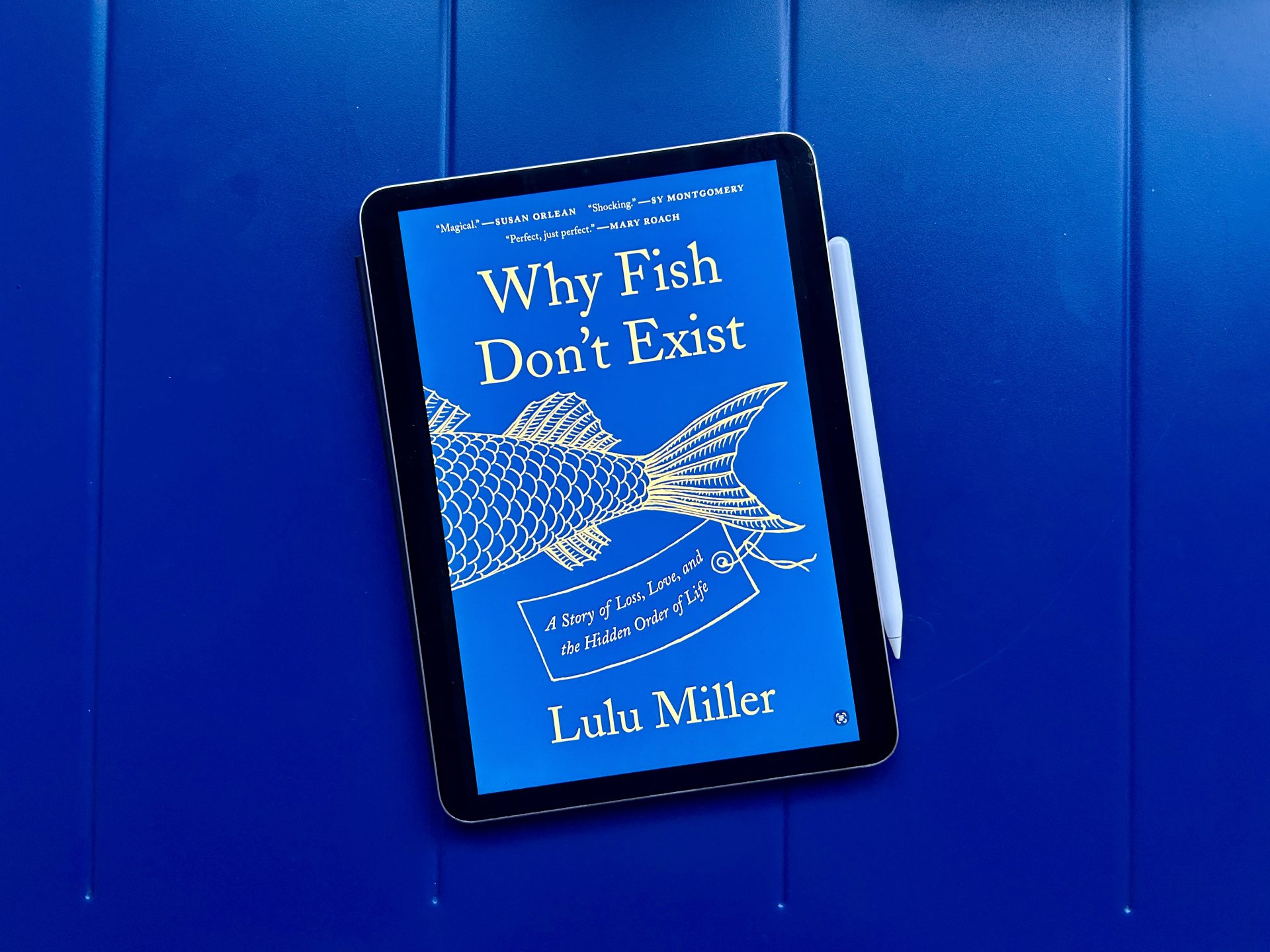
I have a soft spot for books about chaos. There’s something about reading a book where a writer wrestle with the messiness of the world that keeps me turning pages. It had been a few years since one really grabbed me, probably not since Fluke by Brian Klaas. So when Why Fish Don’t Exist showed up in my feed with “chaos” text in the cover, I was already half sold.
At first, I stumbled on it through Instagram, in one of Ryan Holiday’s recommendations. It was published in 2020 by Lulu Miller, and the title alone baited me. Why Fish Don’t Exist? What is that even supposed to mean? Then the subtitle promised “the hidden order of life,” and that was it. The cover had me hooked before I’d read a single page.
Miller builds her story around David Starr Jordan, a taxonomist she became fascinated by during a rough patch in her own life. Jordan spent years cataloging dead fish specimens, and at some point he started pinning nametags directly onto them, an act of defiance so that no future California earthquake could ever scramble his work again. That image sits right at the heart of the book: one man refusing to let the universe undo his careful order.
As Miller digs into his life, she finds qualities she admires. She also uncovers what buried in his story. And the deeper she goes, the bigger the question gets: can we actually tame the chaos of the universe, or are we just fooling ourselves for trying?
Where It Started to Lose Me
The further I read, the less I felt aligned with the people Miller spends her time on, and the more troubling those people turned out to be.
David Starr Jordan was a eugenicist and a white supremacist. He drew inspiration from Louis Agassiz, whose belief in a strict natural hierarchy stretched all the way to human races (he backed polygenism), planting the ideological seeds that later hardened into eugenics and plain hubris across Jordan’s career. To make her story work, Miller humanizes Jordan by handing us the fish-obsessed scientist before she shows how that same hunger for Order curdled into his eugenicist worldview.
I understand what Miller tries to tell the reader. I just never connected with it, or to say it more bluntly, I didn’t find the Jordan sections fascinating, which means most part of the book. The facts about him felt heavy-handed, and the point Miller seemed to be reaching for came across as too simple for the weight of the material. I kept wishing she’d turned the lens inward more often.
Early in the book, for example, she mentions cheating on her partner, a choice I found myself questioning it. Yet, I never got a clear sense of why it happened, what was really going on inside her beyond the guilt, or what actually pulled her toward Jordan in the first place, other than the fact that he’d survived his own kind of tragedy. The emotional wiring felt missing, and after a while the whole thing just felt off to me.
Even so, I don’t regret picking it up. Part of the fun of being a reader is getting to know the spectrum of humanity spread across millions of books, which more or less represent the world population, and some of those people are going to sit uneasily with you. This one was my turn to sit with that discomfort and try to understand how a certain kind of mind actually works. The book never fully won me over. Still, it gave me plenty to chew on, and some days that’s reason enough to keep reading.
Author: Lulu Miller
Publication date: 14 April 2020
Number of pages: 225 pages
Leave a Reply