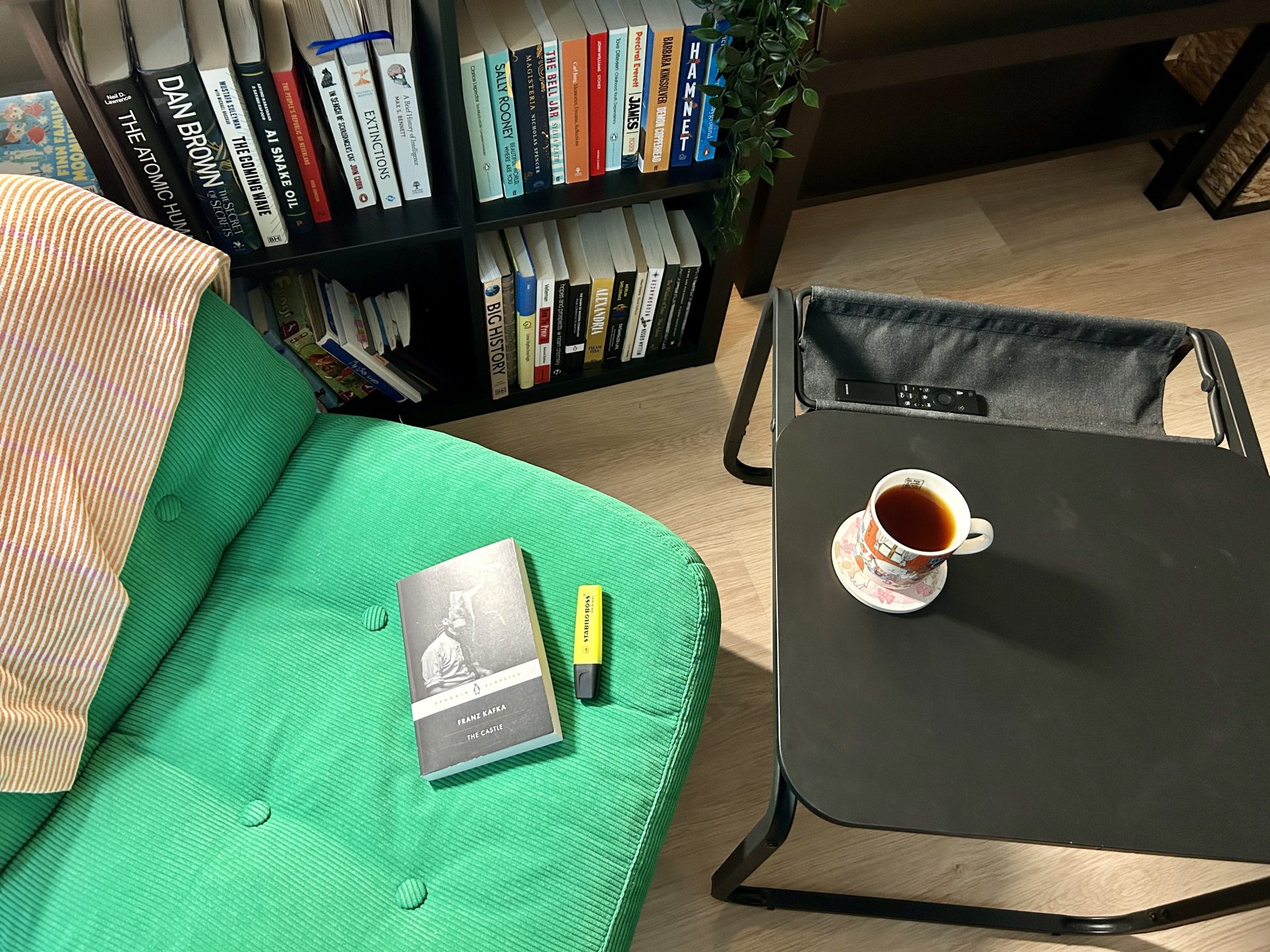
It all started with a random stroll through Akateeminen Kirjakauppa, my favorite bookstore in Helsinki. They were running a buy-three-get-one-free promotion, and there I was, circling the shelves with zero idea of what to pick. Then a memory surfaced. I’d watched an Instagram Reel about the Nobel Prize, featuring László Krasznahorkai, the 2025 laureate in Literature. In it, he described The Castle by Kafka as the most beautiful secret in literature, It was published posthumously in 1926, a book with no ending, possibly by deliberate design, that uses allegory to explore existential uncertainty, alienation, and bureaucratic absurdity.
An endorsement from a Nobel laureate was more than enough to nudge me toward the checkout counter.
I went in feeling pretty confident, too. I adored The Metamorphosis and had read a few of Kafka’s other works before, such as The Trial and Letters to Milena, so I assumed I’d gotten used to his writing style by now. Surely nothing could catch me off guard anymore.
Wrong. The Castle stunned me all over again. His writing remains as creative, unexpected, beautiful, and mesmerizing as ever, and somehow it still feels fresh even after everything else of his I’ve read.
The existential uncertainty and alienation are familiar territory in classic books, I felt both of those in The Metamorphosis as well. The bureaucratic absurdity, though, felt completely new to me among his works. Watching K. wander through endless layers of officials, paperwork, and procedures that lead absolutely nowhere reminded me so much of David Graeber’s nonfiction book The Utopia of Rules. Kafka wrote fiction a century ago, yet it reads like a mirror of the systems Graeber dissects today. That overlap alone made the whole reading experience feel richer.
If a Nobel winner’s praise ever crosses your feed, take the hint. Sometimes the algorithm knows exactly which book you need next.
My Favorite Bits
- Your ignorance regarding the way things are here is appalling, it makes one’s head spin to listen to you and then mentally compare what you say and think with the actual situation.
- You misinterpret everything, even the silence.
- One must fight to get to the top, especially if one starts at the bottom.
Author: Franz Kafka
Publication date: 1 January 1926
Number of pages: 328 pages
Leave a Reply